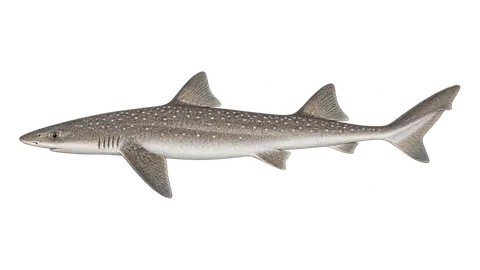
Smooth-hound shark from southern Brazil and Argentina, critically endangered in Brazil: capture is prohibited, so the right thing is to identify it and release it.
Also called: canejo-malhado, gatuzo, musola, striped smooth-hound
The mottled canejo belongs to the family Triakidae and reaches 150 cm. It lives on the continental shelf, from southern Brazil to northern Argentina. Pups are found in shallow beaches of 1 to 5 m, juveniles in waters of 15 to 50 m, and adults down to 50 m, with records on the slope down to 250 m. It probably feeds on crustaceans and other bottom invertebrates. It is ovoviviparous: embryos feed only on the yolk, and are born at up to 39 cm. Adults migrate to the coast to give birth. It is caught by commercial fishing, and in Brazil capture is prohibited.
Essential profile. Identification, where it occurs and rules, with data from FishBase and the cited regulations. Season, time of day, technique and bait are added once we have a good source for the striped smooth-hound; in the meantime, see the similar species.
how to recognize it
identification
Smooth-hound shark with a long snout relative to eye size, and a flatter head. The back is brown, with narrow, dark cross-bands separated by pale spaces. There is a yellow spot in front of each eye, on the orbit. The fins are dark with lighter edges, and the underside is whitish. Unlike the spotted smooth-hound, Mustelus schmitti, which has white spots, this one has dark bands on the back.
how striped smooth-hound fishing looks
Loading the next 7 days…
Each card shows the day's index (0 to 100) and, below it, a strip with the index for each hour, from 0h to 23h. from poor to excellent.
Essential profile: the index uses a general fish model (weather, sun, moon and tide), without a season or time of day specific to this species.
Occurs in the southwestern Atlantic, from southern Brazil to northern Argentina, passing through Uruguay, on the continental shelf.
Habitat: Shallow beaches of 1 to 5 m when young, shelf of 15 to 50 m as juveniles, and down to 50 m as adults.
coast
South Coastcoastalshelf
what the law says
rules for the striped smooth-hound
Summary of the regulations we found, with the source for each. Rules change; before keeping or transporting fish, check with the state environmental agency. Conservation: On the national list of threatened species as CR. Global IUCN assessment: CR.
Threatened species in Brazil: catch banned
full protection
The national list (Portaria GM/MMA nº 1.667/2026) classifies the species as CR. Under Portaria GM/MMA nº 1.666/2026 (art. 3), VU, EN and CR species have full protection: catch, transport, storage, processing and trade are banned. If you hook one by accident, release it right away, with minimal handling.
North CoastNortheast CoastSoutheast CoastSouth Coast
Many sharks and rays are on the national list (CR, EN or VU), with catching, keeping and transport prohibited, including those listed here. Species added to the list only in 2026 follow the 180-day deadline (until about Oct 25, 2026). If unsure of the species, release it.
catch and release Releasing the fish alive, quickly and with a wet hand. During a closed season it isn't always allowed: what the regulation says applies.
Critically endangered species: capture is prohibited in Brazil. If you hook it by accident, release it right away, with minimal handling.
calculator
how much it weighs without taking it out of the water
Length-weight relationship W = a·Lb (a = 0.00229, b = 3.14; FishBase (relação peso-comprimento bayesiana, estimativa pelo gênero e formato do corpo)). It's an average: a fat or lean fish can vary by 10% to 20%.
estimated weight
—
sources and references
Essential profile: size, length-weight, depth, countries and conservation come from FishBase and the cited regulations, and the texts were written from those sources. Season, time of day, sensitivities, technique and baits and lures are not included yet, because we did not find a good source for this species.