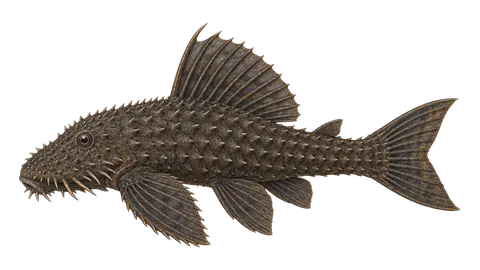
Large armored catfish, up to 49 cm and 2.2 kg, from the São Francisco and upper Paraná rivers, which migrates within the basin. It can live up to 10 years.
Also called: cascudo-preto, vieja, vieja de agua, catfish
The cascudo-preto belongs to the family Loricariidae, the armored catfish: a large, heavy body covered in bony plates, with a suckermouth on the underside. It reaches 49 cm and 2.2 kg, and can live 10 years. It lives on the bottom of freshwater rivers and migrates within its own basin. It occurs in the São Francisco and upper Paraná basins in Brazil, and is also recorded in Argentina and Uruguay. It matures at about 29 cm, and the female lays all her eggs at once, in a single spawning.
Essential profile. Identification, where it occurs and rules, with data from FishBase and the cited regulations. Season, time of day, technique and bait are added once we have a good source for the catfish (cascudo-preto); in the meantime, see the similar species.
fun facts
The female lays all her eggs in a single spawning.
It can live up to 10 years.
how to recognize it
identification
Large armored catfish with a heavy, dark body covered in bony plates and a suckermouth on the underside. Its dark color gives it its common name. It reaches 49 cm and 2.2 kg. It lives in the São Francisco and upper Paraná rivers, which separates it from the cascudo-panaque (Hypostomus commersoni), from the lower Paraná and Plata, which has dark spots on a light background.
how catfish (cascudo-preto) fishing looks
Loading the next 7 days…
Each card shows the day's index (0 to 100) and, below it, a strip with the index for each hour, from 0h to 23h. from poor to excellent.
Essential profile: the index uses a general fish model (weather, sun, moon and tide), without a season or time of day specific to this species.
Occurs in Brazil, Argentina and Uruguay, in the São Francisco and upper Paraná basins.
Habitat: Bottom of freshwater rivers, with migrations within its own basin.
native to the basins
São FranciscoParaná
what the law says
rules for the catfish (cascudo-preto)
Summary of the regulations we found, with the source for each. Rules change; before keeping or transporting fish, check with the state environmental agency. Conservation: Not on the Brazilian national list (Ministerial Ordinance GM/MMA No. 1.667/2026).
We found no species-specific rule beyond the region's general rules.
piracema closures in the basins where the species lives
Spawning closure (piracema) in the Paraná River basin
01/11 to 28/02SPPRMGGOMSDF
Allowed: Recreational fishing only for non-native species and hybrids (peacock bass, tilapia, black bass, carp, croaker, etc.; piauçu remains prohibited), with handline, simple pole, or rod with spinning or baitcasting reel, up to 10 kg + 1 fish. In rivers, from shore only; in reservoirs, from a boat or from shore. Prohibited: floodplain lakes, aquatic-animal bait, within 1,500 m of dams and waterfalls, and within 500 m of confluences. Tournaments only in reservoirs and only with non-native species.
Spawning closure (piracema) in Minas Gerais (state rule)
01/11 to 28/02MG
Allowed: Only exotic or hybrid species, 3 kg + 1 fish per day, with handline, rod, simple pole, or spinning or baitcasting reel. Nets prohibited. Keep the minimum distances from dams and reservoirs.
Allowed: Sport and guided fishing only in reservoirs, catch and release with barbless hooks (no keeping, transporting or eating). Subsistence: up to 5 kg per day, for household consumption only.
Spawning closure (piracema) in the São Francisco River basin (rivers and reservoirs)
01/11 to 28/02MGBAPEALSEGODF
Allowed: Recreational fishing from a boat or from shore with handline, rod, spinning or baitcasting reel, up to 5 kg + 1 fish. Prohibited within 1,000 m of dams, waterfalls and rapids, and within 500 m of confluences. Floodplain lakes have a longer closed season (see next item).
catch and release Releasing the fish alive, quickly and with a wet hand. During a closed season it isn't always allowed: what the regulation says applies.
Not dangerous. Because it is heavy and covered in plates, hold it with both hands, supporting the body, and release it quickly.
calculator
how much it weighs without taking it out of the water
Length-weight relationship W = a·Lb (a = 0.01023, b = 3.08; FishBase (relação peso-comprimento bayesiana, estimativa da própria espécie)). It's an average: a fat or lean fish can vary by 10% to 20%.
estimated weight
—
sources and references
Essential profile: size, length-weight, depth, countries and conservation come from FishBase and the cited regulations, and the texts were written from those sources. Season, time of day, sensitivities, technique and baits and lures are not included yet, because we did not find a good source for this species.