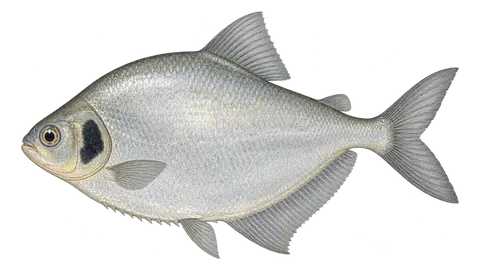
A small pacu of rivers in the Amazon and Paraguay basins, which feeds mainly on fruit and plants. It has little use in fishing and more in the aquarium hobby.
Also called: pacu-peva-pintado, pacu-peva, pacu, palometa, palometa moteada, spotted metynnis
A fish of the family Serrasalmidae, the pacus, with a body flattened from side to side and a small size. Reaches 18 cm. It lives in the Amazon and Paraguay basins, in Argentina and Brazil, in open water, away from the bottom. It feeds mainly on fruit and plants. Under extreme conditions or in captivity it can also eat fish, crustaceans and meat, but it is not considered dangerous. It has little use in commercial fishing and is sold for aquariums.
Essential profile. Identification, where it occurs and rules, with data from FishBase and the cited regulations. Season, time of day, technique and bait are added once we have a good source for the spotted metynnis; in the meantime, see the similar species.
fun facts
It lays about 150 non-sticky eggs per spawning.
how to recognize it
identification
A fish with a body very flattened from side to side, disc-shaped, with a small mouth, typical of the genus Metynnis. It has spots or speckles on the body, which give the species its name. It can be confused with Metynnis lippincottianus, which lives in the Amazon basin and the Guianas. What helps tell them apart is that this species also occurs in the Paraguay basin.
how spotted metynnis fishing looks
Loading the next 7 days…
Each card shows the day's index (0 to 100) and, below it, a strip with the index for each hour, from 0h to 23h. from poor to excellent.
Essential profile: the index uses a general fish model (weather, sun, moon and tide), without a season or time of day specific to this species.
It occurs in the Amazon and Paraguay basins, in Argentina and Brazil.
Habitat: Open water in rivers, away from the bottom.
native to the basins
AmazonParaguay (Pantanal)
what the law says
rules for the spotted metynnis
Summary of the regulations we found, with the source for each. Rules change; before keeping or transporting fish, check with the state environmental agency. Conservation: Not on the Brazilian national list (Ministerial Ordinance GM/MMA No. 1.667/2026).
We found no species-specific rule beyond the region's general rules.
piracema closures in the basins where the species lives
Spawning closure (piracema) in the Pantanal of Mato Grosso do Sul
05/11 to 28/02MS
Allowed: Subsistence fishing by riverside residents and authorized scientific fishing. Decree 15.166/2019 (art. 11, §5) allows catch and release only in February and only in the channels of the Paraguay and Paraná rivers. For the rest of the period, not even catch and release is allowed. Check the Imasul portaria for each season.
Spawning closure (piracema) in Mato Grosso (all basins)
01/10 to 31/01MT
Allowed: All fishing modalities are prohibited in rivers, including catch and release (Law 9.096/2009, art. 19-A). Exceptions: subsistence fishing from shore (3 kg or 1 fish, no transport or sale) and scientific fishing. Law 13.159/2025 now allows licensed sport fishing in UHE/PCH hydropower reservoirs, natural lakes and border rivers, subject to a scientific study and a license from the environmental agency. We have not confirmed whether these licenses are already being issued.
Allowed: Recreational anglers with handline or rod, line and hook are outside the Annex II prohibitions, with a bag limit of 5 kg + 1 fish, unless a stricter state rule applies.
catch and release Releasing the fish alive, quickly and with a wet hand. During a closed season it isn't always allowed: what the regulation says applies.
It is not dangerous to anglers. Handle it with a wet hand and return the fish to the water right after capture.
calculator
how much it weighs without taking it out of the water
Length-weight relationship W = a·Lb (a = 0.01995, b = 3.08; FishBase (relação peso-comprimento bayesiana, estimativa da própria espécie)). It's an average: a fat or lean fish can vary by 10% to 20%.
estimated weight
—
sources and references
Essential profile: size, length-weight, depth, countries and conservation come from FishBase and the cited regulations, and the texts were written from those sources. Season, time of day, sensitivities, technique and baits and lures are not included yet, because we did not find a good source for this species.