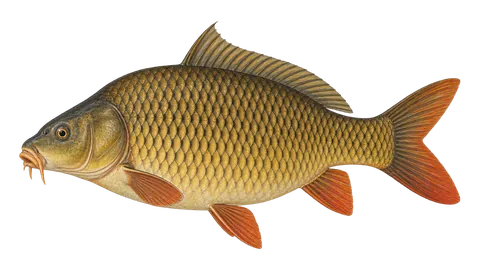
goldfish
Carassius auratus
An Asian ornamental fish, now released into rivers and lakes across almost the whole world, including Brazil, where it is exotic and considered a potential pest. Reaches 48 cm.
Also called: peixe-dourado, peixinho-dourado, kinguio, pez dorado, goldfish

- maximum
- 48 cm
- record/max.
- 1.6 kg
- depth
- 0–20 m
who is the goldfish
The goldfish belongs to the family Cyprinidae, the carps, with a sturdy body and a thick, short caudal peduncle. Reaches 48 centimeters and up to 1.6 kg, and can live 41 years. It is native to East Asia, in China and Japan, and has been introduced worldwide, including Brazil, where it is an exotic species. It lives in rivers, lakes, ponds and ditches with still or slow water, well vegetated, and tolerates brackish water up to 17 parts per thousand. It eats plankton, bottom invertebrates, plants and detritus. It is valued as an ornamental fish, and its flesh is edible but is rarely eaten.
Essential profile. Identification, where it occurs and rules, with data from FishBase and the cited regulations. Season, time of day, technique and bait are added once we have a good source for the goldfish; in the meantime, see the similar species.
fun facts
- It can live up to 41 years.
- It crosses with the common carp, and the hybrids fall between the two species.
identification
A sturdy body, with a thick, short caudal peduncle and a triangular head without scales. It has no barbels on the mouth, which sets it apart from the common carp (Cyprinus carpio), with which it crosses to produce hybrids. The dorsal and anal fins have serrated spines. In the wild, its color ranges from olive green to silvery gray, with a bronze sheen; cultivated forms range from red to white, black and combinations.
Loading the next 7 days…
Each card shows the day's index (0 to 100) and, below it, a strip with the index for each hour, from 0h to 23h. from poor to excellent.
Essential profile: the index uses a general fish model (weather, sun, moon and tide), without a season or time of day specific to this species.
where found
Native to East Asia (China and Japan) and introduced across almost the whole world, including Latin American countries such as Brazil, Argentina, Bolivia, Chile, Colombia, Costa Rica, Mexico, Peru, Puerto Rico and Uruguay. In Brazil it is exotic and has already been recorded in rivers and lakes of the South, Southeast, Northeast and Planalto Central regions.
Habitat: Rivers, lakes, ponds and ditches with still or slow water, well vegetated, from 0 to 20 meters deep, and also brackish water.
introduced in
rules for the goldfish
Summary of the regulations we found, with the source for each. Rules change; before keeping or transporting fish, check with the state environmental agency.
Conservation: Not on the Brazilian national list (Ministerial Ordinance GM/MMA No. 1.667/2026).
We found no species-specific rule beyond the region's general rules.
catch and release
catch and release Releasing the fish alive, quickly and with a wet hand. During a closed season it isn't always allowed: what the regulation says applies.
The serrated spines of the dorsal and anal fins can cut: hold it with a wet hand. Because it is exotic in Brazil, do not transport it or release it into other waters.
in the kitchen
Its flesh is edible, but it is rarely eaten.
how much it weighs without taking it out of the water
Length-weight relationship W = a·Lb (a = 0.01148, b = 3.04; FishBase (relação peso-comprimento bayesiana, estimativa da própria espécie)). It's an average: a fat or lean fish can vary by 10% to 20%.
estimated weight
—
sources and references
Essential profile: size, length-weight, depth, countries and conservation come from FishBase and the cited regulations, and the texts were written from those sources. Season, time of day, sensitivities, technique and baits and lures are not included yet, because we did not find a good source for this species.
- scientific FishBase: Carassius auratus (ficha da espécie)Size, length-weight, depth, habitat, distribution, biology, and IUCN status. Page checked on Oct 13, 2026.
- scientific FishBase: nomes populares de Carassius auratusNames by country and language.
- official Portaria GM/MMA nº 1.667, de 27 de abril de 2026: Lista Nacional Oficial de Espécies da Fauna Ameaçadas de Extinção (peixes e invertebrados aquáticos)The species is not on the list. Checked in the DOU of April 28, 2026.