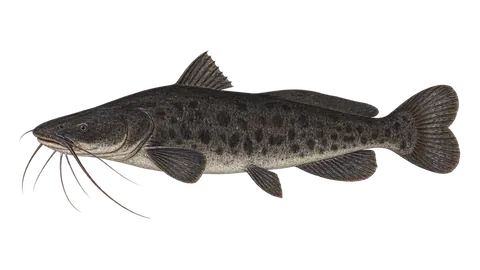
Large leather catfish of the rapids of the upper Uruguay and upper Paraná, threatened by dams. It is on the national list as Vulnerable: catching, transporting and selling wild specimens are banned.
The suruvi is a large catfish of the family Pimelodidae, up to about 1 m, restricted to the upper Uruguay and upper Paraná basins. It is potamodromous, that is, it migrates within the river itself, and like the large Steindachneridion it tends to frequent clearwater rivers with current, over stony beds. The genus review includes specimens from the Uruguay River at Itaqui and Barracão (RS) and Itá (SC), and from the Grande, Paranapanema and Pardo rivers in São Paulo. It was an important resource for riverside fishers, and dams, illegal fishing and industrial waste are named as the main threats in the Uruguay. IUCN rates it Endangered (2023), and ICMBio listed it as Endangered in 2014; the 2026 national list has it as Vulnerable, which gives full protection. If it takes the hook, release it right away.
fun facts
The epithet scriptum means 'written': the dark spots and streaks on the body look like scribbles.
The genus Steindachneridion includes large catfish, 1 m or more in total length (Garavello, 2005); for the suruvi FishBase gives 100 cm and 5.5 kg.
Dams on the upper Uruguay are the main threat identified in genetic studies of the species (Paixão et al., 2018).
how to recognize it
identification
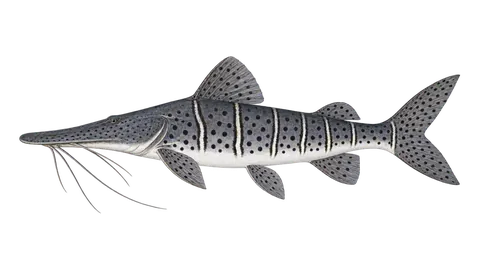
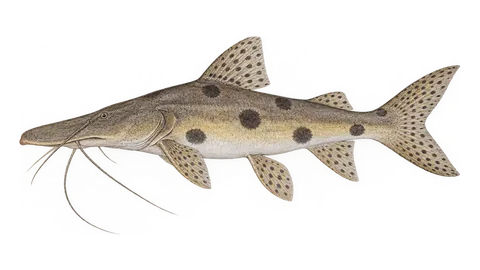
Large catfish with smooth, scaleless skin and an elongated body, light gray with a whitish belly. The head, trunk and fins have irregular black blotches, some elongated, and scattered dark spots. Large mouth, small eyes, long maxillary barbel that reaches past the tip of the pectoral fin, and a deeply notched tail with a larger upper lobe. The Iguazu surubim (Steindachneridion melanodermatum) lives in another basin, above the Iguazu Falls, and the pintados and cacharas (Pseudoplatystoma) have stripes or spots in rows and a flatter head. When in doubt, treat any large rapids catfish from this region as protected.
how catfish (suruvi) fishing looks
Loading the next 7 days…
Each card shows the day's index (0 to 100) and, below it, a strip with the index for each hour, from 0h to 23h. from poor to excellent.
Upper stretches of the Uruguay and Paraná basins, in Brazil, Argentina and Uruguay (Uruguay River). The material examined in the genus review comes from Itaqui and Barracão (RS), Itá (SC) and from the Grande, Paranapanema and Pardo rivers (SP), several specimens from stretches just below dams.
Habitat: Channel of clearwater rivers with current, preferably in pools near rapids, over a stony bottom; it also uses stretches below dams.
native to the basins
UruguayParaná
states
Rio Grande do Sul, Santa Catarina, São Paulo, Minas Gerais
calendar and clock
when to fish
best season
time of year
JanFebSeaAprMayJunJulAugSepOctNovDec
There is no season: fishing for the species is banned. The weights are only there to warn bottom anglers that it may turn up in the upper Uruguay and upper Paraná.
best time of day
Night and twilight. There are few studies on timing. Like other large bottom catfish, it should be more active at night (estimate).
weather, water and behavior
what affects the catfish (suruvi)
sensitivity The little bars show how much each factor affects this species. Five full: it feels it a lot.
cold and cold fronts
Cold reduces activity (estimate).
atmospheric pressure
Little known effect.
moon
Little known effect.
rain
Little known effect.
water level
Floods and dam releases change the current and where it stays; no specific data.
noise
No data; a bottom fish in pools.
wind
Little effect.
depth
Bottom of pools and channels, 1 to 15 m (estimate).
technique, gear and bait
how to fish
rod
not applicable: capture prohibited
spinning / baitcasting reel
not applicable
line
not applicable
leader
not applicable
hook
barbless circle hook helps release without injury, if it bites by chance when fishing the bottom for other species
accessories
long-nose pliers for release
large landing net with smooth mesh, no knots
tip from an angler
When bottom fishing with natural bait in the upper Uruguay or upper Paraná, it may bite. Keep the fish in the water, cut the line close to the hook if it has swallowed it deep, and let it go.
what the law says
rules for the catfish (suruvi)
Summary of the regulations we found, with the source for each. Rules change; before keeping or transporting fish, check with the state environmental agency. Conservation: On the national list of threatened species as VU (Portaria GM/MMA nº 1.667/2026). IUCN global assessment: EN (B2ab(iii,v), June 5, 2023). In 2014, ICMBio had already classed it as Endangered.
Threatened species in Brazil: catch banned
full protection
The national list (Portaria GM/MMA nº 1.667/2026) classifies the species as VU. Under Portaria GM/MMA nº 1.666/2026 (art. 3º), VU, EN and CR species have full protection: catch, transport, storage, processing and sale are banned. If you hook one by accident, release it at once, handling it as little as possible.
Paraná: jaú, pintado, cachara, dorado and piracanjuba catch and release only
PRParanáSoutheast Atlantic
Possession, killing and transport of these species are prohibited in Paraná's inland waters (Paraná and Atlantic Southeast basins, except the Iguaçu River and the coast). Catch and release only, with immediate release at the same spot.
piracema closures in the basins where the species lives
Spawning closure (piracema) in the Paraná River basin
01/11 to 28/02SPPRMGGOMSDF
Allowed: Recreational fishing only for non-native species and hybrids (peacock bass, tilapia, black bass, carp, croaker, etc.; piauçu remains prohibited), with handline, simple pole, or rod with spinning or baitcasting reel, up to 10 kg + 1 fish. In rivers, from shore only; in reservoirs, from a boat or from shore. Prohibited: floodplain lakes, aquatic-animal bait, within 1,500 m of dams and waterfalls, and within 500 m of confluences. Tournaments only in reservoirs and only with non-native species.
Spawning closure (piracema) in Minas Gerais (state rule)
01/11 to 28/02MG
Allowed: Only exotic or hybrid species, 3 kg + 1 fish per day, with handline, rod, simple pole, or spinning or baitcasting reel. Nets prohibited. Keep the minimum distances from dams and reservoirs.
Allowed: Sport and guided fishing only in reservoirs, catch and release with barbless hooks (no keeping, transporting or eating). Subsistence: up to 5 kg per day, for household consumption only.
Spawning closure (piracema) in the Uruguay River basin
01/10 to 31/01RSSC
Allowed: Recreational fishing from shore, or from a boat without motor. Only handline or rod, line and hook, one gear per angler, up to 5 kg. Prohibited in floodplain lakes, within 1,500 m of dams, within 500 m of confluences, and in stretches listed in the rule (e.g., Turvo River).
catch and release Releasing the fish alive, quickly and with a wet hand. During a closed season it isn't always allowed: what the regulation says applies.
Mandatory. Do not take the fish out of the water or lift it by the head: cut the line close to the hook or use long-nose pliers, and return it to the current, facing the flow, until it regains its strength.
in the kitchen
Does not apply: catch in the wild is banned. FishBase records use of the species in aquaculture, and licensed farmed fish are not covered by the ban.
calculator
how much it weighs without taking it out of the water
Length-weight relationship W = a·Lb (a = 0.00589, b = 3.1; FishBase (relação peso-comprimento bayesiana, estimativa)). It's an average: a fat or lean fish can vary by 10% to 20%.
estimated weight
—
sources and references
The season weights (months), the time of day and the sensitivities (cold, pressure, moon, wind, rain, tide, strong light, murky water and noise) are the app's editorial estimates, based on the literature below and on the field experience of anglers and guides. They are not official data nor a measurement made for this species, and they may vary by region and year. Closed seasons and legal rules appear in the rules section, with the norm and a link.
scientificFishBase: Steindachneridion scriptum (ficha da espécie)Size, length-weight relationship, depth, habitat, distribution, biology and IUCN status. Page checked on October 13, 2026. The maximum weight of 5.5 kg is the one published in FishBase; the common sizes and weights on this card are editorial estimates.
technicalScotcat: Steindachneridion scriptumDescription of color, spots, mouth, maxillary barbel and tail; the page cites 80 cm, less than the 100 cm of FishBase, which this card adopts. Page checked on October 13, 2026.