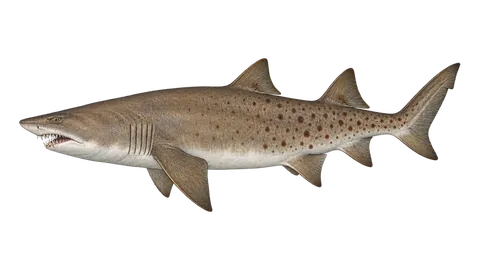
smalltooth sand tiger
Odontaspis ferox
Deep-water shark with long, pointed teeth, which almost never shows up on the line. It is caught in nets and commercial fishing, and is threatened globally.
Also called: tubarão-dente-de-cão, tiburón dientes de perro, tiburón toro, ragged-tooth shark, smalltooth sand tiger

- maximum
- 450 cm
- record/max.
- 289.0 kg
- depth
- 13–880 m
who is the smalltooth sand tiger
The bigtooth sand tiger belongs to the family Odontaspididae and reaches 450 cm and up to 289 kg. It lives near the bottom on the continental shelf and slope, where depth ranges from 13 to 880 m, and sometimes rises into shallow water. It feeds on small bony fish, squid and crustaceans. It is ovoviviparous: embryos feed on the yolk sac reserve and on eggs produced by the mother. It is not linked to attacks on people. Its flesh is used for food, and the liver, rich in squalene, is also used. In recreational fishing it is rarely caught on rod and line.
Essential profile. Identification, where it occurs and rules, with data from FishBase and the cited regulations. Season, time of day, technique and bait are added once we have a good source for the smalltooth sand tiger; in the meantime, see the similar species.
fun facts
- It uses its large, oily liver to control buoyancy.
- It has litters of two pups, born at 105 cm or more.
identification
Shark with a short, pointed snout, small eyes and teeth that project outside the mouth, shaped like spines. The dorsal fins are small and similar in size, and the first is closer to the pectoral fin than to the pelvic fin. It is grey on the back and paler below, and some specimens have red spots on their sides. It resembles the mangona, which also shows long teeth and whose catch is prohibited in Brazil: if in doubt between the two, release it.
Loading the next 7 days…
Each card shows the day's index (0 to 100) and, below it, a strip with the index for each hour, from 0h to 23h. from poor to excellent.
Essential profile: the index uses a general fish model (weather, sun, moon and tide), without a season or time of day specific to this species.
where found
Occurs in several oceans, in deep water. In Latin America it is recorded in Mexico (Yucatán shelf and Baja California), Colombia (Malpelo Island, in the Pacific), Cuba and Brazil.
Habitat: Near the bottom on the shelf and slope, from 13 to 880 m deep, and sometimes in shallow water.
coast
rules for the smalltooth sand tiger
Summary of the regulations we found, with the source for each. Rules change; before keeping or transporting fish, check with the state environmental agency.
Conservation: Not on the Brazilian national list (Ministerial Ordinance GM/MMA No. 1.667/2026).
We found no species-specific rule beyond the region's general rules.
catch and release
catch and release Releasing the fish alive, quickly and with a wet hand. During a closed season it isn't always allowed: what the regulation says applies.
Large shark with long, exposed teeth. If it comes on the line, do not put your hand near the mouth, cut the line flush with the hook if needed, and release it with minimal handling. The species is threatened worldwide, so release it right away.
in the kitchen
Its flesh is used for human food, and the liver is used for squalene.
how much it weighs without taking it out of the water
Length-weight relationship W = a·Lb (a = 0.01122, b = 3.04; FishBase (relação peso-comprimento bayesiana, estimativa)). It's an average: a fat or lean fish can vary by 10% to 20%.
estimated weight
—
sources and references
Essential profile: size, length-weight, depth, countries and conservation come from FishBase and the cited regulations, and the texts were written from those sources. Season, time of day, sensitivities, technique and baits and lures are not included yet, because we did not find a good source for this species.
- scientific FishBase: Odontaspis ferox (ficha da espécie)Size, length-weight, depth, habitat, distribution, biology, and IUCN status. Page checked on Oct 13, 2026.
- scientific FishBase: nomes populares de Odontaspis feroxNames by country and language.
- official Portaria GM/MMA nº 1.667, de 27 de abril de 2026: Lista Nacional Oficial de Espécies da Fauna Ameaçadas de Extinção (peixes e invertebrados aquáticos)The species is not on the list. Checked in the DOU of April 28, 2026.