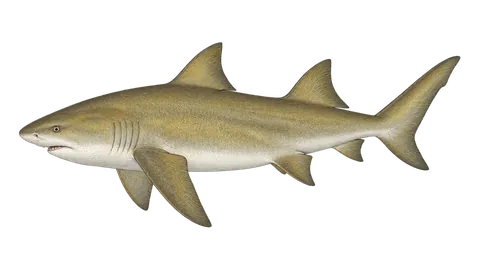
Brown bottom-dwelling shark with barbels and a flattened body, which sleeps in groups under ledges. Vulnerable in Brazil: catch prohibited. It bites if disturbed.
Also called: tubarão-lixa, cação-lixa, lixa, tubarão-enfermeiro, lambaru, urumaru
The nurse shark is a bottom-dwelling shark of reefs, rocky shores, shoals and shallow lagoons in the tropical Atlantic. It spends the day resting in groups under ledges and in caves, and goes out at night to hunt crustaceans, octopuses, sea urchins and fish, which it sucks in with its small, powerful mouth. It can stay still on the bottom by pumping water over its gills. In Brazil it occurs from the North to the Southeast and on oceanic islands, where it is a common sight for divers. Fishing and the capture of juveniles reduced its populations: at Atol das Rocas, the estimated number fell from over 330 to about 200 animals in 20 years. It is Vulnerable on the national list, and catch is prohibited. It is not a sport fish, and it is caught by chance in bottom fishing over rock.
fun facts
It can breathe while resting still on the bottom, pumping water over its gills, unlike many sharks.
It sucks prey in with its small mouth, like a vacuum cleaner, and can pull octopuses out of their dens.
It rests in groups, sometimes piled on top of one another under the same ledge.
how to recognize it
identification
Robust body, flattened underneath, yellowish brown to grayish brown, smooth, with skin as rough as sandpaper. Broad, rounded head, small eyes, a small mouth in front of the eyes and two fleshy barbels at the nostrils. Two large, rounded dorsal fins set far back, and a long tail with an almost nonexistent lower lobe. Juveniles have small dark spots. No other common coastal shark has barbels and this shape.
how nurse shark fishing looks
Loading the next 7 days…
Each card shows the day's index (0 to 100) and, below it, a strip with the index for each hour, from 0h to 23h. from poor to excellent.
From Maranhão to Rio de Janeiro and on oceanic islands (Atol das Rocas, Fernando de Noronha), most common in the Northeast. In the western Atlantic it ranges from the United States to southeastern Brazil, including the Caribbean and the Gulf of Mexico. Pacific nurse sharks belong to another species (Ginglymostoma unami).
Habitat: Coral and sandstone reefs, rocky shores, shoals, shipwrecks, lagoons and shallow channels; rests under ledges and in caves.
coast
North CoastNortheast CoastSoutheast Coastcoastalshelf
states
Maranhão, Piauí, Ceará, Rio Grande do Norte, Paraíba, Pernambuco, Alagoas, Sergipe, Bahia, Espírito Santo, Rio de Janeiro
calendar and clock
when to fish
best season
time of year
JanFebSeaAprMayJunJulAugSepOctNovDec
Estimate: present year-round on the reefs. Biological information: in Brazil, catch is prohibited year-round.
best time of day
Nighttime. Nocturnal: by day it rests still under ledges; at night it leaves to hunt on the bottom.
weather, water and behavior
what affects the nurse shark
sensitivity The little bars show how much each factor affects this species. Five full: it feels it a lot.
cold and cold fronts
A warm-water species.
atmospheric pressure
Not very relevant.
moon
Not well known.
rain
Not very relevant.
water level
Not applicable at sea.
noise
Tolerates calm divers, but reacts if touched.
wind
Not very relevant.
tide
In atolls and lagoons, it enters the channels with the tide.
depth
Usually 1 to 35 m; reaches about 130 m.
technique, gear and bait
how to fish
rod
Catch prohibited in Brazil.
spinning / baitcasting reel
—
line
—
leader
—
hook
For rock-bottom fishing, prefer a circle hook: it makes it easy to release what can't be kept.
accessories
cutting pliers
long hook remover
tip from an angler
If a nurse shark is hooked while bottom fishing, don't haul it into the boat: cut the line close to the mouth. In spearfishing and diving, don't touch or pull it by the tail: it bites and won't let go.
what the law says
rules for the nurse shark
Summary of the regulations we found, with the source for each. Rules change; before keeping or transporting fish, check with the state environmental agency. Conservation: Catch prohibited throughout Brazil. Global: Vulnerable (IUCN, July 5, 2019).
Threatened species (VU): catch prohibited in Brazil
catching, transport, holding and trade prohibited
The nurse shark (Ginglymostoma cirratum) is on the national list as Vulnerable (VU) (it was already on the previous list, Portaria MMA 148/2022). Ministerial Ordinance GM/MMA 1.666/2026 (art. 3) prohibits catch, transport, storage, possession, processing and trade throughout Brazil. Anyone who hooks one by chance must release it alive immediately (art. 3, § 4). The rule does not authorize targeted fishing, even with release: in Brazil, do not seek this species.
Finning prohibited: shark only whole, with its fins
fins naturally attached to the body
In Brazil, finning is prohibited (cutting off the fins and discarding the body). Every shark or ray landed must arrive with its fins attached to the body; it is prohibited to carry on board an animal without fins or with loose fins, and to transfer sharks between vessels. It applies to any shark that may be kept.
1 specimen per angler per day (counts as 5 against the quota of 10)
In recreational sport fishing in Mexican saltwaters, the limit for sharks is one specimen per angler per day, which counts as five toward the total limit of ten fish. Fish caught in sport fishing may not be sold. Catch and release does not count toward the limit: prefer releasing.
commercial or sport extraction not permittedconfirm with the agency
In 2021 Colombia stopped considering sharks and marine rays a fishery resource and began treating them as a hydrobiological resource; the recitals of Decree 281/2021 state that they may not be extracted for commercial or sport purposes, and the decree created an environmental protection plan. Later AUNAP rules dealt with incidental catch in artisanal fishing; we did not check the consolidated text. When in doubt, release it into the water.
North CoastNortheast CoastSoutheast CoastSouth Coast
Many sharks and rays are on the national list (CR, EN or VU), with catching, keeping and transport prohibited, including those listed here. Species added to the list only in 2026 follow the 180-day deadline (until about Oct 25, 2026). If unsure of the species, release it.
catch and release Releasing the fish alive, quickly and with a wet hand. During a closed season it isn't always allowed: what the regulation says applies.
This is not catch and release: it is release of incidental catch. Leave it in the water and cut the line. Keep hands away from the mouth: the bite is strong and it holds on.
in the kitchen
Catch and trade prohibited in Brazil.
calculator
how much it weighs without taking it out of the water
Length-weight relationship W = a·Lb (a = 0.00417, b = 3.08; FishBase (estimativa bayesiana para a família e o formato do corpo, comprimento total)). It's an average: a fat or lean fish can vary by 10% to 20%.
estimated weight
—
sources and references
The seasonal weights (months), time of day and sensitivities (cold, pressure, moon, wind, rain, tide, strong light, murky water and noise) are the app's editorial estimates, based on the literature below and on field experience of anglers and guides. The months indicate the time of year when the angler usually finds the species near the coast, not a catch season. They are not official data or measurements made for this species and may vary by region and year. Legal rules appear in the rules section, with the regulation and link.
officialPortaria GM/MMA nº 1.666, de 27 de abril de 2026 — regras de proteção das espécies ameaçadas da lista nacionalArt. 3: full protection for VU, EN and CR species; § 4: incidental catch with immediate release of the live animal. The 180-day transition rule for species newly added to the list was verified from official summaries (Fiperj) and technical sources; the DOU (Brazil's Official Gazette) page did not open during verification.