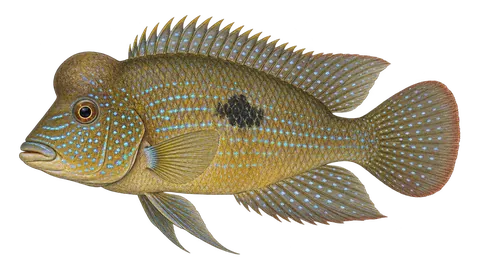
Cará from the far south of Brazil and Uruguay, with smooth cheeks. The female guards the eggs and carries the larvae in her mouth. It has commercial use and is sold for the aquarium.
Also called: cará-de-bochecha-lisa, cará, castañeta, smooth-cheek eartheater
The cará-de-bochecha-lisa is a cichlid of the family Cichlidae, of the genus Gymnogeophagus, a group of caras that live near the bottom. It reaches 15 cm standard length. It occurs in Brazil and Uruguay, in warm waters, between 21 and 24 degrees. Eggs are laid on the substrate and covered with sand. The female guards the brood and takes the larvae into her mouth after hatching. The male may mate with more than one female. It has commercial use and is sold for the aquarium.
Essential profile. Identification, where it occurs and rules, with data from FishBase and the cited regulations. Season, time of day, technique and bait are added once we have a good source for the smooth-cheek eartheater; in the meantime, see the similar species.
fun facts
The female carries the larvae in her mouth after hatching.
how to recognize it
identification
Cichlid with a body compressed sideways and a spiny dorsal fin, of the cará group. The scientific name, gymnogenys, and its common names in other languages point to the smooth cheeks. It can be confused with the cará (Geophagus brasiliensis), another bottom-dwelling cichlid that also occurs in the South, so check the cheeks and the fishing location.
how smooth-cheek eartheater fishing looks
Loading the next 7 days…
Each card shows the day's index (0 to 100) and, below it, a strip with the index for each hour, from 0h to 23h. from poor to excellent.
Essential profile: the index uses a general fish model (weather, sun, moon and tide), without a season or time of day specific to this species.
Occurs in Brazil and Uruguay. In Brazil, there are records in Rio Grande do Sul, in the Uruguay River and in the rivers that flow into the Patos lagoon and the coast.
Habitat: Warm waters, between 21 and 24 degrees, near the bottom and in midwater.
native to the basins
South AtlanticUruguay
what the law says
rules for the smooth-cheek eartheater
Summary of the regulations we found, with the source for each. Rules change; before keeping or transporting fish, check with the state environmental agency. Conservation: Not on the Brazilian national list (Ministerial Ordinance GM/MMA No. 1.667/2026).
We found no species-specific rule beyond the region's general rules.
piracema closures in the basins where the species lives
Spawning closure (piracema) in the Uruguay River basin
01/10 to 31/01RSSC
Allowed: Recreational fishing from shore, or from a boat without motor. Only handline or rod, line and hook, one gear per angler, up to 5 kg. Prohibited in floodplain lakes, within 1,500 m of dams, within 500 m of confluences, and in stretches listed in the rule (e.g., Turvo River).
catch and release Releasing the fish alive, quickly and with a wet hand. During a closed season it isn't always allowed: what the regulation says applies.
The dorsal fin has spines that can prick. Hold it by the body, carefully, and remove the hook without forcing it.
calculator
how much it weighs without taking it out of the water
Length-weight relationship W = a·Lb (a = 0.01778, b = 2.97; FishBase (relação peso-comprimento bayesiana, estimativa da própria espécie)). It's an average: a fat or lean fish can vary by 10% to 20%.
estimated weight
—
sources and references
Essential profile: size, length-weight, depth, countries and conservation come from FishBase and the cited regulations, and the texts were written from those sources. Season, time of day, sensitivities, technique and baits and lures are not included yet, because we did not find a good source for this species.