The cará of coastal lagoons, farm ponds and rivers, from the Northeast to the South. It is the first fish of many children on a cane pole with earthworm.
Also called: cará, acará, acará-topete, acará-ferreira, caratinga, papa-terra
A cichlid native to the coastal rivers of eastern and southern Brazil and Uruguay, living in lagoons, farm ponds, reservoirs and slow rivers, and tolerating brackish water. The genus name means earth-eater: cará takes mouthfuls of sand and mud and filters small invertebrates and plant debris. The pair guards eggs and fry, and adult males develop a hump on the forehead. It tolerates large temperature swings. It is the classic earthworm-on-a-cane-pole fish at lagoon edges, and is also kept in aquariums.
fun facts
Geophagus means earth-eater, for the way it sifts the bottom.
Outside Brazil it has become an introduced species in places such as Australia and the United States, spread by the aquarium trade.
how to recognize it
identification
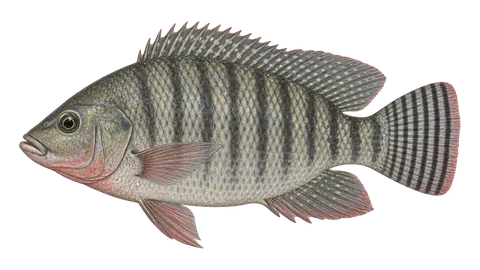
Tall, oval body, colour varying from greenish brown to gold, with bright pearly blue spots on the head and flank and a dark blotch mid-body. Adult males have a forehead hump (crest). Long dorsal and anal fins with spots. Tilapia lacks the pearly spots and has vertical bands.
how pearl cichlid fishing looks
Loading the next 7 days…
Each card shows the day's index (0 to 100) and, below it, a strip with the index for each hour, from 0h to 23h. from poor to excellent.
Coastal rivers of eastern and southern Brazil, the Uruguay River basin and the upper Paraná plain; very common in coastal lagoons, farm ponds and reservoirs.
Habitat: Lagoons, farm ponds, reservoirs and eddies with sandy bottoms and vegetation; tolerates brackish water.
native to the basins
East AtlanticSoutheast AtlanticSouth AtlanticUruguayParaná
states
Bahia, Espírito Santo, Minas Gerais, Rio de Janeiro, São Paulo, Paraná, Santa Catarina, Rio Grande do Sul
Small earthworm on the float, near vegetation. Wait for the float to go fully under.
what the law says
rules for the pearl cichlid
Summary of the regulations we found, with the source for each. Rules change; before keeping or transporting fish, check with the state environmental agency. Conservation: Not on the national list (Portaria GM/MMA 1.667/2026).
We found no species-specific rule beyond the region's general rules.
piracema closures in the basins where the species lives
Spawning closure (piracema) in the Paraná River basin
01/11 to 28/02SPPRMGGOMSDF
Allowed: Recreational fishing only for non-native species and hybrids (peacock bass, tilapia, black bass, carp, croaker, etc.; piauçu remains prohibited), with handline, simple pole, or rod with spinning or baitcasting reel, up to 10 kg + 1 fish. In rivers, from shore only; in reservoirs, from a boat or from shore. Prohibited: floodplain lakes, aquatic-animal bait, within 1,500 m of dams and waterfalls, and within 500 m of confluences. Tournaments only in reservoirs and only with non-native species.
Spawning closure (piracema) in Minas Gerais (state rule)
01/11 to 28/02MG
Allowed: Only exotic or hybrid species, 3 kg + 1 fish per day, with handline, rod, simple pole, or spinning or baitcasting reel. Nets prohibited. Keep the minimum distances from dams and reservoirs.
Allowed: Sport and guided fishing only in reservoirs, catch and release with barbless hooks (no keeping, transporting or eating). Subsistence: up to 5 kg per day, for household consumption only.
Spawning closure (piracema) in the Uruguay River basin
01/10 to 31/01RSSC
Allowed: Recreational fishing from shore, or from a boat without motor. Only handline or rod, line and hook, one gear per angler, up to 5 kg. Prohibited in floodplain lakes, within 1,500 m of dams, within 500 m of confluences, and in stretches listed in the rule (e.g., Turvo River).
Spawning closure (piracema) in the Southeast basins
01/11 to 28/02ESMGRJSPPR
Allowed: In rivers, shore fishing only; in reservoirs, from a boat or from shore. Only non-native species, hybrids, and giant river prawn (camarão-gigante-da-malásia), up to 10 kg + 1 fish. Prohibited in floodplain lakes and within 1,000 m of dams.
catch and release Releasing the fish alive, quickly and with a wet hand. During a closed season it isn't always allowed: what the regulation says applies.
Hardy: release it in shallow water. During nesting season, return the pair close to where they were.
in the kitchen
White, tasty flesh; fried whole or in moqueca.
calculator
how much it weighs without taking it out of the water
Length-weight relationship W = a·Lb (a = 0.01905, b = 3.02; FishBase). It's an average: a fat or lean fish can vary by 10% to 20%.
estimated weight
—
sources and references
The season weights (months), the time of day and the sensitivities (cold, pressure, moon, wind, rain, tide, strong light, murky water and noise) are the app's editorial estimates, based on the literature below and on the field experience of anglers and guides. They are not official data nor a measurement made for this species, and they may vary by region and year. Closed seasons and legal rules appear in the rules section, with the norm and a link.