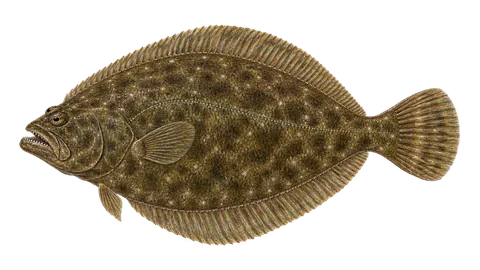
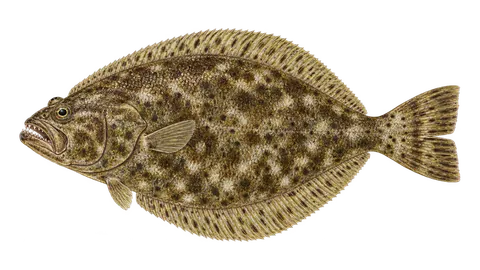
patagonian flounder
Paralichthys patagonicus
A sand-bottom flounder of the southwestern Atlantic, from Rio de Janeiro to Patagonia in Argentina, also present in Chile. It is a commercial fishing species and rarely caught on line.
Also called: linguado-da-patagônia, linguado, lenguado de Patagonia, Patagonian flounder

- maximum
- 48 cm
- depth
- 70–100 m
who is the patagonian flounder
A flounder of the family Paralichthyidae, with a flattened, short, deep body, reaching 48 cm. It lives from the coast down to 200 m, most common between 70 and 100 m, often on sand bottoms. It occurs in the southwestern Atlantic, from Rio de Janeiro to Patagonia in Argentina, and also in the southeastern Pacific, in Chile. It feeds mainly on fish and also on shrimp. It forms pairs during spawning. It is important in commercial fishing. In Brazil it is simply called linguado.
Essential profile. Identification, where it occurs and rules, with data from FishBase and the cited regulations. Season, time of day, technique and bait are added once we have a good source for the patagonian flounder; in the meantime, see the similar species.
fun facts
- Females reach 62 cm, much more than males.
identification
A short, deep-bodied flounder with both eyes on the left side, like other Paralichthys. The scales on the eyed side are rough (ctenoid) and those on the blind side are smooth (cycloid). It lives in the sea, from the coast to 200 m, while the flounder (Paralichthys orbignyanus) is the typical flounder of estuaries and lagoons. The South American flounder (Paralichthys isosceles) lives deeper, from 50 to 190 m.
Loading the next 7 days…
Each card shows the day's index (0 to 100) and, below it, a strip with the index for each hour, from 0h to 23h. from poor to excellent.
Essential profile: the index uses a general fish model (weather, sun, moon and tide), without a season or time of day specific to this species.
where found
It lives in the southwestern Atlantic, from Rio de Janeiro in Brazil to Patagonia in Argentina, passing through Uruguay, and also in the southeastern Pacific, in Chile.
Habitat: From the coast to 200 m, often on sand bottoms, and most common between 70 and 100 m.
coast
rules for the patagonian flounder
Summary of the regulations we found, with the source for each. Rules change; before keeping or transporting fish, check with the state environmental agency.
Conservation: Not on the Brazilian national list (Ministerial Ordinance GM/MMA No. 1.667/2026).
We found no species-specific rule beyond the region's general rules.
catch and release
catch and release Releasing the fish alive, quickly and with a wet hand. During a closed season it isn't always allowed: what the regulation says applies.
It is not dangerous. Hold it by the body, with wet hands, and release it quickly, without leaving it out of the water.
how much it weighs without taking it out of the water
Length-weight relationship W = a·Lb (a = 0.0055, b = 3.15; FishBase (relação peso-comprimento bayesiana, estimativa da própria espécie)). It's an average: a fat or lean fish can vary by 10% to 20%.
estimated weight
—
sources and references
Essential profile: size, length-weight, depth, countries and conservation come from FishBase and the cited regulations, and the texts were written from those sources. Season, time of day, sensitivities, technique and baits and lures are not included yet, because we did not find a good source for this species.
- scientific FishBase: Paralichthys patagonicus (ficha da espécie)Size, length-weight, depth, habitat, distribution, biology, and IUCN status. Page checked on Oct 13, 2026.
- scientific FishBase: nomes populares de Paralichthys patagonicusNames by country and language.
- official Portaria GM/MMA nº 1.667, de 27 de abril de 2026: Lista Nacional Oficial de Espécies da Fauna Ameaçadas de Extinção (peixes e invertebrados aquáticos)The species is not on the list. Checked in the DOU of April 28, 2026.