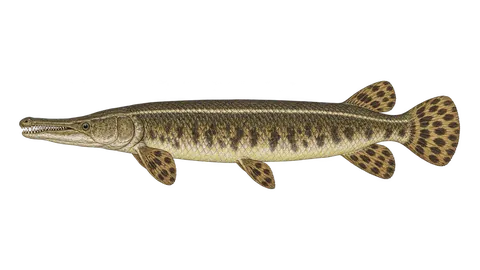
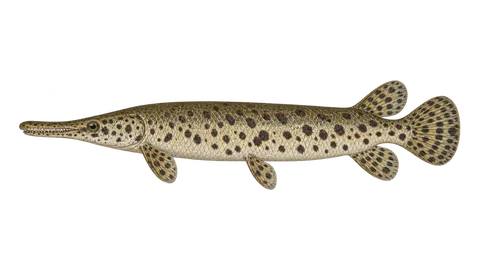
longnose gar
Lepisosteus osseus
Predatory fish of fresh and brackish water, with a long, narrow snout, reaching 200 cm and of sport value. Its eggs are poisonous.
Also called: peixe-jacaré-de-focinho-longo, catán aguja, gaspar picudo, longnose gar

- maximum
- 200 cm
- record/max.
- 22.8 kg
who is the longnose gar
Fish of the family Lepisosteidae, freshwater and sometimes brackish, with a long, narrow snout. It reaches 200 cm and can weigh up to 22.8 kg. It lives in pools, backwaters and lakes of medium and large rivers, near vegetation. It breathes air when oxygen is short in the water. It is a voracious predator that eats other fish and crustaceans. It moves upriver during the spawning season, in fresh or slightly brackish water; the eggs and larvae are sticky and stay on the bottom. It has sport value.
Essential profile. Identification, where it occurs and rules, with data from FishBase and the cited regulations. Season, time of day, technique and bait are added once we have a good source for the longnose gar; in the meantime, see the similar species.
identification
Elongated, cylindrical fish with a long, narrow snout. The body has hard, diamond-shaped ganoid scales, a trait of the family, and there are thin bony plates along the front edges of the unpaired fins and on both sides of the tail. The upper part is olive brown and the lower part is white, with dark spots on the median fins and body. The alligator gar and the pejelagarto, of the same family, have shorter, broader snouts.
Loading the next 7 days…
Each card shows the day's index (0 to 100) and, below it, a strip with the index for each hour, from 0h to 23h. from poor to excellent.
Essential profile: the index uses a general fish model (weather, sun, moon and tide), without a season or time of day specific to this species.
where found
Native to North America, from the eastern United States to Mexico, in freshwater rivers and lakes and sometimes in slightly brackish water. Not recorded in Brazil.
Habitat: Pools, backwaters and lakes of medium and large rivers, near vegetation.
rules for the longnose gar
Summary of the regulations we found, with the source for each. Rules change; before keeping or transporting fish, check with the state environmental agency.
We found no species-specific rule beyond the region's general rules.
catch and release
catch and release Releasing the fish alive, quickly and with a wet hand. During a closed season it isn't always allowed: what the regulation says applies.
The eggs are poisonous and should not be eaten. The long snout has many teeth: handle with care, hold it by the body and do not put your hand in its mouth.
how much it weighs without taking it out of the water
Length-weight relationship W = a·Lb (a = 0.00126, b = 3.19; FishBase (relação peso-comprimento bayesiana, estimativa da própria espécie)). It's an average: a fat or lean fish can vary by 10% to 20%.
estimated weight
—
sources and references
Essential profile: size, length-weight, depth, countries and conservation come from FishBase and the cited regulations, and the texts were written from those sources. Season, time of day, sensitivities, technique and baits and lures are not included yet, because we did not find a good source for this species.
- scientific FishBase: Lepisosteus osseus (ficha da espécie)Size, length-weight, depth, habitat, distribution, biology, and IUCN status. Page checked on Oct 13, 2026.
- scientific FishBase: nomes populares de Lepisosteus osseusNames by country and language.