overview
who is the alligator gar
The largest of all the gars: up to 2.6 m and 137 kg, and it can live over 90 years. Native to the Mississippi basin and the Gulf of Mexico coastal plain, from the USA to Veracruz. In Mexico it is the catán, common in slow rivers, lagoons, swamps and reservoirs of the northeast, such as Vicente Guerrero in Tamaulipas, where it is also fished commercially. It gulps air at the surface when the water warms and loses oxygen, and rarely enters the sea. It hunts by ambush, motionless like a log, and eats fish, crabs and even waterbirds. Its hard, tooth-filled mouth makes hooksets difficult: sport fishing uses natural bait on a float and a lot of patience.
fun facts
- It can live past 90 years: a 2024 radiocarbon dating study estimated 95 years for one specimen.
- It has facultative air breathing: it rises to the surface to gulp air, which lets it live in warm, oxygen-poor water.
how to recognize it
identification
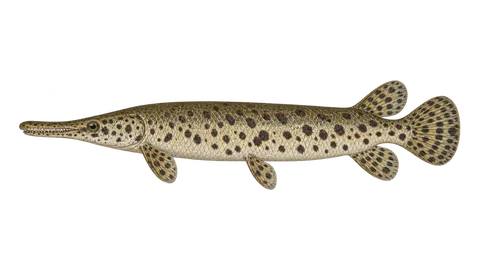
Long, cylindrical body covered in hard diamond-shaped scales, with the dorsal and anal fins set back near the tail. The snout is broad and short for an alligator gar, and adults have two rows of large teeth on each side of the jaw. Olive-brown back with a pale band, white to yellowish belly, dark spots on the fins. The pejelagarto (Atractosteus tropicus), farther south, is much smaller and has its body and fins covered in dark spots.
how alligator gar fishing looks
Loading the next 7 days…
Each card shows the day's index (0 to 100) and, below it, a strip with the index for each hour, from 0h to 23h. from poor to excellent.