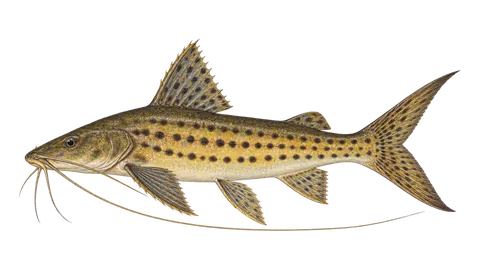
Endemic catfish of the São Francisco, unmistakable for its long, conical snout. Lives on the channel bottom and eats mollusks, larvae and small invertebrates it digs out of the sediment. It has been found from the upper to the lower river; today it is mostly found in the middle São Francisco, in Minas Gerais and Bahia, and has disappeared from the lower river. Dams, which changed the flow and temperature of the water, are the main cause of the decline. Listed as Endangered on the national list, which prohibits catching it. In bottom fishing it still turns up by accident: release it right away, without lifting it out of the water.
fun facts
The anteater snout is used to dig the bottom for mollusks and larvae.
It is such a different catfish that its family is still debated by specialists.
how to recognize it
identification
Long, conical, pointed snout, like an anteater's. Small mouth under the head. Elongated, scaleless body, blue-grey with a light belly and no spots. Short barbels. No other São Francisco catfish has that snout. The mandi has spots and a short snout; the pintado has a shovel-shaped head and spots.
how pirá fishing looks
Loading the next 7 days…
Each card shows the day's index (0 to 100) and, below it, a strip with the index for each hour, from 0h to 23h. from poor to excellent.
Endemic to the São Francisco. Today it is found mostly in the middle river (north of Minas Gerais and Bahia); rare in the upper river and gone from the lower São Francisco.
Habitat: Main channel, sand and gravel bottoms with current.
native to the basins
São Francisco
states
Minas Gerais, Bahia
calendar and clock
when to fish
best season
time of year
JanFebSeaAprMayJunJulAugSepOctNovDec
No fishing season: catching it is prohibited. It shows up more in the dry season, when the river is low.
best time of day
Night and twilight. Most active at night and at dusk, rooting along the bottom.
weather, water and behavior
what affects the pirá
sensitivity The little bars show how much each factor affects this species. Five full: it feels it a lot.
cold and cold fronts
Not well known.
atmospheric pressure
Not well known.
moon
Not well known.
rain
Little effect on the bottom.
water level
Depends on flood pulses to breed; flow controlled by dams harms the species.
Do not target the pirá. It shows up in bottom fishing with a 6' to 7' rod, 15 to 30 lb
spinning / baitcasting reel
spinning reel 3000 to 4000
line
monofilament 0.35 to 0.40 mm
leader
monofilament 40 lb
hook
circle 2/0 to 4/0 reduces the risk of deep hooking
natural baits
giant earthworm (accidental catch)
accessories
alicate
line cutter
tip from an angler
Protected species. If it comes onto the hook, release it right away; if it swallowed the hook, cut the line close to the mouth.
what the law says
rules for the pirá
Summary of the regulations we found, with the source for each. Rules change; before keeping or transporting fish, check with the state environmental agency. Conservation: Threatened species already listed before 2026: catch, transport and trade banned (Portaria GM/MMA no. 1.666/2026, art. 3). Caught it by accident? Release it immediately.
Endangered species: catching it is prohibited
catch, transport and trade prohibitedMGBAPEALSESão Franciscoconfirm with the agency
The pirá is listed as Endangered on the national list (MMA Ordinances 445/2014 and 148/2022), with catching it prohibited. On the current list (Ordinance GM/MMA 1.667/2026), the pirá remains Endangered.
piracema closures in the basins where the species lives
Spawning closure (piracema) in Minas Gerais (state rule)
01/11 to 28/02MG
Allowed: Only exotic or hybrid species, 3 kg + 1 fish per day, with handline, rod, simple pole, or spinning or baitcasting reel. Nets prohibited. Keep the minimum distances from dams and reservoirs.
Allowed: Sport and guided fishing only in reservoirs, catch and release with barbless hooks (no keeping, transporting or eating). Subsistence: up to 5 kg per day, for household consumption only.
Spawning closure (piracema) in the São Francisco River basin (rivers and reservoirs)
01/11 to 28/02MGBAPEALSEGODF
Allowed: Recreational fishing from a boat or from shore with handline, rod, spinning or baitcasting reel, up to 5 kg + 1 fish. Prohibited within 1,000 m of dams, waterfalls and rapids, and within 500 m of confluences. Floodplain lakes have a longer closed season (see next item).
catch and release Releasing the fish alive, quickly and with a wet hand. During a closed season it isn't always allowed: what the regulation says applies.
Release it without taking it out of the water. Don't take photos holding it by the snout.
in the kitchen
Do not eat it: catching this species is prohibited.
calculator
how much it weighs without taking it out of the water
Length-weight relationship W = a·Lb (a = 0.00955, b = 3.09; FishBase). It's an average: a fat or lean fish can vary by 10% to 20%.
estimated weight
—
sources and references
The season weights (months), the time of day and the sensitivities (cold, pressure, moon, wind, rain, tide, strong light, murky water and noise) are the app's editorial estimates, based on the literature below and on the field experience of anglers and guides. They are not official data nor a measurement made for this species, and they may vary by region and year. Closed seasons and legal rules appear in the rules section, with the norm and a link.