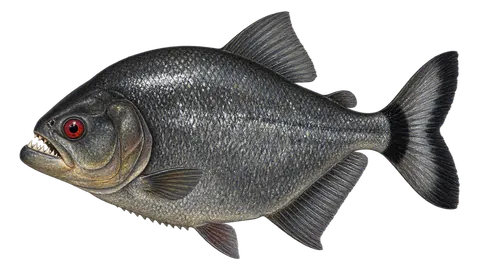
A rare piranha of the Orinoco basin, the rivers of the Guianas and tributaries of the lower Amazon, with a strong set of teeth that can cause serious bites.
Also called: piranha-de-dentes-lobados, piranha, palometa caribe, lobetoothed piranha
Fish of the family Serrasalmidae, the piranhas and pacus, with a tall body flattened from side to side. Reaches 21.5 cm. It is a rare species that lives in the Orinoco basin, in rivers of the north and east of the Guiana Shield and in tributaries of the lower Amazon, from the bottom to midwater. In Brazil it occurs in the Amazon basin. It has a very strong set of teeth, capable of causing serious bites. It appears in commercial fishing and is not a target of sport fishing. The main care for anglers is to avoid bites when handling it.
Essential profile. Identification, where it occurs and rules, with data from FishBase and the cited regulations. Season, time of day, technique and bait are added once we have a good source for the lobetoothed piranha; in the meantime, see the similar species.
how to recognize it
identification
A piranha with a tall body flattened from side to side and a very strong set of teeth. Its teeth have several points (lobed), unlike the simple triangular teeth of the black piranha. Being rare, it is hard to see. In the lower Amazon and the Guianas it can be confused with the catirina and the black piranha, which live in the same areas; its size of up to 21.5 cm and its teeth help tell it apart.
how lobetoothed piranha fishing looks
Loading the next 7 days…
Each card shows the day's index (0 to 100) and, below it, a strip with the index for each hour, from 0h to 23h. from poor to excellent.
Essential profile: the index uses a general fish model (weather, sun, moon and tide), without a season or time of day specific to this species.
It lives in the Orinoco basin, in rivers of the north and east of the Guiana Shield and in tributaries of the lower Amazon, in Brazil, Venezuela and the Guianas.
Habitat: Freshwater rivers, from the bottom to midwater, in large rivers and their tributaries.
native to the basins
Amazon
what the law says
rules for the lobetoothed piranha
Summary of the regulations we found, with the source for each. Rules change; before keeping or transporting fish, check with the state environmental agency. Conservation: Not on the Brazilian national list (Ministerial Ordinance GM/MMA No. 1.667/2026).
We found no species-specific rule beyond the region's general rules.
piracema closures in the basins where the species lives
Spawning closure (piracema) in Mato Grosso (all basins)
01/10 to 31/01MT
Allowed: All fishing modalities are prohibited in rivers, including catch and release (Law 9.096/2009, art. 19-A). Exceptions: subsistence fishing from shore (3 kg or 1 fish, no transport or sale) and scientific fishing. Law 13.159/2025 now allows licensed sport fishing in UHE/PCH hydropower reservoirs, natural lakes and border rivers, subject to a scientific study and a license from the environmental agency. We have not confirmed whether these licenses are already being issued.
Allowed: Recreational anglers with handline or rod, line and hook are outside the Annex II prohibitions, with a bag limit of 5 kg + 1 fish, unless a stricter state rule applies.
catch and release Releasing the fish alive, quickly and with a wet hand. During a closed season it isn't always allowed: what the regulation says applies.
Very strong teeth can cause serious bites: do not bring your hands near the mouth and use pliers or a cloth to release the hook.
calculator
how much it weighs without taking it out of the water
Length-weight relationship W = a·Lb (a = 0.02089, b = 3.12; FishBase (relação peso-comprimento bayesiana, estimativa da própria espécie)). It's an average: a fat or lean fish can vary by 10% to 20%.
estimated weight
—
sources and references
Essential profile: size, length-weight, depth, countries and conservation come from FishBase and the cited regulations, and the texts were written from those sources. Season, time of day, sensitivities, technique and baits and lures are not included yet, because we did not find a good source for this species.