Minimum size in Tocantins
10 cmTOTocantins-Araguaia
In Tocantins the black piranha may only be kept if it is 10 cm or longer.
Source: Portaria NATURATINS/GABIN nº 47/2026 (annexes amended by Portaria nº 105/2026)
Serrasalmus rhombeus
The largest piranha in the Amazon, with red eyes and a very powerful bite. It steals bait, cuts line and fights hard for its size.
Also called: piranha-preta, piranha-de-olho-vermelho

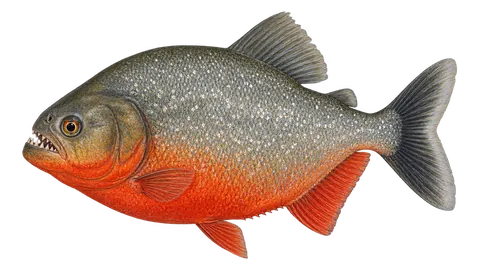
The black piranha is the largest piranha and lives in clear- and blackwater rivers and lakes of the Amazon and Araguaia-Tocantins. Adults usually travel alone or in small groups, unlike the red piranha, which forms schools. It eats fish, fin pieces and scales, and quickly attacks any bait with the smell of blood. It has the strongest bite ever measured in fish relative to body size. For peacock bass anglers it is a nuisance, because it destroys silicone lures and cuts line; for those seeking action, it guarantees a strong fight and jumps. It requires a steel leader.
Tall, diamond-shaped body, silver-grey to nearly black in large fish. Ruby-red eye. Protruding lower jaw with sharp triangular teeth. Serrated keel on the belly and tail with a dark band. The red piranha has a red belly and a shorter, rounder snout. The young pirapitinga has a red chest but molar teeth.
Loading the next 7 days…
Each card shows the day's index (0 to 100) and, below it, a strip with the index for each hour, from 0h to 23h. from poor to excellent.
Rivers and lakes of the Amazon and Araguaia-Tocantins basins, most abundant in clear- and blackwater.
Habitat: Backwaters, beaches, rocky stretches, shorelines, lake mouths and pools; also in rapids.
native to the basins
states
Amazonas, Pará, Amapá, Acre, Rondônia, Roraima, Mato Grosso, Tocantins, Goiás, Maranhão
Bites all year; in the dry season it concentrates more and is more aggressive.
Daytime. Active all day, with more strikes early and late in the afternoon.
A cold snap (friagem) reduces activity.
Little effect.
Little effect.
Little effect.
Dry season concentrates them and makes them more aggressive.
Almost indifferent; splashing on the water may even attract them.
Little effect.
From surface to bottom; follows the lure.
lures
natural baits
accessories
Use a long-shank hook and a short steel leader. Set the hook quickly: it strips the bait in seconds.
Summary of the regulations we found, with the source for each. Rules change; before keeping or transporting fish, check with the state environmental agency.
Conservation: Not on the national list (Portaria GM/MMA 1.667/2026).
In Tocantins the black piranha may only be kept if it is 10 cm or longer.
Source: Portaria NATURATINS/GABIN nº 47/2026 (annexes amended by Portaria nº 105/2026)
Allowed: Sport and guided fishing only in reservoirs, catch and release with barbless hooks (no keeping, transporting or eating). Subsistence: up to 5 kg per day, for household consumption only.
Allowed: All fishing modalities are prohibited in rivers, including catch and release (Law 9.096/2009, art. 19-A). Exceptions: subsistence fishing from shore (3 kg or 1 fish, no transport or sale) and scientific fishing. Law 13.159/2025 now allows licensed sport fishing in UHE/PCH hydropower reservoirs, natural lakes and border rivers, subject to a scientific study and a license from the environmental agency. We have not confirmed whether these licenses are already being issued.
Allowed: Recreational fishing only in reservoirs, with handline, rod, or spinning or baitcasting reel. Fish may only be eaten on site, not transported. Competitions prohibited. Subsistence: 3 kg + 1 fish. State rules (GO and TO) may be stricter.
Allowed: Recreational fishing only in reservoirs, with on-site consumption. Subsistence: 5 kg + 1 fish. State rules may be stricter.
Allowed: In 2025/26: catch and release with barbless hooks and recreational fishing card; subsistence fishing on foot or from a rowboat, with simple pole or handline.
Source: Portaria Naturatins nº 244/2025 (2025/26 season); INIs MPA/MMA nº 12 and 13/2011
Allowed: The same recreational-angler exceptions as in Portaria 48/2007 apply (handline or rod, 5 kg + 1 fish), unless a stricter state rule applies.
Source: Portaria IBAMA nº 48/2007
Allowed: Recreational anglers with handline or rod, line and hook are outside the Annex II prohibitions, with a bag limit of 5 kg + 1 fish, unless a stricter state rule applies.
Source: Portaria IBAMA nº 48/2007
Allowed: Subsistence fishing only.
Source: Portaria IBAMA nº 48/2007
Allowed: See the exceptions in Portaria 48/2007 and the state rules for each bank.
Source: Portaria IBAMA nº 48/2007
Never put your fingers near the mouth. Hold it firmly behind the head or with a boga-grip, and remove the hook with pliers.
White, tasty flesh with bones. Piranha broth is traditional in the Pantanal and the Amazon; fried is also good.
Length-weight relationship W = a·Lb (a = 0.01288, b = 3.19; FishBase (bayesiano, espécie + gênero)). It's an average: a fat or lean fish can vary by 10% to 20%.
estimated weight
—
The season weights (months), the time of day and the sensitivities (cold, pressure, moon, wind, rain, tide, strong light, murky water and noise) are the app's editorial estimates, based on the literature below and on the field experience of anglers and guides. They are not official data nor a measurement made for this species, and they may vary by region and year. Closed seasons and legal rules appear in the rules section, with the norm and a link.
Your location is saved only on this device and feeds the forecast, the map and the "today" on the home page.