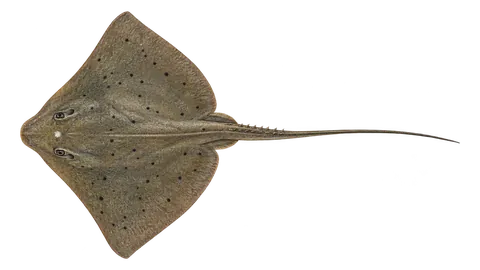
Very broad-disc ray, like butterfly wings, with a short tail and a stinger. Critically Endangered in Brazil, with catch banned: release it right away, with minimal handling.
The butterfly ray lives on sand and mud, from 5 to 100 m, and enters brackish water in bays and estuaries. It eats fish, crustaceans, mollusks and plankton. It is ovoviviparous: gestation lasts about 6 months and 4 to 7 pups are born. In Brazil it has been studied mainly in the Southeast, and a study in Guanabara Bay (RJ) raised the hypothesis of a nursery area there. Genetic analyses indicate two lineages, one on each side of the Atlantic, which may be different species. It is Critically Endangered on the national list (Portaria GM/MMA 1.667/2026), more serious than the global assessment (Endangered, IUCN): catch, transport and sale are banned. It turns up by chance in coastal fishing.
fun facts
Genetic studies in 2022 showed two lineages, one on each side of the Atlantic, which could be cryptic species (identical outwardly, different inside).
In Guanabara Bay, a 2018 study of diet and reproduction raised the possibility of a nursery area in a heavily impacted environment.
FishBase cites 140 cm as the largest length measured in the species' biology, well below the 400 cm disc width it publishes as the maximum.
how to recognize it
identification
Very broad disc, much wider than long, with sharp lateral tips like butterfly wings; small head and short, thin tail with a stinger and very low skin folds above and below. Dark brown to greyish back; white belly and pelvic fins, sometimes with a brownish, pink or rust tone; the underside of the tail is white or pinkish-white. It lacks the long, thin tail of whiptail rays (Dasyatidae), and its body is much broader than that of guitarfish.
how spiny butterfly ray fishing looks
Loading the next 7 days…
Each card shows the day's index (0 to 100) and, below it, a strip with the index for each hour, from 0h to 23h. from poor to excellent.
In the western Atlantic it ranges from southern New England (USA) to Brazil and Argentina, passing through Uruguay; in the eastern Atlantic, from Portugal to Angola, including the Mediterranean. In Brazil the studies cited are from the Southeast (Guanabara Bay, RJ, and Espírito Santo); occurrence along the rest of the coast is less documented in the sources checked.
Habitat: Shallow shelf sand and mud bottoms, bays and estuaries, 5 to 100 m.
coast
Southeast CoastSouth Coastcoastalshelf
calendar and clock
when to fish
best season
time of year
JanFebSeaAprMayJunJulAugSepOctNovDec
Estimate: no known season; the species is recorded year-round in the Southeast. Catch is banned at any time; this information is for knowing when it may turn up by chance.
best time of day
Any time. There is no time-of-day study for this species in the sources checked. It stays on the bottom, usually buried or resting on sand and mud (estimate).
weather, water and behavior
what affects the spiny butterfly ray
sensitivity The little bars show how much each factor affects this species. Five full: it feels it a lot.
cold and cold fronts
Cold water keeps rays away from shallow areas (estimate).
atmospheric pressure
Little known effect.
moon
Little known effect.
rain
In bays and estuaries, heavy rain makes the water murky and less salty; the ray tends to move outward (estimate).
water level
Not applicable at sea.
noise
Not very sensitive; it tends to stay still on the bottom.
wind
Little direct effect.
tide
Uses bays and estuaries; the tide moves food around (estimate).
depth
From 5 to 100 m; in nursery areas, in shallow bay waters.
technique, gear and bait
how to fish
rod
Catch banned: not applicable.
spinning / baitcasting reel
not applicable
line
not applicable
leader
not applicable
hook
not applicable
accessories
long-nose pliers
line cutter
thick gloves
tip from an angler
If a butterfly ray is hooked while bottom fishing, don't pull it onto dry sand or into the boat. Keep it in the water, watch the tail stinger, and cut the line close to the mouth if the hook won't come out easily.
what the law says
rules for the spiny butterfly ray
Summary of the regulations we found, with the source for each. Rules change; before keeping or transporting fish, check with the state environmental agency. Conservation: Catch banned throughout Brazil. Already on the previous list (Portaria MMA 148/2022) as CR. Global assessment: Endangered (IUCN, Jun 21, 2019); a 2022 genetic study considers it Critically Endangered in the Mediterranean and the southwestern Atlantic.
Threatened species in Brazil: catch banned
full protection
The national list (Portaria GM/MMA nº 1.667/2026) classifies the species as CR. Under Portaria GM/MMA nº 1.666/2026 (art. 3), VU, EN and CR species have full protection: catch, transport, storage, processing and trade are banned. If you hook one by accident, release it right away, with minimal handling.
Buenos Aires (AR): rays in the "with reserve" category, up to 2 killed per day
up to 2 specimens per angler per day may be killed; the surplus goes back into the waterconfirm with the agency
In recreational sea fishing on the Buenos Aires province coast, chuchos (Myliobatis), "rayas en general", pez ángel, pez elefante and corvina negra form the "Mixed Fishing With Reserve" subcategory: up to two specimens per angler per day may be killed, counted within the 40-piece limit of mixed fishing, and all surplus must be released right away. The text says "rayas en general" and does not list species. We did not check whether a more recent provision replaces it; confirm with the province's Ministry of Agrarian Development.
North CoastNortheast CoastSoutheast CoastSouth Coast
Many sharks and rays are on the national list (CR, EN or VU), with catching, keeping and transport prohibited, including those listed here. Species added to the list only in 2026 follow the 180-day deadline (until about Oct 25, 2026). If unsure of the species, release it.
catch and release Releasing the fish alive, quickly and with a wet hand. During a closed season it isn't always allowed: what the regulation says applies.
This is not catch and release: it is release of an accidental catch. Keep the ray in the water, away from the tail stinger (FishBase classifies it as harmless, but the tail has a stinger: handle it with care), remove the hook with long pliers or cut the line close to the mouth. Hold it as little as possible and don't drag it across the sand.
in the kitchen
Catch and trade banned in Brazil. FishBase records minor commercial fishing. Don't buy it.
calculator
how much it weighs without taking it out of the water
Length-weight relationship W = a·Lb (a = 0.01445, b = 3.09; FishBase (relação peso-comprimento bayesiana, estimativa da própria espécie)). It's an average: a fat or lean fish can vary by 10% to 20%.
estimated weight
—
sources and references
The season factors (months), the time of day, and the sensitivities (cold, pressure, moon, wind, rain, tide, strong light, murky water, and noise) are editorial estimates by the app, based on the literature cited below and on field experience of anglers and guides. They are not official data or measurements made for this species and may vary by region and year. Closed seasons and legal rules appear in the rules section, with the standard and link. The months indicate when the species is usually found near the coast or at the fishing spot, not a catch season. The water temperature range is also an editorial estimate, supported by FishBase values where they exist.
scientificFishBase: Gymnura altavela (ficha da espécie)Size, length-weight relationship, depth, habitat, distribution, biology and IUCN status. Page checked on Oct 13, 2026. The maximum size of 400 cm (disc width) is the one FishBase publishes; we did not verify it in another source, and the published maximum weight (60 kg) is much lower than the length-weight relationship would indicate for 400 cm, which suggests the maximum size is overestimated.