Skip to content
catalog Dasyatidae · predator

raia-prego

Hypanus berthalutzae

SeaEstuarynational list: VU · vulnerable

The raia-prego of the Brazilian coast, separated in 2020 from the Caribbean stingray. It is Vulnerable and catching it is prohibited: if you hook one, release it carefully and away from the stinger.

Also called: raia-prego, arraia-prego, raia-de-pedra, raia-cravadora, arraia-mijona

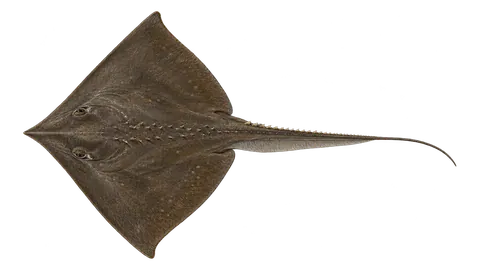
Scientific illustration of Raia-prego
common size
40–65 cm
maximum
68 cm
common weight
—
record/max.
— kg
depth
1–50 m
ideal water
24–29 °C
overview

who is the raia-prego

The raia-prego is a whiptail stingray (family Dasyatidae) found only in Brazil, from the mouth of the Amazon to São Paulo, including the oceanic islands of the Northeast. Until 2020 it was treated as Hypanus americanus, the stingray of the Caribbean and North America; DNA, morphology and niche studies showed that the Brazilian form is a different species, Hypanus berthalutzae, a name that honors the scientist Bertha Lutz. It lives close to the coast, over sand, gravel and mud, in beaches, bays and reefs, and sometimes on the shelf, far from shore. Like other rays, it grows slowly and has few young. It is on the national list as Vulnerable, with catching, transport and sale prohibited. In beach and bottom fishing it turns up by chance: the right thing is to release it.

fun facts

  • The scientific name honors Bertha Lutz, a zoologist at the National Museum and a pioneer of women's suffrage in Brazil.
  • In 2025, a mature female measuring 2.44 m total length, counting the tail, was recorded at Cabo Frio (RJ), well above the sizes cited in the species description.
how to recognize it

identification

Diamond-shaped disc with angled lateral corners and a short snout; grayish-brown to olive back and pale belly. Long whip-like tail with one or more serrated stingers near the base, a skin fold underneath and a low ridge on top. Live fish have scattered black spots on the back and a pale patch between the eyes. The measurements in this entry are disc width. The raia-ticonha and raia-manteiga have a very different shape.

how raia-prego fishing looks

Loading the next 7 days…

Each card shows the day's index (0 to 100) and, below it, a strip with the index for each hour, from 0h to 23h. from poor to excellent.

distribution

where found

open on the large map

Endemic to Brazil: from the mouth of the Amazon to São Paulo, including the oceanic islands of the Northeast; a DNA-confirmed record exists at Cabo Frio (RJ), in 2025.

Habitat: Sand, gravel and mud bottoms near reefs, beaches, coves and bays; sometimes on the shelf, up to 250 km from shore.

coast

North CoastNortheast CoastSoutheast Coastcoastalshelf

states

Pará, Maranhão, Piauí, Ceará, Rio Grande do Norte, Paraíba, Pernambuco, Alagoas, Sergipe, Bahia, Espírito Santo, Rio de Janeiro, São Paulo

calendar and clock

when to fish

best season

time of year
JanFebSeaAprMayJunJulAugSepOctNovDec

Present all year. Catching it is prohibited at any time; this information is useful for knowing when it may turn up by chance.

best time of day

0h6h12h18h sunrise ~6amsunset ~6pm

Night and twilight. It spends part of the day buried in the sand and comes out to feed late in the afternoon and at night, when it shows up more often as bycatch in bottom fishing.

weather, water and behavior

what affects the raia-prego
sensitivity The little bars show how much each factor affects this species. Five full: it feels it a lot.

cold and cold fronts

Cold water pushes it away from the shallows.

atmospheric pressure

Not very sensitive.

moon

Little known effect.

rain

Little effect.

water level

Not applicable at sea.

noise

In shallow, clear water it shies away from noise; in the surf, it is not very sensitive.

wind

Little effect.

tide

It moves into the shallows on the rising tide to look for food.

depth

1 to 30 m in most coastal records.

technique, gear and bait

how to fish

rod
Catch prohibited.
spinning / baitcasting reel
—
line
—
leader
—
hook
—

accessories

  • long-nose pliers
  • line cutter
  • thick gloves

tip from an angler

If a stingray hooks on bottom fishing, don't drag it onto dry sand or into the boat. Keep it in the water, away from the stinger, and cut the line close to the mouth if the hook won't come out easily.

what the law says

rules for the raia-prego

Summary of the regulations we found, with the source for each. Rules change; before keeping or transporting fish, check with the state environmental agency.
Conservation: Catching prohibited. In the previous list (Portaria MMA 148/2022) the Brazilian form appeared as Hypanus americanus, Vulnerable.

Vulnerable species: capture prohibited

catching, transport, storage and sale prohibitedNorth CoastNortheast CoastSoutheast Coast

The raia-prego (Hypanus berthalutzae) is on the national list as Vulnerable (VU). VU species have full protection: catching, transport, storage, processing and trade are prohibited. The Brazilian form was already protected before, under the name Hypanus americanus (Portaria MMA nº 148/2022). A specimen caught by chance must be released alive immediately.

Source: Portaria GM/MMA nº 1.667/2026 (list, VU) and Portaria GM/MMA nº 1.666/2026, art. 3º
catch and release
catch and release Releasing the fish alive, quickly and with a wet hand. During a closed season it isn't always allowed: what the regulation says applies.

This is not catch and release: it is release of an accidental catch. The tail stinger is serrated and venomous; a sting causes intense pain and a deep cut. Don't step on the stingray or hold it by the tail. Keep it in the water, out of reach of the tail, and remove the hook with long pliers or cut the line close to the mouth. If you are stung: wash the area, immerse it in very hot water (not hot enough to burn) and seek medical care, because pieces of the stinger may stay in the wound.

in the kitchen

Catch and trade banned. Don't buy it.

calculator

how much it weighs without taking it out of the water

Length-weight relationship W = a·Lb (a = 0.00447, b = 3.12; FishBase (estimativa bayesiana genérica para o formato de corpo da subfamília, em comprimento total com a cauda); para raias a medida usual é a largura do disco, e a calculadora dá só uma ordem de grandeza). It's an average: a fat or lean fish can vary by 10% to 20%.

estimated weight

—

sources and references

The season weights (months), the time of day and the sensitivities (cold, pressure, moon, wind, rain, tide, strong light, murky water and noise) are the app's editorial estimates, based on the literature below and on the field experience of anglers and guides. They are not official data nor a measurement made for this species, and they may vary by region and year. Closed seasons and legal rules appear in the rules section, with the norm and a link.

  1. scientific FishBase — Hypanus berthalutzae (ficha da espécie)Names, distribution, biology, length-weight relationship, country list and references. Page checked on 13/10/2026. Measurements are disc width (males up to 68 cm in the description).
  2. official Portaria GM/MMA nº 1.667, de 27 de abril de 2026 — Lista Nacional Oficial de Espécies da Fauna Ameaçadas de Extinção (peixes e invertebrados aquáticos)Most recent national list, published in Brazil's Official Gazette (DOU) of 28/04/2026. The species is listed as Vulnerable (VU) (checked against the published text on 13/10/2026).
  3. official Portaria GM/MMA nº 1.666, de 27 de abril de 2026 — regras de proteção das espécies da lista nacionalArt. 3: VU, EN and CR species are fully protected (catching, transport, keeping and trade prohibited); § 4: a specimen caught by chance must be released alive immediately. Arts. 4 and 11: use only under a recovery plan, and existing plans remain valid during the review.
  4. official Portaria MMA nº 148, de 7 de junho de 2022 — anexos da lista de espécies ameaçadas (versão anterior)Earlier list, in which the stingray of the Brazilian coast appeared as Hypanus americanus, Vulnerable. Checked against the text published in the DOU.
  5. scientific Petean, F. F.; Naylor, G. J. P.; Lima, S. M. Q. (2020). Integrative taxonomy identifies a new stingray species of the genus Hypanus Rafinesque, 1818 (Dasyatidae, Myliobatiformes), from the Tropical Southwestern Atlantic. Journal of Fish Biology 97: 1120–1142.Description of Hypanus berthalutzae and separation from H. americanus; distribution from the mouth of the Amazon to São Paulo, including the oceanic islands of the Northeast. DOI and abstract checked on Crossref.
  6. scientific Cutrim, M. et al. (2026). New data on maximum size and geographic distribution of the Brazilian stingray Hypanus berthalutzae Petean, Naylor & Lima, 2020. Journal of Fish Biology.Record of a mature female 2.44 m total length at Cabo Frio (RJ), in January 2025. DOI and abstract checked on Crossref.
  7. official ICMBio/SALVE — Ficha de Hypanus berthalutzae (avaliação nacional do risco de extinção)National extinction risk assessment by ICMBio, published in 2025. DOI checked on Crossref.
  8. scientific IUCN Red List — Hypanus berthalutzae (avaliação global: Vulnerável, VU, 08/08/2020)Global assessment. Link given on the FishBase entry (Red List, version 2025-2).
don't confuse

similar species