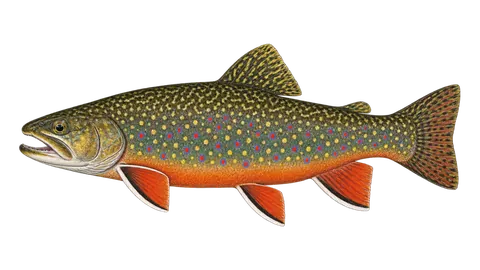
lake trout
Salvelinus namaycush
Large lake trout from deep lakes in northern North America, much sought after by sport anglers. It reaches 150 cm and was introduced to Argentina and Peru.
Also called: truta-de-lago, trucha lacustre, lake trout

- maximum
- 150 cm
- record/max.
- 32.7 kg
- depth
- 18–53 m
who is the lake trout
The lake trout is a fish of the family Salmonidae, freshwater and cold water, reaching 150 cm and weighing up to 32.7 kg. It lives in deep lakes and rivers of northern North America, and rarely enters brackish water. It spends most of its time between 18 and 53 meters deep, and is a solitary animal. It eats mostly fish, especially whitefish, and also sponges, crustaceans, insects and small mammals. Spawning happens mostly at night, over stones on the bottom. It is much sought by sport anglers and was introduced to Argentina and Peru, where it is exotic.
Essential profile. Identification, where it occurs and rules, with data from FishBase and the cited regulations. Season, time of day, technique and bait are added once we have a good source for the lake trout; in the meantime, see the similar species.
fun facts
- It has been introduced to many areas outside its natural range, and there are hybrids with the brook trout.
identification
Elongated trout with a dark green or gray back covered in pale spots, white or yellowish, which are never red or pink. The tail is deeply forked, and the pelvic fins have a small process at the base. During spawning, males gain a dark lateral band and their backs lighten. To tell it apart from the brook trout, of the same genus, look at the spot pattern and the shape of the tail.
Loading the next 7 days…
Each card shows the day's index (0 to 100) and, below it, a strip with the index for each hour, from 0h to 23h. from poor to excellent.
Essential profile: the index uses a general fish model (weather, sun, moon and tide), without a season or time of day specific to this species.
where found
Native to North America, in the Atlantic, Arctic and Pacific basins and the Great Lakes, and introduced to Argentina and Peru. Not recorded in Brazil.
Habitat: Deep, cold lakes, between 18 and 53 meters deep, and northern rivers.
rules for the lake trout
Summary of the regulations we found, with the source for each. Rules change; before keeping or transporting fish, check with the state environmental agency.
We found no species-specific rule beyond the region's general rules.
catch and release
catch and release Releasing the fish alive, quickly and with a wet hand. During a closed season it isn't always allowed: what the regulation says applies.
Harmless and large fish. Handle it with a wet hand, holding it firmly by the body, and return it to the water quickly.
in the kitchen
It is a food fish: the flesh is usually yellow or cream, and can range from white to orange.
how much it weighs without taking it out of the water
Length-weight relationship W = a·Lb (a = 0.00832, b = 3.02; FishBase (relação peso-comprimento bayesiana, estimativa da própria espécie)). It's an average: a fat or lean fish can vary by 10% to 20%.
estimated weight
—
sources and references
Essential profile: size, length-weight, depth, countries and conservation come from FishBase and the cited regulations, and the texts were written from those sources. Season, time of day, sensitivities, technique and baits and lures are not included yet, because we did not find a good source for this species.
- scientific FishBase: Salvelinus namaycush (ficha da espécie)Size, length-weight, depth, habitat, distribution, biology, and IUCN status. Page checked on Oct 13, 2026.
- scientific FishBase: nomes populares de Salvelinus namaycushNames by country and language.