Skip to content
catalog Salmonidae · predator

brook trout

Salvelinus fontinalis

Freshwater

The most colorful of Patagonia's trouts, actually a North American char. It lives in streams, lagoons and headwaters of very cold water and takes flies and small lures well.

Also called: truta-fontinalis, fontinalis, truta-de-arroio, brook trout

Scientific illustration of Brook trout
common size
20–40 cm
maximum
86 cm
common weight
0.2–1.5 kg
record/max.
8.0 kg
depth
0.3–6 m
ideal water
8–14 °C
overview

who is the brook trout

Native to eastern North America, it was introduced to Argentina and Chile and now lives in mountain streams, high lagoons and the headwaters of Patagonian rivers. It is not a true trout but a char, a relative of the Northern Hemisphere chars. It needs very cold, clean, well-oxygenated water. It eats insects, crustaceans and small fish; the largest live in lakes and lagoons rich in food and in some lowland Patagonian rivers. It spawns in autumn over gravel in running water, and at that time males develop an intense red belly. Being introduced, it competes with the native stream fauna. It is a classic light fly and ultralight spinning fish.

fun facts

  • Despite its common name, it is a char, a relative of the Arctic char, and not a trout of the genus Salmo.
  • At autumn spawning, males develop an intense red-orange belly.
how to recognize it

identification

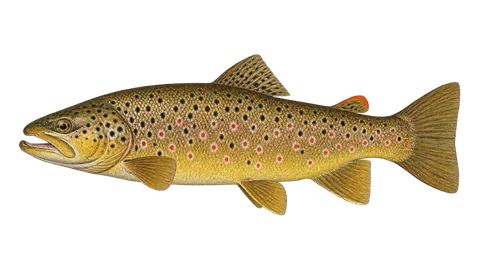
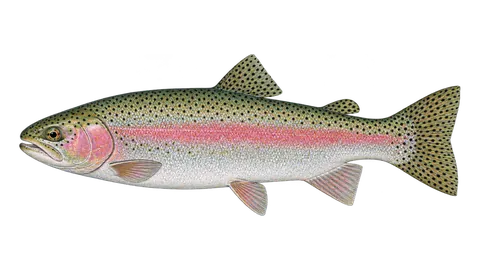
Olive-green back with pale worm-like markings (vermiculations) that climb toward the dorsal fin. Flanks with pale spots and small red spots with blue halos. Pectoral, pelvic and anal fins with a white edge followed by a black band. Nearly straight tail. The brown trout has no vermiculations or white edges; the rainbow has a pink stripe and black spots on the tail.

how brook trout fishing looks

Loading the next 7 days…

Each card shows the day's index (0 to 100) and, below it, a strip with the index for each hour, from 0h to 23h. from poor to excellent.

distribution

where found

open on the large map

Not established in Brazil. Exotic, native to eastern North America. Streams, lagoons and headwaters of Argentine Patagonia (from Neuquén to Tierra del Fuego) and southern Chile.

Habitat: Mountain and steppe streams, high lagoons, river headwaters and stream mouths on lakes; cold, clear, well-oxygenated water.

calendar and clock

when to fish

best season

time of yearbest: Dec–Apr
JanFebSeaAprMayJunJulAugSepOctNovDec

Summer and early Patagonian autumn (December to April) are the best months, within each province's or region's legal season. In high lagoons the start of the season, with colder water, is usually very good.

best time of day

0h6h12h18h sunrise ~6amsunset ~6pm

Daytime, with peaks at dawn and dusk. Active by day, peaking at dawn, late afternoon and during insect hatches.

weather, water and behavior

what affects the brook trout
sensitivity The little bars show how much each factor affects this species. Five full: it feels it a lot.

cold and cold fronts

Likes very cold water; suffers in water above 18 to 20 °C.

atmospheric pressure

A sudden change in weather reduces insect hatches and activity.

moon

Little effect.

rain

Light rain activates them; runoff muddies the stream.

water level

Low, clear stream, fish concentrated in the pools.

noise

Wary in a small stream: approach from downstream, without casting a shadow.

wind

It hampers dry flies; on a lagoon, the shore with the wind at its back gathers insects and fish.

depth

Shallow in the stream; in a lagoon, 1 to 5 m near vegetation and inlets.

technique, gear and bait

how to fish

rod
fly #3 to #6, 7'6" to 9'; or ultralight 5' to 6'6", 2 to 6 lb
spinning / baitcasting reel
simple fly reel or 1000 spinning reel
line
floating WF fly line; monofilament 0.16 to 0.20 mm
leader
leader 9' 4X to 5X; fluorocarbon 4 to 6 lb
hook
flies #10 to 16, barbless

lures

  • nymphs (pheasant tail, hare's ear)
  • dry flies (elk hair caddis)
  • small streamer (woolly bugger)
  • spinner #0 to 2
  • small spoon 2 to 5 g

natural baits

  • natural bait is usually banned for salmonid fishing in Patagonia; use artificials only

accessories

  • rubber passaguá
  • wader
  • polarized glasses
  • water thermometer

tip from an angler

In a stream, cast upstream and let the nymph drift along the bottom. In a lagoon, retrieve a dark streamer in short tugs near the vegetation.

what the law says

rules for the brook trout

Summary of the regulations we found, with the source for each. Rules change; before keeping or transporting fish, check with the state environmental agency.
Conservation: Exotic in South America; it can compete with native fish of streams and lagoons.

Chile: license and limit of 3 fish or 15 kg per day

3 fish or 15 kg per day (whichever comes first)confirm with the agency

In recreational salmonid fishing in Chile's inland waters, including the fontinalis, the general rule published by Sernapesca is a maximum of 3 fish or 15 kg per angler per day, with a valid recreational fishing license and one rod per person. The season is set by region (in Magallanes, 2025-2026: Oct 16 to Apr 14), and some rivers and lakes are catch-and-release only. In some regions live or organic bait is banned for salmonids.

Source: Sernapesca — Ley de Pesca Recreativa nº 20.256 and regional season resolutions (official notices from 2023 and 2025)

Argentina (Patagonia): season-based regulations

permit required; bag limits and release rules vary by habitatconfirm with the agency

Fishing for fontinalis and other salmonids in Argentine Patagonia follows the Reglamento General de Pesca Deportiva Continental Patagónico, renewed each season by the Patagonian provinces and the Administración de Parques Nacionales (for 2025/2026, Resolución APN 417/2025). A fishing permit is required, and opening dates, bag limits and mandatory release sections vary by lake and river. Check the season regulations before keeping any fish.

Source: Resolución APN nº 417/2025 (Boletín Oficial, Dec 9, 2025) and General Regulation of Patagonian Inland Sport Fishing

catch and release
catch and release Releasing the fish alive, quickly and with a wet hand. During a closed season it isn't always allowed: what the regulation says applies.

Small, delicate fish: wet hands, no squeezing, unhook it in the water. Above 18 °C water, avoid fishing.

in the kitchen

Pink, delicate flesh; grilled in butter or smoked, where keeping fish is allowed.

calculator

how much it weighs without taking it out of the water

Length-weight relationship W = a·Lb (a = 0.00912, b = 3.03; FishBase). It's an average: a fat or lean fish can vary by 10% to 20%.

estimated weight

—

sources and references

The season weights (months), the time of day and the sensitivities (cold, pressure, moon, wind, rain, tide, strong light, murky water and noise) are the app's editorial estimates, based on the literature below and on the field experience of anglers and guides. They are not official data nor a measurement made for this species, and they may vary by region and year. Closed seasons and legal rules appear in the rules section, with the norm and a link.

  1. scientific FishBase — Salvelinus fontinalis (ficha da espécie)Names, distribution, biology, length-weight relationship, country list and references. Page checked on Oct 13, 2026.
  2. scientific IUCN Red List — Salvelinus fontinalis (avaliação global: Pouco Preocupante, LC, 01/08/2021)Global assessment. Link given on the FishBase entry (Red List, version 2025-2).
  3. technical CABI Compendium — Salvelinus fontinalis (brook trout). Copp, G. H.; Godard, M. (2010).Data sheet for an invasive species. DOI checked in Crossref.
  4. scientific Soto, D. et al. (2006). Southern Chile, trout and salmon country: invasion patterns and threats for native species. Revista Chilena de Historia Natural 79(1).DOI checked in Crossref.
  5. official Sernapesca (Chile) — Comenzó la temporada de pesca recreativa en la región de Magallanes (16/10/2025)Official notice with the 2025-2026 season in Magallanes, mandatory license, a limit of 3 fish or 15 kg per day, and habitats with mandatory release.
  6. official Argentina — Resolución APN nº 417/2025 (Administración de Parques Nacionales): aprova o Reglamento General de Pesca Deportiva Continental Patagónico, temporada 2025/2026Published in the Boletín Oficial on Dec 9, 2025. The text approves the regulation and annex for the southern national parks; dates, bag limits and release sections are in the annexes.
don't confuse

similar species