

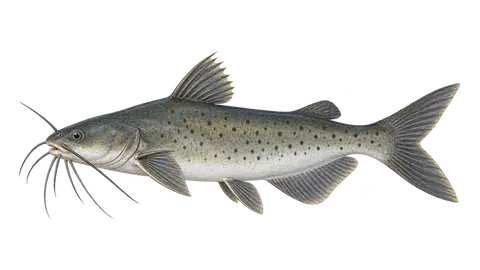
yellow bullhead
Ameiurus natalis · Ictaluridae · omnivore
Freshwater catfish of eastern North America, with a record of introduction in Mexico. It turns up now and then on the line of anglers.
Also called: bagre-amarelado, bagre torito amarillo, yellow bullhead

- maximum
- 60 cm
- record/max.
- 1.9 kg

the right time
to be on the water
Choose the place and the species. The index, from 0 to 100, combines weather, sun, moon and tide with each fish's habits. Up to 28 days, with each day's confidence.
Reading the weather across 3 global models and 31 simulations…
—
hour by hour
slide your finger or mouse over the chart to see each hoursee hour-by-hour table
why this index at —?
choose the day
Each card shows the day's index (0 to 100) and, below it, a strip with the index for each hour, from 0h to 23h. from poor to excellent.
the fishing month at a glance
what's the best window for the crew?
Choose how many fishing days. We compare each stretch by its average index, discount days with a warning or closed season, and show the 3 best.
trend for the coming weeks
Line: the middle value of 31 simulations of the American GEFS model. Band: where 8 out of 10 fall. Narrow, firm trend; wide, high uncertainty.
everything about the yellow bullhead
who is the yellow bullhead
Catfish of the family Ictaluridae, a freshwater bottom-dweller that reaches 60 cm and weighs up to 1.9 kg. It lives in pools, backwaters and slow currents, over soft bottoms of streams and rivers of small to large size, as well as reservoirs, lagoons and ponds. It does not migrate. It feeds on insects and other bottom organisms, such as mollusks and crustaceans. In fishing it turns up now and then on the line and is used for subsistence. It is listed as introduced in Mexico, where it is exotic, and in at least one country it has caused ecological impact.
Essential profile. Identification, where it occurs and rules, with data from FishBase and the cited regulations. Season, time of day, technique and bait are added once we have a good source for the yellow bullhead; in the meantime, see the similar species.
identification
Scaleless catfish, with barbels around the mouth and spines on the pectoral and dorsal fins. The name comes from the yellowish tone of its body. It looks very much like the black bullhead and the brown bullhead, of the same genus; of the three, it is the intermediate in maximum size: it reaches 60 cm, versus 66 cm for the black bullhead and 55 cm for the brown bullhead.
where found
Native to eastern North America, in the Atlantic and Gulf basins, from New York to northern Mexico. It is listed as introduced in Mexico, where it is exotic outside that natural range. It is not recorded in Brazil.
Habitat: Pools, backwaters and slow currents, over soft bottoms of small and large rivers, as well as reservoirs and farm ponds.
rules for the yellow bullhead
Summary of the regulations we found, with the source for each. Rules change; before keeping or transporting fish, check with the state environmental agency.
We found no species-specific rule beyond the region's general rules.
catch and release
catch and release Releasing the fish alive, quickly and with a wet hand. During a closed season it isn't always allowed: what the regulation says applies.
It has fin spines that can cut. Handle it carefully, holding it by the body. In at least one country it caused ecological impact after its introduction, so do not release it into waters where it does not occur.
in the kitchen
It is caught for subsistence, that is, for the consumption of the people who catch it.
how much it weighs without taking it out of the water
Length-weight relationship W = a·Lb (a = 0.00891, b = 3.06; FishBase (relação peso-comprimento bayesiana, estimativa da própria espécie)). It's an average: a fat or lean fish can vary by 10% to 20%.
estimated weight
—
sources and references
Essential profile: size, length-weight, depth, countries and conservation come from FishBase and the cited regulations, and the texts were written from those sources. Season, time of day, sensitivities, technique and baits and lures are not included yet, because we did not find a good source for this species.
- scientific FishBase: Ameiurus natalis (ficha da espécie)Size, length-weight, depth, habitat, distribution, biology, and IUCN status. Page checked on Oct 13, 2026.
- scientific FishBase: nomes populares de Ameiurus natalisNames by country and language.
similar species


where each number comes from
The weather comes from three independent global models, cross-checked hour by hour: when they agree, confidence goes up; when they diverge, the band between them shows on the chart. Beyond 16 days, we use the GEFS ensemble of 31 simulations: if 20 of the 31 predict rain, the chance of rain is 65%. Sun and moon are calculated astronomically, with no uncertainty.
The index adds up, weighted for each species: time of day (species curve anchored to real sunrise and sunset), moon (transits, rise and set, phase), pressure (3 h trend and 24 h swing), water temperature (in rivers, estimated from air temperature; at sea, estimated by an ocean model), wind, rain, clouds, tide and the month in the species' cycle.
sources for this lookup
how accurate the forecast is
Accuracy measured in the reference project (4 regions, 93 days, forecast vs. observed): maximum temperature is off by 0.6 °C on average the next day and 1.7 °C at 7 days; rain of 5 mm or more is detected 76% of the time the next day and 57% at 7 days. Detection isn't everything: the false alarm rate isn't published here yet, and 93 days in 4 regions is still a small sample. We now also measure every day, at the app's destinations: