Skip to content
catalog Ictaluridae · predator

channel catfish

Ictalurus punctatus

Freshwaternon-native in Brazil

Exotic catfish from North America, raised in fish farms and pay lakes. A hard fighter, it eats anything and already appears loose in rivers of the upper Paraná.

Also called: bagre-americano, bagre-do-canal, catfish, channel catfish

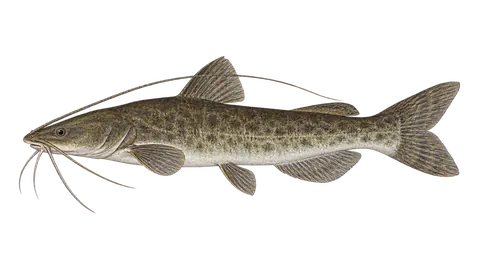
Scientific illustration of Channel catfish
common size
35–60 cm
maximum
132 cm
common weight
0.8–4 kg
record/max.
26.3 kg
depth
1–8 m
ideal water
22–29 °C
overview

who is the channel catfish

Native to North America, where it is one of the most farmed and fished fish, the channel catfish was brought to Brazil for fish farming and is now common in pay lakes in the South and Southeast. It prefers clean, well-oxygenated water, but lives well in reservoirs and tanks. It eats small fish, crustaceans, mollusks and insects. In the upper Paraná there are already wild records, in the São Francisco Verdadeiro River (PR), and Goiás and Minas rules treat it as exotic. For anglers it is a bottom fish, active at night, that fights with strong runs.

fun facts

  • It is one of the most farmed fish in aquaculture in the United States.
  • There is an albino form, raised as an ornamental fish.
how to recognize it

identification

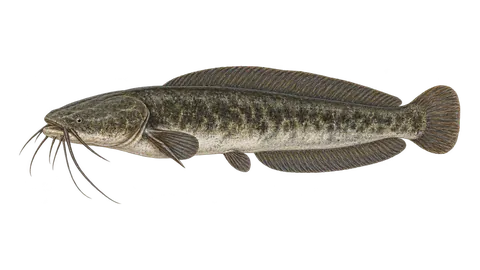
Smooth body without scales, blue-grey to olive on the back and white on the belly, with scattered dark spots on the flank (clearer in juveniles). Four pairs of barbels around the mouth. Deeply forked tail. The African catfish has a rounded tail and a long dorsal fin without a spine.

how channel catfish fishing looks

Loading the next 7 days…

Each card shows the day's index (0 to 100) and, below it, a strip with the index for each hour, from 0h to 23h. from poor to excellent.

distribution

where found

open on the large map

Exotic, native to North America. Raised in fish farms and pay lakes; recorded in the wild in the upper Paraná (PR) and listed as exotic by the Goiás rules (Paranaíba and Araguaia-Tocantins) and by Minas Gerais.

Habitat: Pay lakes, farm ponds and reservoirs; in rivers, deep pools with sand or stone bottoms.

introduced in

ParanáTocantins-Araguaia

states

Paraná, Goiás, Minas Gerais

calendar and clock

when to fish

best season

time of yearbest: Oct–Mar
JanFebSeaAprMayJunJulAugSepOctNovDec

Warm months, October to March; eats less in winter.

best time of day

0h6h12h18h sunrise ~6amsunset ~6pm

Night and twilight. Feeds more at night and at dusk; in a pay lake it also feeds by day.

weather, water and behavior

what affects the channel catfish
sensitivity The little bars show how much each factor affects this species. Five full: it feels it a lot.

cold and cold fronts

Tolerates cold, but feeds little below about 15 °C.

atmospheric pressure

A cold front stops the bites for a day or two.

moon

Dark nights tend to produce more.

rain

Often becomes active when the water starts to cloud.

water level

Little effect in a lake.

noise

Moderately sensitive.

wind

Little effect.

depth

Bottom, 1 to 5 m.

technique, gear and bait

how to fish

rod
6' to 7', medium action, 15 to 30 lb
spinning / baitcasting reel
spinning reel 3000 to 5000 or baitcasting reel
line
monofilament 0.35 to 0.40 mm or braided 30 lb
leader
monofilament 40 lb
hook
#2/0 to 5/0 hook or circle hook

natural baits

  • piece of fish
  • chicken liver
  • strong-smelling dough
  • minhoca

accessories

  • olive sinker
  • alicate

tip from an angler

Strong-smelling bait on the bottom, late afternoon and at night. Follow the pay lake's rules.

what the law says

rules for the channel catfish

Summary of the regulations we found, with the source for each. Rules change; before keeping or transporting fish, check with the state environmental agency.
Conservation: In its native range, the global IUCN assessment is Least Concern (LC, Feb 20, 2012).

Releasing into the wild without a license is an offense

releasing or introducing fish into rivers, reservoirs and lakes is prohibitedconfirm with the agency

Introducing an exotic species without a technical opinion and license is a federal environmental offense. This includes releasing a fish from a tank, pay lake or aquarium into a river or reservoir.

Source: Lei federal nº 9.605/1998, art. 31, and Decreto federal nº 6.514/2008, art. 25

catch and release
catch and release Releasing the fish alive, quickly and with a wet hand. During a closed season it isn't always allowed: what the regulation says applies.

At a pay lake, follow the house rules. In the wild, do not release exotic fish somewhere else.

in the kitchen

White, firm flesh with no intermuscular bones; fried as fillets, breaded or smoked.

calculator

how much it weighs without taking it out of the water

Length-weight relationship W = a·Lb (a = 0.00525, b = 3.13; FishBase). It's an average: a fat or lean fish can vary by 10% to 20%.

estimated weight

—

sources and references

The season weights (months), the time of day and the sensitivities (cold, pressure, moon, wind, rain, tide, strong light, murky water and noise) are the app's editorial estimates, based on the literature below and on the field experience of anglers and guides. They are not official data nor a measurement made for this species, and they may vary by region and year. Closed seasons and legal rules appear in the rules section, with the norm and a link.

  1. scientific FishBase — Ictalurus punctatus (ficha da espécie)Names, distribution, biology, length-weight relationship and references. Page checked on October 13, 2026.
  2. scientific IUCN Red List — Ictalurus punctatus (avaliação global: Pouco Preocupante, LC, 20/02/2012)Global assessment. Link given on the FishBase entry (Red List, version 2025-2).
  3. technical CABI Compendium — Ictalurus punctatus (channel catfish). Engle, C.; Kumar, G. (2023).Data sheet for an introduced species. DOI checked in Crossref.
  4. scientific Ota, R. R.; Deprá, G. C.; Graça, W. J.; Pavanelli, C. S. (2018). Peixes da planície de inundação do alto rio Paraná e áreas adjacentes: revised, annotated and updated. Neotropical Ichthyology 16(2): e170094.Annotated list of the species of the upper Paraná, indicating native and non-native species. Open access; species name checked in the text. Records the species as non-native in the São Francisco Verdadeiro River (PR).
  5. official IN Semad-GO nº 17/2026 — normas de pesca em Goiás (Anexos I e II)Annex II lists exotic, allochthonous and hybrid species with free capture and transport. Text checked on Oct 13, 2026.
don't confuse

similar species