Skip to content
fishing forecast

disk tetra

Myloplus schomburgkii · Serrasalmidae · omnivore

Freshwater

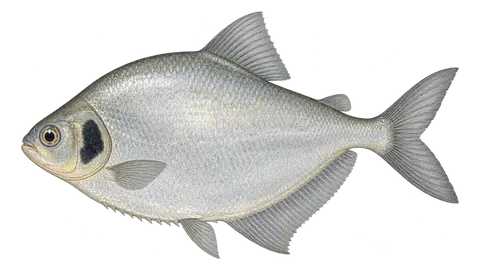
Disc-shaped, silvery pacu with a vertical black bar on the flank. From the Amazon and the upper Orinoco, it eats fruit and seeds and gives serious bites to anyone who holds it carelessly.

Also called: pacu-cadete, pacu, pacu-ferrado, pacu-jumento

Scientific illustration of Disk tetra
common size
20–32 cm
maximum
42 cm
common weight
0.2–0.7 kg
record/max.
1.5 kg
depth
0.5–6 m
ideal water
24–28 °C
location

Sample location: choose yours to see the forecast for where you fish.

period

Reading the weather across 3 global models and 31 simulations…

the species

everything about the disk tetra

overview

who is the disk tetra

Disc-bodied pacu from the middle and lower Amazon, from the Nanay River (Peru) and the upper Orinoco (Venezuela), with doubtful occurrence in Suriname according to FishBase. It lives between mid-water and the bottom, in acidic tropical water (pH 5 to 7), and general sources describe it as eating fruit, seeds, small fish, crustaceans and snails. FishBase lists it as a sport and minor commercial fishery species, and as 'traumatogenic': its powerful teeth cause serious bites. Size records reach 42 cm standard length. Pacu is a common name for several species in the family, which makes it hard to know which local rule cites it; the genus Myloplus was treated as Myleus in older works.

fun facts

  • The epithet honors the explorer Robert Hermann Schomburgk, who provided notes and an illustration for the description.
  • Males have a more pointed dorsal fin than females.
  • In English it is 'disk tetra', although it is a pacu and not a tetra.
how to recognize it

identification

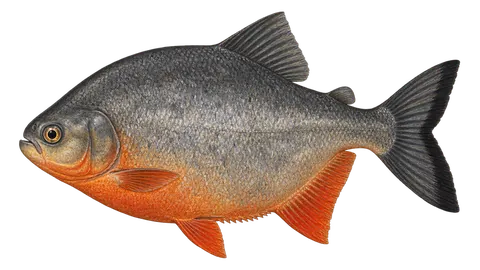
Tall, flattened, disc-shaped, silvery body with a vertical black bar on the flank (hence 'disk tetra' and 'black-band myleus' in English), small head, strong crushing teeth and a serrated keel on the belly. Males have a more pointed dorsal fin. The pacu-branco (Myloplus rubripinnis) lacks the black bar and is told apart by its red anal fin with a black edge. The pacu-peva (Mylossoma duriventre) has a black spot on the gill cover, not a bar on the flank.

distribution

where found

open on the large map

Middle and lower Amazon, in Brazil; outside it, the Nanay River (Peru) and upper Orinoco (Venezuela), with doubtful occurrence in Suriname.

Habitat: Mid-water and bottom of acidic rivers and lakes in the Amazon, near vegetation and submerged timber (typical habitat of the genus's pacus).

native to the basins

Amazon

states

Amazonas, Pará

calendar and clock

when to fish

best season

time of yearbest: Jul–Nov
JanFebSeaAprMayJunJulAugSepOctNovDec

Estimate: falling water and dry season (August to November in central Amazonia) concentrate the pacus in eddies and lakes. At high water the fish spreads through the flooded forest.

best time of day

0h6h12h18h sunrise ~6amsunset ~6pm

Daytime. No timing studies. Like pacus in general, it feeds by day (estimate).

weather, water and behavior

what affects the disk tetra
sensitivity The little bars show how much each factor affects this species. Five full: it feels it a lot.

cold and cold fronts

Cold snaps (friagem) shut down activity for a few days.

atmospheric pressure

Stable pressure helps.

moon

Little known effect.

rain

Light rain doesn't bother it.

water level

A falling river or lake concentrates the shoal.

noise

Tends to be shy: approach quietly.

wind

Little effect.

depth

Mid-water, 1 to 4 m.

technique, gear and bait

how to fish

rod
bamboo pole 3 to 4 m or rod 5'6" to 6', 8 to 15 lb
spinning / baitcasting reel
spinning reel 1000 to 2500
line
monofilament 0.25 to 0.30 mm
leader
fluorocarbon 30 lb, 30 cm: the teeth cut thin line
hook
No. 2 to 1/0, strong, short shank

natural baits

  • fruit and seeds from the bank
  • boiled corn
  • flour dough
  • piece of fish

accessories

  • small float
  • long-nose pliers

tip from an angler

Fruit or corn bait on the float, near the bank vegetation. Set the hook fast and use a leader: the teeth are strong and the bite hurts.

what the law says

rules for the disk tetra

Summary of the regulations we found, with the source for each. Rules change; before keeping or transporting fish, check with the state environmental agency.
Conservation: Not on the Brazilian national list (Ministerial Ordinance GM/MMA No. 1.667/2026).

PA and AP: the portaria cites 'pacu (Myleus spp.)' in the closed season

fishing banned Nov 15 to Mar 15 for 'pacu (Myleus spp.)'; application to the genus Myloplus not confirmed15/11 to 15/03PAAPAmazonconfirm with the agency

The portaria bans fishing for 'pacu (Myleus spp. and Mylossoma spp.)' in PA and AP, from Nov 15 to Mar 15. Myloplus pacus are not named and have already been classified as Myleus; applying the ban to them depends on the agency's interpretation. Under art. 2º, II, the recreational angler using handline or rod is exempt, unless a stricter state rule applies. When in doubt, check with the state agency.
Source: Portaria IBAMA nº 48/2007, Annexes I and II

piracema closures in the basins where the species lives

Spawning closure (piracema) in Mato Grosso (all basins)

01/10 to 31/01MT

Allowed: All fishing modalities are prohibited in rivers, including catch and release (Law 9.096/2009, art. 19-A). Exceptions: subsistence fishing from shore (3 kg or 1 fish, no transport or sale) and scientific fishing. Law 13.159/2025 now allows licensed sport fishing in UHE/PCH hydropower reservoirs, natural lakes and border rivers, subject to a scientific study and a license from the environmental agency. We have not confirmed whether these licenses are already being issued.

Source: IN Interministerial MAPA/MMA nº 10/2017; Resolução Cepesca-MT nº 1/2026; Lei estadual MT nº 9.096/2009, arts. 19-A and 27 (Leis 12.434/2024 and 13.159/2025)

Closed season in the rivers of Marajó Island (PA)

01/01 to 30/04PA

Allowed: The same recreational-angler exceptions as in Portaria 48/2007 apply (handline or rod, 5 kg + 1 fish), unless a stricter state rule applies.

Source: Portaria IBAMA nº 48/2007

Closed season in the Amazon basin in Amapá

15/11 to 15/03AP

Allowed: Recreational anglers with handline or rod, line and hook are outside the Annex II prohibitions, with a bag limit of 5 kg + 1 fish, unless a stricter state rule applies.

Source: Portaria IBAMA nº 48/2007

Border rivers MT/RO and MT/PA

05/11 to 28/02MTROPA

Allowed: See the exceptions in Portaria 48/2007 and the state rules for each bank.

Source: Portaria IBAMA nº 48/2007

catch and release
catch and release Releasing the fish alive, quickly and with a wet hand. During a closed season it isn't always allowed: what the regulation says applies.

Hold it from below, with a damp cloth and away from the mouth: the teeth crush and cut. Remove the hook with long-nose pliers and return the fish to the water.

in the kitchen

FishBase lists it as a minor commercial fishery species. Pacu meat, good baked or fried; we found no market notes specific to the species.

calculator

how much it weighs without taking it out of the water

Length-weight relationship W = a·Lb (a = 0.02455, b = 2.95; FishBase (relação peso-comprimento bayesiana, estimativa da própria espécie)). It's an average: a fat or lean fish can vary by 10% to 20%.

estimated weight

—

sources and references

The season weights (months), the time of day and the sensitivities (cold, pressure, moon, wind, rain, tide, strong light, murky water and noise) are the app's editorial estimates, based on the literature below and on the field experience of anglers and guides. They are not official data nor a measurement made for this species, and they may vary by region and year. Closed seasons and legal rules appear in the rules section, with the norm and a link.

  1. scientific FishBase: Myloplus schomburgkii (ficha da espécie)Size, length-weight, depth, habitat, distribution, biology and IUCN status. Page checked on October 13, 2026. The maximum weight and the typical sizes and weights on the page are editorial estimates made with the length-weight relationship, because FishBase does not publish a maximum weight for the species.
  2. scientific FishBase: nomes populares de Myloplus schomburgkiiNames by country and language.
  3. official Portaria GM/MMA nº 1.667, de 27 de abril de 2026: Lista Nacional Oficial de Espécies da Fauna Ameaçadas de Extinção (peixes e invertebrados aquáticos)The species is not on the list. Checked in the DOU of April 28, 2026.
  4. technical Seriously Fish: Myloplus schomburgkiiVertical black bar on the flank, more pointed dorsal fin in males and plant-based diet. Page checked on October 13, 2026.
  5. technical Wikipédia (en): Myloplus schomburgkiiDistribution, English names, etymology and diet cited for aquariums. Open encyclopedia; page checked on October 13, 2026.
  6. official Portaria IBAMA nº 48/2007: defeso na bacia do rio AmazonasAnnex II: pacu (Myleus spp. and Mylossoma spp.) in Pará and Amapá during the closed season. Myloplus are not named. Page checked on October 13, 2026.
don't confuse

similar species