

flying halfbeak
Euleptorhamphus velox
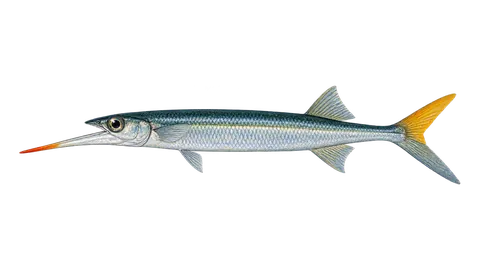
Needlefish with a very long, thin body, from coastal and oceanic waters of the western Atlantic, with commercial use. It turns up in fishing by accident and is not a target of recreational fishing.
- maximum
- 61 cm
how to recognize it
Very long, thin body, with the lower jaw elongated, as in all halfbeaks of the family. It is one of the largest halfbeaks in the region: it reaches 61 cm, much more than the white halfbeak (Hyporhamphus unifasciatus), which reaches 29.5 cm. The long, slender body is the strongest sign.
Also called: agulhinha, agulhinha-voadora, agujeta voladora, flying halfbeak
don't confuse with:
We don't have tips on season, bait or technique for this species yet.
where found
open on the large mapWhere to look: Coastal and oceanic waters, near the surface.
Western Atlantic, from Rhode Island (USA) and the northern Gulf of Mexico to the Antilles and Brazil, including the Caribbean and the Guianas. In Brazil there are records from Maranhão to Pernambuco and off São Paulo.
coast
rules for the flying halfbeak
Rules change; before keeping or transporting fish, check with the state environmental agency.
We found no species-specific rule beyond the region's general rules.
Conservation: Not on the Brazilian national list (Ministerial Ordinance GM/MMA No. 1.667/2026).
how much it weighs without taking it out of the water
estimated weight
—
how we calculate
Length-weight relationship W = a·Lb (a = 0.00102, b = 3.06; FishBase (relação peso-comprimento bayesiana, estimativa)). It's an average: a fat or lean fish can vary by 10% to 20%.
more about the flying halfbeak
Fish of the family Hemiramphidae, with a very long, thin body, reaching 61 cm. It occurs in the western Atlantic, from Rhode Island (USA) and the northern Gulf of Mexico to the Antilles and Brazil, including the Caribbean and the Guianas, and also in the eastern Atlantic, from Cape Verde to Nigeria. It lives in coastal and oceanic waters. It has commercial use, but is not a fish sought by recreational anglers. It is neither venomous nor has dangerous spines.
Family: Hemiramphidae · forage fish
similar species

sources and references (3)
Essential profile: size, length-weight, depth, countries and conservation come from FishBase and the cited regulations, and the texts were written from those sources. Season, time of day, sensitivities, technique and baits and lures are not included yet, because we did not find a good source for this species.
- scientific FishBase: Euleptorhamphus velox (ficha da espécie)Size, length-weight, depth, habitat, distribution, biology, and IUCN status. Page checked on Oct 13, 2026.
- scientific FishBase: nomes populares de Euleptorhamphus veloxNames by country and language.
- official Portaria GM/MMA nº 1.667, de 27 de abril de 2026: Lista Nacional Oficial de Espécies da Fauna Ameaçadas de Extinção (peixes e invertebrados aquáticos)The species is not on the list. Checked in the DOU of April 28, 2026.