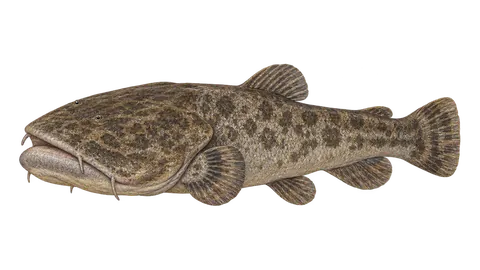
A robust catfish with a broad head and a huge mouth that looks like a toad. It lives on the bottom of rivers in the Plata basin and turns up in bottom fishing. In Argentina it is the manguruyú amarillo, not the manguruyú (which is the jaú).
A bottom-dwelling catfish of the family Pseudopimelodidae, with a short, robust body, living in the Paraná, Paraguay, Uruguay and Plata basins in Brazil, Argentina, Paraguay, Bolivia and Uruguay. According to FishBase it is carnivorous and reaches about 69 cm and 6.7 kg. It has commercial value and is farmed, and the IUCN rates it Least Concern (2020). Like other pseudopimelodids, it should stay still on the bottom, camouflaged, waiting for prey within reach of its mouth. In Argentina it is called manguruyú amarillo; the name manguruyú without a qualifier refers to the jaú, which has an absolute closed season in the Uruguay River, so take care when reading Spanish-language fishing rules and news. In Brazil, FishBase records the names bagre-sapo, jaú-sapo and piracururu.
fun facts
In Spanish it is manguruyú amarillo. CARU Resolution 8/98 prohibits fishing for the 'manguruyú' (Paulicea luetkeni, the old name of the jaú) in the Uruguay River, and that rule does not concern the bagre-sapo.
In Brazil it is also known as jaú-sapo, but it is not a close relative of the jaú: it belongs to a different family.
how to recognize it
identification
Short, robust body, very broad, flattened head, huge mouth, small eyes and short barbels, with smooth skin and no scales. The color is yellowish to brown, with irregular dark blotches (hence the 'amarillo' in the Spanish name). Fins are rounded and the tail is broad. The pacamã (Lophiosilurus alexandri), also called peixe-sapo, is from the São Francisco. Telling apart toad-like catfish of the same family requires meristic counts; in the field, go by the combination of broad, flat head, large mouth and stocky body.
how bagre-sapo fishing looks
Loading the next 7 days…
Each card shows the day's index (0 to 100) and, below it, a strip with the index for each hour, from 0h to 23h. from poor to excellent.
4000 to 5000 spinning reel or low-profile baitcaster 200
line
monofilament 0.35 to 0.45 mm
leader
0.50 mm monofilament, 30 to 40 cm
hook
circle hook 1/0 to 4/0
natural baits
live lambari or tuvira
piece of fish
minhoca
chicken heart
accessories
long-nose pliers
landing net
luvas
tip from an angler
Bait on the bottom, in backwaters and pools, at night. The mouth is huge and the fish swallows the bait whole: a circle hook makes release easy without injury. There is little sport-fishing literature on the species; use medium bottom-catfish tackle.
what the law says
rules for the bagre-sapo
Summary of the regulations we found, with the source for each. Rules change; before keeping or transporting fish, check with the state environmental agency. Conservation: Not on the Brazilian national list (Ministerial Ordinance GM/MMA No. 1.667/2026).
We found no species-specific rule beyond the region's general rules.
piracema closures in the basins where the species lives
Spawning closure (piracema) in the Paraná River basin
01/11 to 28/02SPPRMGGOMSDF
Allowed: Recreational fishing only for non-native species and hybrids (peacock bass, tilapia, black bass, carp, croaker, etc.; piauçu remains prohibited), with handline, simple pole, or rod with spinning or baitcasting reel, up to 10 kg + 1 fish. In rivers, from shore only; in reservoirs, from a boat or from shore. Prohibited: floodplain lakes, aquatic-animal bait, within 1,500 m of dams and waterfalls, and within 500 m of confluences. Tournaments only in reservoirs and only with non-native species.
Spawning closure (piracema) in Minas Gerais (state rule)
01/11 to 28/02MG
Allowed: Only exotic or hybrid species, 3 kg + 1 fish per day, with handline, rod, simple pole, or spinning or baitcasting reel. Nets prohibited. Keep the minimum distances from dams and reservoirs.
Allowed: Sport and guided fishing only in reservoirs, catch and release with barbless hooks (no keeping, transporting or eating). Subsistence: up to 5 kg per day, for household consumption only.
Spawning closure (piracema) in the Pantanal of Mato Grosso do Sul
05/11 to 28/02MS
Allowed: Subsistence fishing by riverside residents and authorized scientific fishing. Decree 15.166/2019 (art. 11, §5) allows catch and release only in February and only in the channels of the Paraguay and Paraná rivers. For the rest of the period, not even catch and release is allowed. Check the Imasul portaria for each season.
Spawning closure (piracema) in Mato Grosso (all basins)
01/10 to 31/01MT
Allowed: All fishing modalities are prohibited in rivers, including catch and release (Law 9.096/2009, art. 19-A). Exceptions: subsistence fishing from shore (3 kg or 1 fish, no transport or sale) and scientific fishing. Law 13.159/2025 now allows licensed sport fishing in UHE/PCH hydropower reservoirs, natural lakes and border rivers, subject to a scientific study and a license from the environmental agency. We have not confirmed whether these licenses are already being issued.
Spawning closure (piracema) in the Uruguay River basin
01/10 to 31/01RSSC
Allowed: Recreational fishing from shore, or from a boat without motor. Only handline or rod, line and hook, one gear per angler, up to 5 kg. Prohibited in floodplain lakes, within 1,500 m of dams, within 500 m of confluences, and in stretches listed in the rule (e.g., Turvo River).
catch and release Releasing the fish alive, quickly and with a wet hand. During a closed season it isn't always allowed: what the regulation says applies.
Support the fish from below, cradling its belly, and remove the hook with long-nose pliers; the mouth is large, but the pectoral spines also cut. Release it with the body horizontal.
in the kitchen
Commercial and farmed fish (FishBase). It can be prepared like other catfish: in steaks, roasted or in a stew (caldeirada).
calculator
how much it weighs without taking it out of the water
Length-weight relationship W = a·Lb (a = 0.0055, b = 3.11; FishBase (relação peso-comprimento bayesiana, estimativa)). It's an average: a fat or lean fish can vary by 10% to 20%.
estimated weight
—
sources and references
The season weights (months), the time of day and the sensitivities (cold, pressure, moon, wind, rain, tide, strong light, murky water and noise) are the app's editorial estimates, based on the literature below and on the field experience of anglers and guides. They are not official data nor a measurement made for this species, and they may vary by region and year. Closed seasons and legal rules appear in the rules section, with the norm and a link.
scientificFishBase: Pseudopimelodus mangurus (ficha da espécie)Size, length-weight, depth, habitat, distribution, biology and IUCN status. Page checked on October 13, 2026. The maximum weight of 6.7 kg is the figure published by FishBase; the typical sizes and weights on the page are editorial estimates, calculated from the length-weight relationship.