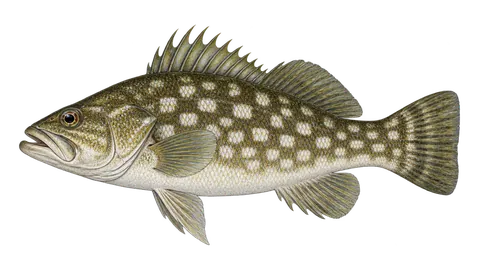
barred sand bass
Paralabrax nebulifer
Sea bass of sand bottoms near rocks, reaching 67 cm and 6 kg. It is an important fish for sport fishing.
Also called: cabrilha-de-areia-barrada, cabrilla de arena, cabrilla verde de arena, barred sand bass

- maximum
- 67 cm
- record/max.
- 6.0 kg
- depth
- 1–183 m
who is the barred sand bass
Sea bass of the family Serranidae. It reaches 67 cm and up to 6 kg. It lives on sand bottoms near rocks, mostly down to 30 m, and can reach 183 m. Juveniles feed on bottom invertebrates such as crabs, bivalves and mysids. Adults hunt fish and crustaceans. Spawning takes place in the water, with eggs released freely. It ranges from Santa Cruz, in central California, to Magdalena Bay, in Baja California, and also appears off Acapulco, Mexico. It is an important sport fish.
Essential profile. Identification, where it occurs and rules, with data from FishBase and the cited regulations. Season, time of day, technique and bait are added once we have a good source for the barred sand bass; in the meantime, see the similar species.
fun facts
- There are reports of individuals up to 31 years old.
identification
Sea bass with stripes on the body, as its common name indicates. It lives on sand bottoms near rocks and usually stays down to 30 m. It can be confused with the spotted sand bass, which lives on the same coast, but that one has spots, not stripes.
Loading the next 7 days…
Each card shows the day's index (0 to 100) and, below it, a strip with the index for each hour, from 0h to 23h. from poor to excellent.
Essential profile: the index uses a general fish model (weather, sun, moon and tide), without a season or time of day specific to this species.
where found
Lives in the eastern Pacific, from Santa Cruz, in central California, to Magdalena Bay, in Baja California, and also appears off Acapulco, Mexico. In Latin America, it occurs only in Mexico.
Habitat: Sand bottom near rocks, mostly down to 30 m, but it can reach 183 m.
rules for the barred sand bass
Summary of the regulations we found, with the source for each. Rules change; before keeping or transporting fish, check with the state environmental agency.
We found no species-specific rule beyond the region's general rules.
catch and release
catch and release Releasing the fish alive, quickly and with a wet hand. During a closed season it isn't always allowed: what the regulation says applies.
Poses no danger to anglers. When releasing it, remove the hook carefully.
in the kitchen
It is taken in subsistence fishing, for the consumption of the angler.
how much it weighs without taking it out of the water
Length-weight relationship W = a·Lb (a = 0.01122, b = 3.05; FishBase (relação peso-comprimento bayesiana, estimativa pelo gênero e formato do corpo)). It's an average: a fat or lean fish can vary by 10% to 20%.
estimated weight
—
sources and references
Essential profile: size, length-weight, depth, countries and conservation come from FishBase and the cited regulations, and the texts were written from those sources. Season, time of day, sensitivities, technique and baits and lures are not included yet, because we did not find a good source for this species.
- scientific FishBase: Paralabrax nebulifer (ficha da espécie)Size, length-weight, depth, habitat, distribution, biology, and IUCN status. Page checked on Oct 13, 2026.
- scientific FishBase: nomes populares de Paralabrax nebuliferNames by country and language.