

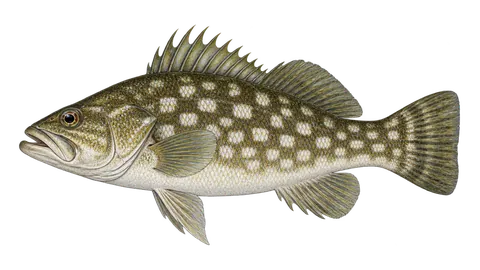
spotted sand bass
Paralabrax maculatofasciatus
Sea bass of sand bottoms near stones and seagrass in the eastern Pacific, reaching 60 cm. It is an important sport fish in bays and harbors.
- maximum
- 60 cm
- record/max.
- 0.9 kg
- depth
- 1–61 m
how to recognize it
Sea bass with spots over the body, as its common name indicates, on sand and mud bottoms near rocks, seagrass and the coast, down to 60 m. It looks like the kelp bass, which lives on the same coast, and like the barred sand bass, but the latter has stripes, not spots.
Also called: cabrilha-manchada, cabrilla de roca, spotted sand bass
don't confuse with:
where found
open on the large mapWhere to look: Sand or mud bottom near rocks and seagrass, from the shore down to 60 m.
Lives in the eastern Pacific, from central California to Mexico, including the Gulf of California. In Latin America, it occurs in Mexico, and a record exists for Nicaragua.
when to fish
next 7 days
Loading the next 7 days…
best time of day
Daytime. It feeds on small fish and bottom crustaceans during the day.
how to fish
lures
- 1/2 to 1 1/2 oz jig head with silicone tube
natural baits
- live anchovy
- live sardine
- pieces of fish (cut bait)
tip from an angler
Same fishing as the barred sand bass, same genus: live bait just above the bottom, with enough sinker to keep the line vertical, and light line.
- rod
- 7' to 7'6", medium action, 15 to 25 lb
- spinning / baitcasting reel
- spinning reel 4000 to 5000 or low-profile baitcasting reel
- line
- braided line 30 lb
- leader
- monofilament or fluorocarbon 12 to 25 lb, 90 cm
- hook
- #1 to 3/0 (depending on bait size)
catch and release
Poses no danger to anglers. When releasing it, remove the hook carefully so the fish survives.
rules for the spotted sand bass
Rules change; before keeping or transporting fish, check with the state environmental agency.
We found no species-specific rule beyond the region's general rules.
how much it weighs without taking it out of the water
estimated weight
—
how we calculate
Length-weight relationship W = a·Lb (a = 0.01175, b = 3.04; FishBase (relação peso-comprimento bayesiana, estimativa da própria espécie)). It's an average: a fat or lean fish can vary by 10% to 20%.
more about the spotted sand bass
Sea bass of the family Serranidae. It reaches 60 cm and up to 900 g. It lives on sand or mud bottoms near rocks and seagrass, from the shore down to 60 m. It ranges from Monterey, California, to Mexico, including the Gulf of California, and a record exists for Nicaragua. It is a shy fish that feeds on small fish and bottom crustaceans during the day. Spawning takes place in open water, with eggs released freely. It is an important sport fish in bays and harbors.
Family: Serranidae · predator
fun facts
- Tolerates water temperatures from 7.5 °C to 32 °C.
- There are reports of individuals up to 20 years old.
similar species

sources and references (3)
Essential profile: size, weight-length, depth, countries and conservation come from FishBase and the cited regulations, and the texts were written from those sources. Technique, baits and hook come from the cited fishing source; rod, spinning reel and line, when the source does not say, were estimated from the size of the species. Season, time of day and sensitivities are not included yet, because we did not find a good source for this species.
- scientific FishBase: Paralabrax maculatofasciatus (ficha da espécie)Size, length-weight, depth, habitat, distribution, biology, and IUCN status. Page checked on Oct 13, 2026.
- scientific FishBase: nomes populares de Paralabrax maculatofasciatusNames by country and language.
- pesca Saltwater Sportsman: Basic Techniques for Targeting Barred Sand BassI did not find a source for this species alone: I used the fishing for barred sand bass (Paralabrax nebulifer), same genus and similar diet and methods (live bait on a dropper, #1 to 3/0 hooks, 12 lb leader with 30 lb braided line), according to the search summary. Rod and spinning reel estimated.