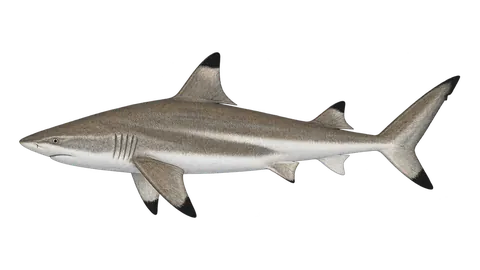
Small shark of the shelf, over sand, shell, and coral bottoms, with a dark snout tip. Vulnerable (VU) on the national list and Endangered (EN) worldwide: catch banned in Brazil.
The blacknose shark (cação-corta-garoupa) is a small to medium shark of the continental and island shelves of the western Atlantic, from North Carolina (USA) to southern Brazil and Uruguay, including the Gulf of Mexico and the Caribbean. It usually lives between 9 and 64 m, over sand, shell, and coral bottoms. It eats small fish, such as sargos and porcupinefish, and is prey for larger sharks. The female has 3 to 6 pups per litter. Near divers, it adopts a threat display, with an arched back, low tail, and raised head. It is Vulnerable (VU) on the national list, where it was added in 2023, and Endangered (EN) in the IUCN global assessment (2019). Do not seek out this species.
fun facts
Near divers, it arches its back, raises its head and lowers its tail, the "hunchback" posture that FishBase reads as a possible threat.
It feeds on small fish, such as porgies and spiny pufferfish, and is prey for larger sharks.
Each female has 3 to 6 pups per litter, according to FishBase.
It was added to the national list by Portaria MMA nº 354/2023, in force since May 22, 2023.
how to recognize it
identification
Small to medium shark, with a fusiform body, grayish brown above and pale below. Its mark is the dark spot on the tip of the snout, which gives it its English name, blacknose. It resembles other small Carcharhinus sharks, such as the blacktip shark (galha-preta) and the night shark (tubarão-noturno); the snout spot helps tell it apart. When in doubt, release it.
how blacknose shark fishing looks
Loading the next 7 days…
Each card shows the day's index (0 to 100) and, below it, a strip with the index for each hour, from 0h to 23h. from poor to excellent.
Western Atlantic, from North Carolina (USA) to southern Brazil and Uruguay, including the Gulf of Mexico and the Caribbean (FishBase: 40°N to 37°S). In Brazil, the species occurs along the coast, on the shelf. In Latin America, FishBase lists it from Mexico and the Caribbean to Venezuela, the Guianas, Brazil, and Uruguay.
Habitat: Continental and island shelves, from 9 to 64 m, over sand, shell, and coral bottoms.
coast
North CoastNortheast CoastSoutheast CoastSouth Coastcoastalshelf
calendar and clock
when to fish
best season
time of year
JanFebSeaAprMayJunJulAugSepOctNovDec
Estimate: present all year on the shelf; the weights are neutral. Catch is banned all year.
best time of day
Any time. There is no reliable data on the activity schedule in Brazil.
weather, water and behavior
what affects the blacknose shark
sensitivity The little bars show how much each factor affects this species. Five full: it feels it a lot.
cold and cold fronts
A warm-water species; cold water pushes the shark out of the shallows.
atmospheric pressure
Little known effect.
moon
No known effect.
rain
Heavy rain muddies coastal water; the shark usually moves away.
water level
Not applicable at sea.
noise
Not well known.
wind
Rough seas make any trip hard.
tide
The tide moves food in channels and sandbanks.
depth
From 9 to 64 m.
technique, gear and bait
how to fish
rod
Catch banned in Brazil; there is no recommended gear for targeting the species.
spinning / baitcasting reel
Not applicable.
line
Not applicable.
leader
Not applicable. If a shark takes the steel leader, cut close to the mouth when releasing it.
hook
Barbless circle hook (or one with the barb flattened) for any open-sea fishing: it comes out more easily and causes less injury.
accessories
cutting pliers
long-handled hook remover
thick gloves
tip from an angler
If a blacknose shark is hooked by chance while bottom fishing, keep it in the water and cut the leader close to the hook. On sand and shell bottoms, a barbless circle hook comes out more easily.
what the law says
rules for the blacknose shark
Summary of the regulations we found, with the source for each. Rules change; before keeping or transporting fish, check with the state environmental agency. Conservation: On the national list of threatened species as VU, in force since May 22, 2023 (Portaria MMA nº 354/2023). Global: Endangered (EN, assessed by IUCN on Jul 1, 2019). The whole family Carcharhinidae has been in CITES Appendix II since Nov 25, 2023.
Threatened species in Brazil: catch banned
full protection
The national list (Portaria GM/MMA nº 1.667/2026) classifies the species as VU. Under Portaria GM/MMA nº 1.666/2026 (art. 3º), VU, EN and CR species have full protection: catch, transport, storage, processing and sale are banned. If you hook one by accident, release it at once, handling it as little as possible.
Finning prohibited: shark only whole, with its fins
fins naturally attached to the body
In Brazil, finning is banned: cutting off the fins and discarding the rest of the body. The rule covers landing, transport, and trade by fishing vessels: every shark or ray must arrive whole, with its fins naturally attached to the body (partially folding them against the body is allowed); carrying an animal aboard without fins or with loose fins, and transferring sharks and rays between vessels, is prohibited. This does not authorize catching this species, which is banned.
1 specimen per angler per day (counts as 5 against the quota of 10)
In recreational sport fishing in Mexican saltwaters, the limit for sharks is one specimen per angler per day, which counts as five toward the total limit of ten fish. Fish caught in sport fishing may not be sold. Catch and release does not count toward the limit: prefer releasing.
Colombia: marine sharks and rays are not fishery resources
commercial or sport extraction not permittedconfirm with the agency
In 2021 Colombia stopped considering sharks and marine rays a fishery resource and began treating them as a hydrobiological resource; the recitals of Decree 281/2021 state that they may not be extracted for commercial or sport purposes, and the decree created an environmental protection plan. Later AUNAP rules dealt with incidental catch in artisanal fishing; we did not check the consolidated text. When in doubt, release it into the water.
Panama: shark finning banned in its jurisdictional waters
banned: cutting off the fins and throwing the body back into the sea
Law 9 of 2006 bans finning in Panama's jurisdictional waters. The law's definition of shark fishing covers directed or incidental catch by artisanal, commercial, industrial and sport vessels. The fine for artisanal fishing reaches 1,000 balboas, without prejudice to criminal liability. In the sources we checked, we did not find a specific Panamanian rule on retention or release for sport anglers.
catch and release Releasing the fish alive, quickly and with a wet hand. During a closed season it isn't always allowed: what the regulation says applies.
This is not catch and release: it is release of an accidental catch. Keep the shark in the water and cut the line as close to the hook as possible. Don't lift it by the tail or take photos out of the water.
in the kitchen
Catch and trade are banned in Brazil. In other countries it is used salted and dried (FishBase). Under the national list, release it.
calculator
how much it weighs without taking it out of the water
Length-weight relationship W = a·Lb (a = 0.00525, b = 3.08; FishBase (relação peso-comprimento bayesiana, estimativa pelo gênero e formato do corpo)). It's an average: a fat or lean fish can vary by 10% to 20%.
estimated weight
—
sources and references
The seasonal weights (months), the time of day and the sensitivities (cold, pressure, moon, wind, rain, tide, strong light, murky water and noise) are the app's editorial estimates, based on the literature below and on field experience from anglers and guides. The water temperature range and the common size range are also editorial estimates, supported by FishBase. The months show when an angler usually finds the species, not a catch season. They are not official data or measurements made for this species, and they may vary by region and year. Legal rules appear in the rules section, with the norm and a link.
scientificFishBase: Carcharhinus acronotus (ficha da espécie)Size, length-weight relationship, depth, habitat, distribution, biology and IUCN status. Page checked on Oct 13, 2026. The common size range follows FishBase's maturity range (87 to 137 cm); FishBase does not give a common length. We do not give a common weight: by the length-weight relationship, the weight of the common size range would exceed the maximum weight published by FishBase.