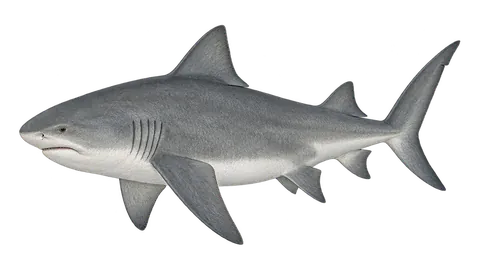
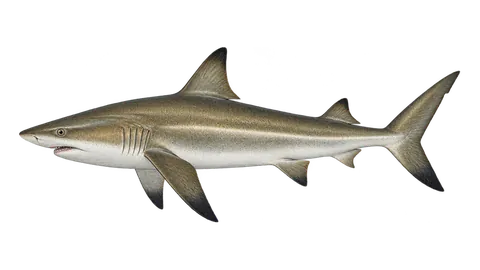
A fast shark of warm beaches and bays, with black tips on its fins, that jumps when hooked. It is not on the national list, but it is easily confused with the spinner shark, which is protected: when in doubt, release it.
Also called: tubarão-galha-preta, galha-preta, cação-galha-preta, sicuri, cação-sicuri, machote, serra-garoupa
The blacktip shark lives in warm coastal waters worldwide: beaches, bays, estuary mouths, mangroves and shallow reefs, almost always less than 30 m deep. It hunts schools of sardines, mullet and other small fish at speed, and sometimes leaps out of the water during attacks. Females give birth in shallow bays, which serve as nursery areas. In Brazil it occurs along the whole coast, more in the North, Northeast and Southeast. In sport fishing it is one of the most sought-after sharks in the Caribbean and the Gulf of Mexico, taken on natural bait, lures and even fly, for its jumps and runs. It is not on the national list of threatened species, but its global assessment is Vulnerable, and it closely resembles protected species.
fun facts
In 2008 researchers confirmed parthenogenesis (a pup without a father) in a female kept in an aquarium.
It sometimes leaps and spins out of the water when attacking schools, like the spinner shark.
In a catch-and-release study, only the great hammerhead built up more lactic acid during the fight.
how to recognize it
identification
Streamlined body, grayish bronze on the back, white belly and a pale band on the flank. Long, pointed snout. Black tips on the pectoral fins, both dorsal fins and the lower lobe of the tail; the anal fin is pale, without a black tip (in adults the tips can fade). The spinner shark (C. brevipinna, Vulnerable) has an even longer snout, a first dorsal fin set further back, and a black-tipped anal fin. When in doubt, release it.
how blacktip shark fishing looks
Loading the next 7 days…
Each card shows the day's index (0 to 100) and, below it, a strip with the index for each hour, from 0h to 23h. from poor to excellent.
The entire Brazilian coast, most common from the North to the Southeast. In the western Atlantic it ranges from Canada to Brazil, including the Gulf of Mexico and the Caribbean; in the Pacific, from Mexico to Peru and the Galápagos.
Habitat: Beaches, bays, estuary mouths, mangroves, lagoons and shallow reefs; juveniles in shallow bays that serve as nurseries.
coast
North CoastNortheast CoastSoutheast CoastSouth Coastcoastalshelf
states
Amapá, Pará, Maranhão, Piauí, Ceará, Rio Grande do Norte, Paraíba, Pernambuco, Alagoas, Sergipe, Bahia, Espírito Santo, Rio de Janeiro, São Paulo, Paraná, Santa Catarina, Rio Grande do Sul
calendar and clock
when to fish
best season
time of yearbest: Dec–Feb
JanFebSeaAprMayJunJulAugSepOctNovDec
Estimate: present year-round from the North to the Northeast; in the Southeast and South it appears more in summer, with warm water.
best time of day
Daytime, with peaks at dawn and dusk. Hunts by day, most active at dawn and in the late afternoon, when schools come close to the beach.
weather, water and behavior
what affects the blacktip shark
sensitivity The little bars show how much each factor affects this species. Five full: it feels it a lot.
cold and cold fronts
Water below about 20 °C keeps the blacktip away from the coast.
atmospheric pressure
Little direct effect.
moon
Spring tides concentrate schools at the bar mouths.
rain
Heavy rain muddies the beach water and scatters the schools.
water level
Not applicable at sea.
noise
Engine noise and hull knocks scare the shark out of the shallows.
wind
Rough seas make it hard to see the attacks and to cast.
tide
A rising tide pushes schools into bays and channels.
spinning 7' to 8', 20 to 40 lb; from the beach, 10' to 12'
spinning / baitcasting reel
5000 to 8000 spinning reel with light drag
line
braid 30 to 50 lb
leader
40 to 60 cm wire leader joined to 1 m of 80 lb fluorocarbon
hook
barbless circle hook 7/0 to 10/0 on natural bait; single hook in place of trebles
lures
metal spoon and jig of 30 to 60 g
large mid-water lure
fly: streamer on a thin wire leader (bite tippet)
natural baits
cut bait or fillet of mullet, sardine or bonito
small live fish
accessories
long-nose pliers
desanzolador
luvas
tip from an angler
Release them all if you can: the spinner shark, which is protected, looks almost the same. Keep the fight short and release it in the water; don't drag the shark across the sand. Avoid fishing for sharks near swimmers.
what the law says
rules for the blacktip shark
Summary of the regulations we found, with the source for each. Rules change; before keeping or transporting fish, check with the state environmental agency. Conservation: Not on the national list (Ministerial Ordinance GM/MMA 1.667/2026). Global assessment: Vulnerable (IUCN, November 18, 2020). Listed in CITES Appendix II. The general rules for recreational fishing apply, as does the ban on finning.
Watch out for protected look-alikes
Several Carcharhinus sharks look very similar and are protected in Brazil: spinner shark (C. brevipinna, VU), blacknose shark (C. acronotus, VU), dusky shark (C. obscurus, EN), sandbar shark (C. plumbeus, CR), silky shark (C. falciformis, CR), Caribbean reef shark (C. perezi, VU), smalltail shark (C. porosus, CR) and night shark (C. signatus, EN), plus the bull shark (C. leucas, VU from late October 2026). If you're not sure of the species, release it.
Finning prohibited: shark only whole, with its fins
fins naturally attached to the body
In Brazil, finning is prohibited (cutting off the fins and discarding the body). Every shark or ray landed must arrive with its fins attached to the body; it is prohibited to carry on board an animal without fins or with loose fins, and to transfer sharks between vessels. It applies to any shark that may be kept.
1 specimen per angler per day (counts as 5 against the quota of 10)
In recreational sport fishing in Mexican saltwaters, the limit for sharks is one specimen per angler per day, which counts as five toward the total limit of ten fish. Fish caught in sport fishing may not be sold. Catch and release does not count toward the limit: prefer releasing.
commercial or sport extraction not permittedconfirm with the agency
In 2021 Colombia stopped considering sharks and marine rays a fishery resource and began treating them as a hydrobiological resource; the recitals of Decree 281/2021 state that they may not be extracted for commercial or sport purposes, and the decree created an environmental protection plan. Later AUNAP rules dealt with incidental catch in artisanal fishing; we did not check the consolidated text. When in doubt, release it into the water.
catch and release Releasing the fish alive, quickly and with a wet hand. During a closed season it isn't always allowed: what the regulation says applies.
Keep the fight short and release the shark in the water. Hold it with a glove by the base of the tail and under the belly, never by the gills. If the hook is deep, cut the leader close to the mouth. Revive it facing the current: it has to swim to breathe.
in the kitchen
It may be kept where the law allows, but release is the best practice: it is Vulnerable worldwide and easy to confuse with protected species. Sharks accumulate mercury.
calculator
how much it weighs without taking it out of the water
Length-weight relationship W = a·Lb (a = 0.00501, b = 3.06; FishBase (estimativa bayesiana para a espécie, comprimento total)). It's an average: a fat or lean fish can vary by 10% to 20%.
estimated weight
—
sources and references
The seasonal weights (months), time of day and sensitivities (cold, pressure, moon, wind, rain, tide, strong light, murky water and noise) are the app's editorial estimates, based on the literature below and on field experience of anglers and guides. The months indicate the time of year when the angler usually finds the species near the coast, not a catch season. They are not official data or measurements made for this species and may vary by region and year. Legal rules appear in the rules section, with the regulation and link.