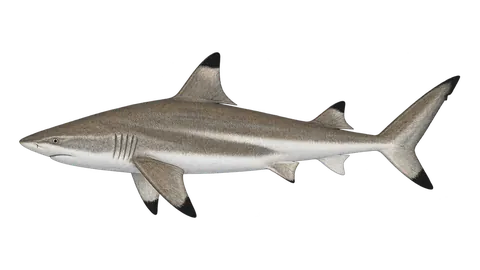
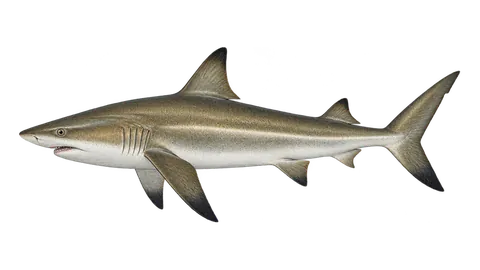
Slender shark of beaches, bays and shelf, famous for leaping out of the water while spinning as it moves through schools. Vulnerable: in Brazil, capture becomes banned at the end of October 2026.
Also called: tubarão-rotador, cação-galha-preta, galha-preta-rotador, spinner shark, tiburón aleta negra
The spinner shark is a slender carcharhinid shark that exceeds 3 m and approaches 200 kg. It lives on continental shelves and around islands in warm waters worldwide, from the shallows near the beach to the open sea, but almost always at less than 100 m. It travels in schools and hunts pelagic fish, small sharks, cuttlefish, squid and octopus. To do so it darts into a school and rises spinning, mouth open, until it leaps out of the water, the gesture that gave the species its name. It is migratory, with long movements in Florida and the Gulf of Mexico. It is targeted by commercial and sport fishing in several countries. In Brazil, the 2026 national list classified it as Vulnerable, and capture bans apply from the end of October 2026.
fun facts
It darts in a spiral through a school and rises spinning, mouth open, until it leaps clear of the water: the leap gives the species its name.
Each pregnancy produces 3 to 15 pups, born at 60 to 80 cm.
FishBase notes that it was often cited as Carcharhinus limbatus, the blacktip shark.
how to recognize it
identification
Slender, cylindrical body, bronze-grey on the back and white below, with a well-marked white band along the flank. Long, narrow, pointed snout, long gill slits, small first dorsal fin and no ridge between the dorsal fins. In adults and subadults the second dorsal, the anal fin, the underside of the pectorals and the lower tail lobe have black or dark grey tips; in juveniles the marks are faint. The black tip on the anal fin separates it from the blacktip shark (Carcharhinus limbatus), which has a pale anal fin and a shorter snout, and with which it was long confused. When in doubt, release it.
how spinner shark fishing looks
Loading the next 7 days…
Each card shows the day's index (0 to 100) and, below it, a strip with the index for each hour, from 0h to 23h. from poor to excellent.
The Brazilian coast, from north to south. Outside Brazil, FishBase lists Argentina, Uruguay, Cuba, the Bahamas, Mexico, Nicaragua, Guyana and Trinidad and Tobago, with long movements in Florida and the Gulf of Mexico. It also occurs in the Mediterranean and the Indo-Pacific, in warm and warm-temperate waters.
Habitat: Beaches, bays and continental and island shelves, from shallow water near the coast to open sea, almost always down to 100 m.
coast
North CoastNortheast CoastSoutheast CoastSouth Coastcoastalshelf
calendar and clock
when to fish
best season
time of yearbest: Dec–Mar
JanFebSeaAprMayJunJulAugSepOctNovDec
Estimate: in the Southeast and South of Brazil it appears more in summer, with warm water; in the North and Northeast it tends to be seen year-round. In Florida and the Gulf of Mexico it makes long migrations.
best time of day
Daytime, with peaks at dawn and dusk. Hunts near the surface, in schools of small fish, and the spinning leap is usually seen by day (estimate). There is more activity in the first and last hours of light.
weather, water and behavior
what affects the spinner shark
sensitivity The little bars show how much each factor affects this species. Five full: it feels it a lot.
cold and cold fronts
Cold water pushes the school away from the coast; in the South and Southeast it disappears with the arrival of winter.
atmospheric pressure
Little known direct effect.
moon
Spring tides concentrate prey schools at inlet mouths.
rain
Heavy rain muddies the beach water and scatters the prey.
water level
Not applicable at sea.
noise
Engine noise and hull knocks drive the school away from the shallows.
wind
Rough seas make it hard to see the leaps and attacks.
tide
A rising tide pushes prey schools into bays and channels.
depth
Usually 0 to 100 m.
technique, gear and bait
how to fish
rod
No recommended gear: in Brazil, capture becomes banned at the end of October 2026.
spinning / baitcasting reel
Not applicable.
line
Not applicable.
leader
Not applicable.
hook
In any beach or boat fishing at sea, prefer a barbless circle hook: it makes it easier to release what cannot be kept.
accessories
cutting pliers for steel cable
long hook remover
luvas
tip from an angler
If a spinner shark bites by accident, release it in the water, cutting the line flush with the mouth. In other countries where fishing is allowed (Mexico, for example), local limits apply.
what the law says
rules for the spinner shark
Summary of the regulations we found, with the source for each. Rules change; before keeping or transporting fish, check with the state environmental agency. Conservation: New species on the 2026 national list, as VU: the bans take effect at the end of October 2026. IUCN global assessment: VU (A2bd, assessed Feb 11, 2020).
Threatened species (VU): capture banned in Brazil from the end of Oct 2026
full protection: capture, transport, storage, keeping and trade banned (from the end of October 2026)
The national list (Portaria GM/MMA nº 1.667/2026) classifies the spinner shark (Carcharhinus brevipinna) as VU, and the species was added to the list only in 2026. Under Portaria GM/MMA nº 1.666/2026 (art. 3), species listed as VU, EN and CR have full protection: capture, transport, storage, keeping, processing and sale are banned. As it was not on the previous list, the deadline in art. 12 applies: the bans take effect 180 days after publication (28/04/2026), that is, around 25/10/2026 (Fiperj, the fisheries agency of Rio de Janeiro, gives 27/10/2026). Incidental capture with immediate release of the live animal is outside the ban (art. 3, § 4). The rule does not authorize targeted fishing, not even with release: in Brazil, do not seek out this species. If you hook one by accident, release it right away, with minimal handling.
Finning banned: sharks and rays only whole, with their fins
fins naturally attached to the body
In Brazil, finning is banned: catching sharks and rays and keeping only the fins, discarding the body (art. 3). Sharks and rays landed must arrive with all fins naturally attached to the body; carrying an animal aboard without fins or with loose fins, and transferring sharks and rays between fishing vessels, is prohibited. This applies to any species that may be retained.
1 specimen per angler per day (counts as 5 against the quota of 10)
In recreational sport fishing in Mexican marine waters, the limit for sharks is one fish per angler per day, which counts as five toward the total limit of ten fish (item 4.9.1 b). Fish over the limit must be returned alive to the water (item 4.9.5), and recreational catch may not be sold (item 4.11). Fish that are released do not count toward the limit: prefer to release it.
Bahamas: sharks protected since 2011, release them all
shark fishing not permitted; a shark hooked must be released unharmedconfirm with the agency
The official fishing guide of the Bahamas states that shark fishing is not allowed, that sharks have been protected since a 2011 amendment, that they may only be taken under special permits for very specific purposes, and that a shark hooked in any fishing must be released unharmed. The page does not cite the number of the rule.
catch and release Releasing the fish alive, quickly and with a wet hand. During a closed season it isn't always allowed: what the regulation says applies.
This is not catch and release: it is release of an accidental catch. Keep the shark in the water, cut the line close to the mouth if the hook is deep, and let it go. Don't drag it on the sand, don't hold it by the tail or gills, and don't take it out of the sea for a photo.
in the kitchen
Catching, transporting and selling are banned in Brazil from the end of October 2026. In other countries the meat is eaten fresh or dried and salted, the fins go to the fin market and the liver to vitamin oil (FishBase), but the species is Vulnerable: it is better to release it.
calculator
how much it weighs without taking it out of the water
Length-weight relationship W = a·Lb (a = 0.00447, b = 3.06; FishBase (relação peso-comprimento bayesiana, estimativa da própria espécie)). It's an average: a fat or lean fish can vary by 10% to 20%.
estimated weight
—
sources and references
The season factors (months), the time of day, and the sensitivities (cold, pressure, moon, wind, rain, tide, strong light, murky water, and noise) are editorial estimates by the app, based on the literature cited below and on field experience of anglers and guides. They are not official data or measurements made for this species and may vary by region and year. Closed seasons and legal rules appear in the rules section, with the standard and link. The months indicate when anglers usually find the species near the coast, not a catch season.
scientificFishBase: Carcharhinus brevipinna (ficha da espécie)Size, length-weight, depth, habitat, distribution, biology, and IUCN status. Page checked on Oct 13, 2026. Here the common size runs from the length at maturity to the reported common length.