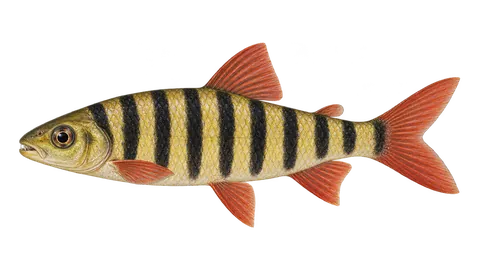
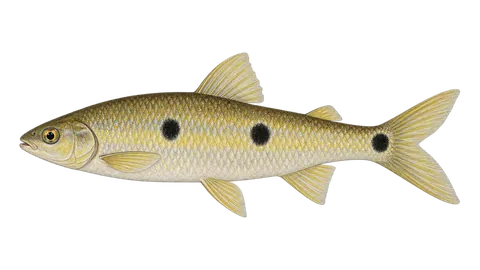
The canivete is of the family Anostomidae and reaches 25 cm. Adults live in fast-current stretches of the rivers. It occurs in the Paraná and Paraguay basins, with a record in the Uruguay River, in Brazil. It also appears in Argentina, Bolivia, Colombia, Ecuador, Peru, Paraguay and Uruguay. It eats plants, and pairs spawn in areas with dense vegetation. It has commercial use and also goes to the aquarium trade, but rarely shows up on the line of rod anglers.
Essential profile. Identification, where it occurs and rules, with data from FishBase and the cited regulations. Season, time of day, technique and bait are added once we have a good source for the characin; in the meantime, see the similar species.
how to recognize it
identification
Piau of elongated body, with a small mouth at the tip of the snout and incisor teeth, traits common to Leporinus. The scientific name, striatus, refers to stripes on the body. It reaches 25 cm. Among the piaus of the region, the piau-flamengo (Leporinus octofasciatus) has eight black bars and the piau-três-pintas (Leporinus friderici) has three spots, while the canivete is striped.
how characin fishing looks
Loading the next 7 days…
Each card shows the day's index (0 to 100) and, below it, a strip with the index for each hour, from 0h to 23h. from poor to excellent.
Essential profile: the index uses a general fish model (weather, sun, moon and tide), without a season or time of day specific to this species.
Paraná and Paraguay river basins, with a record in the Uruguay River, in Brazil. It also occurs in Argentina, Bolivia, Colombia, Ecuador, Peru, Paraguay and Uruguay.
Habitat: Fast waters of rivers and streams, where adults live, with dense plants at the spawning sites.
native to the basins
ParanáParaguay (Pantanal)Uruguay
what the law says
rules for the characin
Summary of the regulations we found, with the source for each. Rules change; before keeping or transporting fish, check with the state environmental agency. Conservation: Not on the Brazilian national list (Ministerial Ordinance GM/MMA No. 1.667/2026).
We found no species-specific rule beyond the region's general rules.
piracema closures in the basins where the species lives
Spawning closure (piracema) in the Paraná River basin
01/11 to 28/02SPPRMGGOMSDF
Allowed: Recreational fishing only for non-native species and hybrids (peacock bass, tilapia, black bass, carp, croaker, etc.; piauçu remains prohibited), with handline, simple pole, or rod with spinning or baitcasting reel, up to 10 kg + 1 fish. In rivers, from shore only; in reservoirs, from a boat or from shore. Prohibited: floodplain lakes, aquatic-animal bait, within 1,500 m of dams and waterfalls, and within 500 m of confluences. Tournaments only in reservoirs and only with non-native species.
Spawning closure (piracema) in Minas Gerais (state rule)
01/11 to 28/02MG
Allowed: Only exotic or hybrid species, 3 kg + 1 fish per day, with handline, rod, simple pole, or spinning or baitcasting reel. Nets prohibited. Keep the minimum distances from dams and reservoirs.
Allowed: Sport and guided fishing only in reservoirs, catch and release with barbless hooks (no keeping, transporting or eating). Subsistence: up to 5 kg per day, for household consumption only.
Spawning closure (piracema) in the Pantanal of Mato Grosso do Sul
05/11 to 28/02MS
Allowed: Subsistence fishing by riverside residents and authorized scientific fishing. Decree 15.166/2019 (art. 11, §5) allows catch and release only in February and only in the channels of the Paraguay and Paraná rivers. For the rest of the period, not even catch and release is allowed. Check the Imasul portaria for each season.
Spawning closure (piracema) in Mato Grosso (all basins)
01/10 to 31/01MT
Allowed: All fishing modalities are prohibited in rivers, including catch and release (Law 9.096/2009, art. 19-A). Exceptions: subsistence fishing from shore (3 kg or 1 fish, no transport or sale) and scientific fishing. Law 13.159/2025 now allows licensed sport fishing in UHE/PCH hydropower reservoirs, natural lakes and border rivers, subject to a scientific study and a license from the environmental agency. We have not confirmed whether these licenses are already being issued.
Spawning closure (piracema) in the Uruguay River basin
01/10 to 31/01RSSC
Allowed: Recreational fishing from shore, or from a boat without motor. Only handline or rod, line and hook, one gear per angler, up to 5 kg. Prohibited in floodplain lakes, within 1,500 m of dams, within 500 m of confluences, and in stretches listed in the rule (e.g., Turvo River).
catch and release Releasing the fish alive, quickly and with a wet hand. During a closed season it isn't always allowed: what the regulation says applies.
Small-mouthed fish: take the hook out in the water carefully and release it quickly.
calculator
how much it weighs without taking it out of the water
Length-weight relationship W = a·Lb (a = 0.00955, b = 3.04; FishBase (relação peso-comprimento bayesiana, estimativa da própria espécie)). It's an average: a fat or lean fish can vary by 10% to 20%.
estimated weight
—
sources and references
Essential profile: size, length-weight, depth, countries and conservation come from FishBase and the cited regulations, and the texts were written from those sources. Season, time of day, sensitivities, technique and baits and lures are not included yet, because we did not find a good source for this species.