Skip to content
catalog Anostomidae · omnivore

piau-flamengo

Leporinus octofasciatus

Freshwater

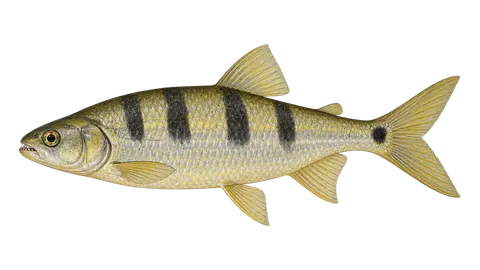
The yellow piau with eight black stripes from the upper Paraná. Small, pretty and feisty on a cane pole and light rod.

Also called: piau-flamengo, flamenguinho, ferreirinha, piau-listrado, piava

Scientific illustration of Piau-flamengo
common size
18–26 cm
maximum
31 cm
common weight
0.1–0.3 kg
record/max.
0.4 kg
depth
0.5–4 m
ideal water
22–28 °C
overview

who is the piau-flamengo

A small piau from the upper Paraná and the Cubatão River in Santa Catarina, easy to recognize by the eight black bars on a yellow background. It eats plants and small invertebrates, and pairs spawn in dense vegetation. It lives in rivers and reservoirs, near rocks and vegetation, and bites on corn, dough and earthworm chum. It is also prized in the aquarium trade. In Goiás, in the Paranaíba basin, it has minimum and maximum size limits for capture.

fun facts

  • Octofasciatus means eight-striped.
  • In Tocantins-Araguaia, the name piau-flamengo is used for other striped species of the genus.
how to recognize it

identification

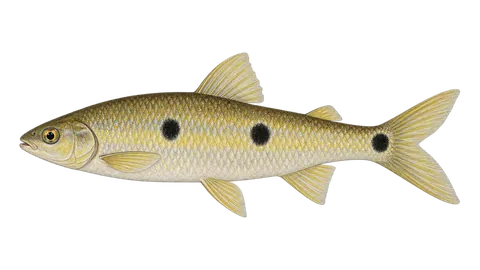
Light yellow body with eight transverse black bars behind the head; reddish fins. Small mouth at the tip of the snout, with incisor teeth. The aracu-comum has only three or four stripes and is from the Amazon; the piau-três-pintas has spots, not bars.

how piau-flamengo fishing looks

Loading the next 7 days…

Each card shows the day's index (0 to 100) and, below it, a strip with the index for each hour, from 0h to 23h. from poor to excellent.

distribution

where found

open on the large map

Upper Paraná (Grande, Paranaíba, Tietê, Paranapanema and Paraná rivers) and the Cubatão River in Santa Catarina.

Habitat: Rivers and reservoirs, near rocks, submerged timber and aquatic vegetation.

native to the basins

ParanáSouth Atlantic

states

São Paulo, Minas Gerais, Paraná, Goiás, Mato Grosso do Sul, Santa Catarina

calendar and clock

when to fish

best season

time of yearbest: Oct–Mar
JanFebSeaAprMayJunJulAugSepOctNovDec

Good from September to April; yields less in winter.

best time of day

0h6h12h18h sunrise ~6amsunset ~6pm

Daytime, with peaks at dawn and dusk. Active by day, with peaks early and late in the afternoon.

weather, water and behavior

what affects the piau-flamengo
sensitivity The little bars show how much each factor affects this species. Five full: it feels it a lot.

cold and cold fronts

Strong cold leaves the fish inactive.

atmospheric pressure

A cold front shuts down biting.

moon

Little effect.

rain

Little effect.

water level

Stable river.

noise

Wary in clear water.

wind

Little effect.

depth

Shallow, 0.5 to 3 m.

technique, gear and bait

how to fish

rod
cane pole 3 to 4 m or light 5'6" rod, 4 to 10 lb
spinning / baitcasting reel
spinning reel 1000 to 2000
line
monofilament 0.18 to 0.22 mm
leader
optional
hook
#6 to 2, short shank

natural baits

  • green corn
  • massa
  • minhoca

accessories

  • corn chum
  • small float

tip from an angler

Small hook and quick hookset: it nibbles like the other piaus.

what the law says

rules for the piau-flamengo

Summary of the regulations we found, with the source for each. Rules change; before keeping or transporting fish, check with the state environmental agency.
Conservation: Not on the national list (Portaria GM/MMA 1.667/2026).

piracema closures in the basins where the species lives

Spawning closure (piracema) in the Paraná River basin

01/11 to 28/02SPPRMGGOMSDF

Allowed: Recreational fishing only for non-native species and hybrids (peacock bass, tilapia, black bass, carp, croaker, etc.; piauçu remains prohibited), with handline, simple pole, or rod with spinning or baitcasting reel, up to 10 kg + 1 fish. In rivers, from shore only; in reservoirs, from a boat or from shore. Prohibited: floodplain lakes, aquatic-animal bait, within 1,500 m of dams and waterfalls, and within 500 m of confluences. Tournaments only in reservoirs and only with non-native species.

Source: IN IBAMA nº 25/2009

Closed season in Goiás (state rule)

01/11 to 28/02GO

Allowed: Sport and guided fishing only in reservoirs, catch and release with barbless hooks (no keeping, transporting or eating). Subsistence: up to 5 kg per day, for household consumption only.

Source: IN Semad-GO nº 17/2026, arts. 8º to 11

Spawning closure (piracema) in the southern basins (RS and SC, outside the Uruguay)

01/11 to 31/01RSSC

Allowed: Recreational fishing from a boat or from shore, with a single hook, one gear per angler, up to 5 kg.

Source: IN IBAMA nº 197/2008

catch and release
catch and release Releasing the fish alive, quickly and with a wet hand. During a closed season it isn't always allowed: what the regulation says applies.

Small fish: unhook it in the water and release it.

in the kitchen

Small and bony; fried whole.

calculator

how much it weighs without taking it out of the water

Length-weight relationship W = a·Lb (a = 0.01, b = 3.13; FishBase). It's an average: a fat or lean fish can vary by 10% to 20%.

estimated weight

—

sources and references

The season weights (months), the time of day and the sensitivities (cold, pressure, moon, wind, rain, tide, strong light, murky water and noise) are the app's editorial estimates, based on the literature below and on the field experience of anglers and guides. They are not official data nor a measurement made for this species, and they may vary by region and year. Closed seasons and legal rules appear in the rules section, with the norm and a link.

  1. scientific FishBase — Leporinus octofasciatus (ficha da espécie)Names, distribution, biology, length-weight relationship and references. Page checked on October 13, 2026.
  2. official Portaria GM/MMA nº 1.667, de 27 de abril de 2026 — Lista Nacional Oficial de Espécies da Fauna Ameaçadas de Extinção (peixes e invertebrados aquáticos)Most recent national list. The species is not on it (search by scientific name in the text published in the DOU, checked on October 13, 2026).
  3. official ICMBio/SALVE — Ficha de Leporinus octofasciatus (avaliação nacional do risco de extinção)National assessment by ICMBio, published in 2024. DOI verified on Crossref.
  4. scientific IUCN Red List — Leporinus octofasciatus (avaliação global: Pouco Preocupante, LC, 07/11/2018)Global assessment. Link given on the FishBase entry (Red List, version 2025-2).
  5. scientific Ota, R. R.; Deprá, G. C.; Graça, W. J.; Pavanelli, C. S. (2018). Peixes da planície de inundação do alto rio Paraná e áreas adjacentes: revised, annotated and updated. Neotropical Ichthyology 16(2): e170094.Annotated list of species of the upper Paraná River, indicating native and non-native ones. Open access; species name checked in the text.
  6. scientific Garavello, J. C.; Britski, H. A. (2003). Anostomidae (headstanders). In: Reis, R. E.; Kullander, S. O.; Ferraris Jr., C. J. (orgs.). Check List of the Freshwater Fishes of South and Central America. Porto Alegre: EDIPUCRS, p. 71–84.Printed book chapter; the URL is the bibliographic record on FishBase, which cites the chapter for the species.
  7. official IN Semad-GO nº 17/2026 — normas de pesca em Goiás (Anexos I e II)Annex II lists exotic, allochthonous and hybrid species with free capture and transport. Text checked on Oct 13, 2026.
don't confuse

similar species