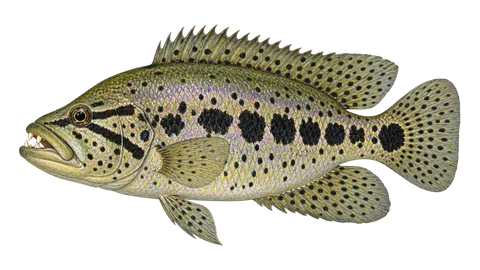
false yellowjacket cichlid
Parachromis motaguensis
Guapote from rivers and lakes of Guatemala, Honduras and El Salvador, reaching 30 cm, feeding on fish and insects.
Also called: guapote-do-motagua, moro, pando, false yellowjacket cichlid

- maximum
- 30 cm
who is the false yellowjacket cichlid
The Motagua guapote belongs to the family Cichlidae and reaches 30 cm. It occurs on the Atlantic slope of the Motagua basin, in Guatemala and Honduras, and also in rivers of the Pacific slope, from the Naranjo River in Guatemala to the Choluteca River in Honduras. It lives in lakes and rivers, and prefers stretches with moderate to strong current, in the lower and middle courses. It eats fish, aquatic insects and land insects. It is oviparous, and both sexes guard the substrate where the eggs and larvae are. It is caught commercially and also farmed in aquaculture.
Essential profile. Identification, where it occurs and rules, with data from FishBase and the cited regulations. Season, time of day, technique and bait are added once we have a good source for the false yellowjacket cichlid; in the meantime, see the similar species.
identification
Fish-eating guapote, up to 30 cm, from rivers with moderate to strong current. It resembles the yellowjacket cichlid (Parachromis friedrichsthalii), with which it can be confused. Location helps tell them apart: this species is known from the Motagua basin and Pacific rivers of Guatemala and Honduras, with records also in El Salvador.
Loading the next 7 days…
Each card shows the day's index (0 to 100) and, below it, a strip with the index for each hour, from 0h to 23h. from poor to excellent.
Essential profile: the index uses a general fish model (weather, sun, moon and tide), without a season or time of day specific to this species.
where found
Atlantic slope of the Motagua basin, in Guatemala and Honduras, and rivers of the Pacific slope, from the Naranjo River in Guatemala to the Choluteca River in Honduras. There are also records in El Salvador.
Habitat: Lakes and rivers with moderate to strong current, in the lower and middle reaches, in fresh and brackish water.
rules for the false yellowjacket cichlid
Summary of the regulations we found, with the source for each. Rules change; before keeping or transporting fish, check with the state environmental agency.
We found no species-specific rule beyond the region's general rules.
catch and release
catch and release Releasing the fish alive, quickly and with a wet hand. During a closed season it isn't always allowed: what the regulation says applies.
It poses no danger to anglers, but as a predator it can bite, and the fin spines can prick the hand. Hold it by the body, with a wet hand, and not by the mouth.
how much it weighs without taking it out of the water
Length-weight relationship W = a·Lb (a = 0.02692, b = 3.03; FishBase (relação peso-comprimento bayesiana, estimativa)). It's an average: a fat or lean fish can vary by 10% to 20%.
estimated weight
—
sources and references
Essential profile: size, length-weight, depth, countries and conservation come from FishBase and the cited regulations, and the texts were written from those sources. Season, time of day, sensitivities, technique and baits and lures are not included yet, because we did not find a good source for this species.
- scientific FishBase: Parachromis motaguensis (ficha da espécie)Size, length-weight, depth, habitat, distribution, biology, and IUCN status. Page checked on Oct 13, 2026.
- scientific FishBase: nomes populares de Parachromis motaguensisNames by country and language.