Skip to content
catalog Cichlidae · predator

yellowjacket cichlid

Parachromis friedrichsthalii

FreshwaterEstuary

Predatory cichlid with a golden-yellow body and yellow fins, living in slow rivers, lakes, and lagoons on the Atlantic slope of Central America. It ambushes other fish and does not exceed about 28 cm.

Also called: guapote-amarelo, yellowjacket cichlid, yellowjacket

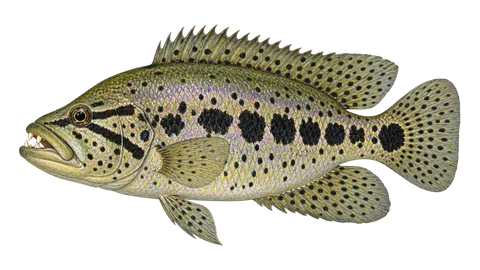
Scientific illustration of Yellowjacket cichlid
common size
12–22 cm
maximum
28 cm
common weight
0.1–0.3 kg
record/max.
0.7 kg
depth
0.5–2 m
ideal water
26–30 °C
overview

who is the yellowjacket cichlid

Predatory cichlid of the same genus as the guapotes (Parachromis), but much smaller: FishBase gives a maximum of 28 cm standard length. It lives in rivers and lakes with weak current, lagoons, and lowland swamps, usually down to about 2 m deep, and enters brackish water. It mainly eats other fish, ambushing them. Pairs dig the nest in sand or mud bottoms and guard the young. According to FishBase and Mexican fishing practice, it occurs on the Atlantic slope of Mexico (Usumacinta), Belize, Guatemala, and Honduras. The most recent treatment of Nicaragua's fish fauna places the species from eastern Honduras to western Panama, on both slopes, which shows that the species' limits and identity are under review. FishBase lists it as of sport and aquarium interest and of no interest for commercial fishing, but the Mexican inland waters standard lists it, as mojarra pinta, among the commercial species of the Malpaso reservoir in Chiapas.

fun facts

  • FishBase lists the species as of interest for behavioral research in the laboratory.
  • According to a Mexican outreach website, it plays dead to lure prey, which still needs confirmation in scientific work.
  • In Mexico, the name castarrica also applies to the Mayan cichlid (Mayaheros urophthalmus), another fish from the same region.
how to recognize it

identification

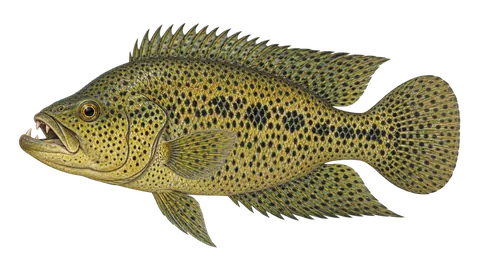
Elongated, robust, strongly compressed body, golden yellow, with broken dark blotches running from the eye to the tail and yellowish fins. The forehead slopes gently, the eyes and mouth are large, and the tail is rounded; the dorsal and anal fins extend backward, and males have stronger colors and more pointed fins. The female of P. motaguensis, also yellowish, can be mistaken for it. The tiger guapote (P. managuensis) has large, well-separated black blotches on its flank.

how yellowjacket cichlid fishing looks

Loading the next 7 days…

Each card shows the day's index (0 to 100) and, below it, a strip with the index for each hour, from 0h to 23h. from poor to excellent.

distribution

where found

open on the large map

Not found in Brazil. Atlantic slope of Central America: Mexico (Usumacinta River, in Chiapas and Tabasco), Belize, Guatemala, and Honduras, according to FishBase. The 2023 review of Nicaragua's fish fauna records it in Nicaragua and places the range from eastern Honduras to western Panama, in rivers on both slopes, from 9 to 65 m elevation. The distribution and valid name of the northern populations of that range remain under review.

Habitat: Lowland rivers, streams, lakes, ponds, and swamps with weak current, down to about 2 m deep, near logs, vegetation, and roots; enters brackish water.

calendar and clock

when to fish

best season

time of yearbest: Mar–Jun
JanFebSeaAprMayJunJulAugSepOctNovDec

Bites all year round in the tropics. Pairs guard the nest at various times of the year and defend their territory; the dry season, with clearer, lower water, concentrates fish in holes and bank areas with logs.

best time of day

0h6h12h18h sunrise ~6amsunset ~6pm

Daytime, with peaks at dawn and dusk. The sources consulted do not give a time. As an ambush predator, it should bite best early and late in the day, along the bank.

weather, water and behavior

what affects the yellowjacket cichlid
sensitivity The little bars show how much each factor affects this species. Five full: it feels it a lot.

cold and cold fronts

Tropical species: cold fronts and water below about 22 °C reduce activity.

atmospheric pressure

No known effect.

moon

Little effect.

rain

Heavy rain muddies rivers and lagoons and scatters the fish.

water level

Low water concentrates fish in holes and banks with logs.

noise

Moderate: an ambush predator, approach quietly.

wind

Little effect in sheltered backwaters.

depth

Shallow, down to about 2 m, next to logs and vegetation.

technique, gear and bait

how to fish

rod
6' to 6'6", medium-fast action, 6 to 10 lb; or fly #5 to #6
spinning / baitcasting reel
spinning reel 2000 to 2500
line
monofilament 0.23 to 0.28 mm or braided line 8 to 12 lb
leader
fluorocarbon 10 to 15 lb
hook
size 4 to 1/0

lures

  • small minnow 5 to 8 cm
  • spinner #2 to 3
  • jig 1/16 to 1/8 oz
  • small streamer

natural baits

  • fish pieces

accessories

  • alicate
  • landing net
  • polarized glasses

tip from an angler

Imitate a wounded baitfish and pause near logs and vegetation: it strikes from ambush.

what the law says

rules for the yellowjacket cichlid

Summary of the regulations we found, with the source for each. Rules change; before keeping or transporting fish, check with the state environmental agency.
Conservation: Assessed on Dec 18, 2019 as Least Concern, with an unknown population trend.

Mexico: up to 5 freshwater fish per day, one rod, and no live fish as bait

5 fish per angler per day; one rod in use; no live fish as bait

In Mexico's federal inland waters, recreational fishing for freshwater species is limited to 5 fish per angler per day (this also applies to the yellow guapote). Each reservoir's committee may lower the bag limit and set sizes. Only one rod per angler may be in use, and using live fish as bait is prohibited. Fish kept may not be sold, and any fish over the limit must be returned alive to the water. No permit is required to fish from the bank; a permit is required from a boat.
Source: Amendment to NOM-017-PESC-1994, DOF Nov 25, 2013, items 4.3, 4.6 b, 4.7 c, 4.9.2, 4.9.5 and 4.11 (Sagarpa/Conapesca)

catch and release
catch and release Releasing the fish alive, quickly and with a wet hand. During a closed season it isn't always allowed: what the regulation says applies.

Small fish with a wide mouth: use a barbless hook, pliers, and a soft-mesh landing net, and return it to the water quickly.

in the kitchen

Small fish, for local consumption; FishBase marks no interest for commercial fishing.

calculator

how much it weighs without taking it out of the water

Length-weight relationship W = a·Lb (a = 0.02692, b = 3.03; FishBase (relação peso-comprimento bayesiana, estimativa)). It's an average: a fat or lean fish can vary by 10% to 20%.

estimated weight

—

sources and references

The season factors (months), the time of day, and the sensitivities (cold, pressure, moon, wind, rain, tide, strong light, murky water, and noise) are editorial estimates by the app, based on the literature cited below and on field experience of anglers and guides. They are not official data or measurements made for this species and may vary by region and year. Closed seasons and legal rules appear in the rules section, with the standard and link. The profile's maximum weight was estimated from the length-weight relationship, because FishBase has no maximum weight. Time of day, depth, gear, and baits are editorial recommendations, based on the ambush-predator habit; there is no specific source on recreational fishing for the species.

  1. scientific FishBase: Parachromis friedrichsthalii (ficha da espécie)Size, length-weight, depth, habitat, distribution, biology, and IUCN status. Page checked on Oct 13, 2026.
  2. scientific FishBase: nomes populares de Parachromis friedrichsthaliiNames by country and language.
  3. scientific IUCN Red List: Parachromis friedrichsthalii (avaliação global: Pouco Preocupante, LC, 18/12/2019)Global assessment. Link given on the FishBase entry (Red List, version 2025-2).
  4. scientific Angulo, A. et al. (2023). Continental fishes of Nicaragua. Zootaxa 5376(1): 1-89 (tratamento de Parachromis friedrichsthalii, via Zenodo/Plazi)It places the species from eastern Honduras to western Panama, on both slopes, with records in Nicaragua (9 to 65 m elevation), and treats P. loisellei as a synonym of P. friedrichsthalii. Because of this, the profile added Nicaragua to the FishBase country list; the northern range (Mexico, Belize, Guatemala) follows FishBase and the Mexican standard, with the review caveat. The page reproduces only the summary of the treatment, without identification characters. Page checked on Oct 13, 2026.
  5. technical Mexican Fish: Yellowjacket Cichlid (Parachromis friedrichsthalii)Mexican fish outreach website, used only for the body and blotch description, typical depth (up to 2 m), diet, and local names (guapote amarillo, molula, mojarra del San Juan). Information without a reference in the text. Page checked on Oct 13, 2026.
  6. official DOF: Modificação da NOM-017-PESC-1994, que regula a pesca esportivo-recreativa em águas de jurisdição federal do México (publicada em 25/11/2013)Items 4.3, 4.4, 4.6 b, 4.7 c, 4.9.2, 4.9.5, and 4.11: permit, one rod per angler in inland waters, ban on live fish as bait, limit of 5 freshwater fish per day, release of the fish over the limit, and ban on sale. Text checked on Oct 13, 2026.
  7. official DOF: NOM-060-SAG/PESC-2014, pesca responsável em corpos de água continentais de jurisdição federal do México (publicada em 27/05/2014)Annex 1: the mojarra pinta (Parachromis friedrichsthalii) is named among the species of commercial fishing in the Netzahualcóyotl (Malpaso) reservoir, in Chiapas. The standard sets no minimum size or limit for it outside the general recreational bag limit. Text checked on Oct 13, 2026.
don't confuse

similar species