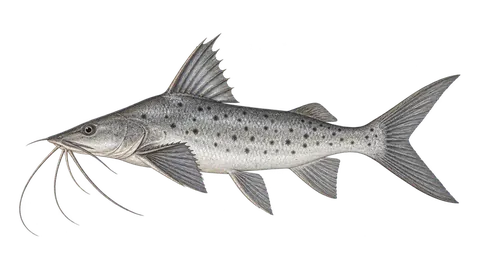
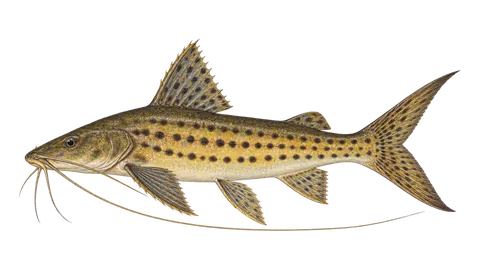
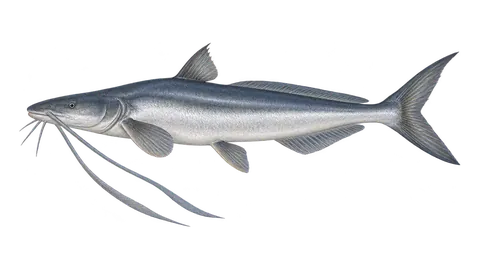
A silver catfish with flanks marked by dark bands and blotches, from large rivers in the Amazon, the Araguaia-Tocantins and the Pantanal. Active at dusk, it grunts when it leaves the water and stings anyone who handles it carelessly.
Also called: mandi-cabeçudo, bagre-cabeçudo, cabeçudo, mandi-guaru, mandi-pinima
A medium-sized catfish of the family Pimelodidae, widely distributed in the Amazon, the Orinoco, the Guianas and the Plata basin. According to FishBase, it lives on the bed of main rivers, in headwaters, in riffles downstream, in backwaters and in deep rocky pools with fallen logs; it is active at dusk and eats mostly fish. It makes loud grunts when taken out of the water, and its skin releases a toxic mucus; the stings from its pectoral spines hurt badly. It was one of the fish of the lower Paraná that moved upriver after the Itaipu reservoir covered the Sete Quedas falls in 1982, and it now occurs in the upper Paraná, where Goiás treats it as allochthonous. It has commercial use and appears in Tocantins' size table, a sign that it is caught in the region. Mandi-guaru, mandi-pinima and bagre-cabeçudo are names of the same species.
fun facts
According to FishBase, the mandi-cabeçudo grunts loudly when taken out of the water.
The female stores sperm received from the male in her genital tract, and FishBase points to evidence of internal fertilization in the species.
After the closing of Itaipu in 1982, the mandi-cabeçudo is among the 33 fish of the lower Paraná that colonized the upper Paraná (Júlio Júnior et al., 2009).
how to recognize it
identification
A scaleless catfish with an elongated, slightly compressed body, a broad head (hence cabeçudo, 'big-headed') and three pairs of barbels. The flank is silver to gray, with a pattern of dark bands and blotches that explains the names bagre fajado, in Argentina, and pinima (spotted), in Tocantins; the belly is pale. Strong serrated spines on the dorsal and pectoral fins, a small adipose fin and a forked tail. The mandi-prata (Pimelodus blochii) is silver to gray, sometimes with spots, and the mandi-amarelo (P. maculatus) has rows of round spots on a yellowish background. Among Pimelodus, reliable separation requires counts and is difficult in the field.
how katvis fishing looks
Loading the next 7 days…
Each card shows the day's index (0 to 100) and, below it, a strip with the index for each hour, from 0h to 23h. from poor to excellent.
Large rivers of the Amazon basin, the Araguaia-Tocantins and the Pantanal (Paraguay basin). Outside Brazil it also occurs in the Orinoco, the Guianas and the lower Paraná. It reached the upper Paraná after the closing of Itaipu in 1982, and Goiás lists it as allochthonous in the Paranaíba.
Habitat: Bed of large rivers, backwaters, downstream riffles and rocky-bottomed pools with fallen logs; also channels, tributaries and floodplain lakes left after the flood.
native to the basins
AmazonTocantins-AraguaiaParaguay (Pantanal)
introduced in
Paraná
states
Amazonas, Pará, Mato Grosso, Mato Grosso do Sul, Tocantins, Goiás
calendar and clock
when to fish
best season
time of yearbest: Jul–Oct
JanFebSeaAprMayJunJulAugSepOctNovDec
Year-round. In the Amazon and the Araguaia-Tocantins it produces best during falling water and the dry season, with fish concentrated in channels and pools; in the flood it spreads across the floodplain.
best time of day
Night and twilight. FishBase describes it as active at dusk. It produces from late afternoon into early evening; by day it stays sheltered among logs and pools.
weather, water and behavior
what affects the katvis
sensitivity The little bars show how much each factor affects this species. Five full: it feels it a lot.
cold and cold fronts
Cold fronts reduce bites, especially in the Pantanal and the upper Paraná.
atmospheric pressure
Little known effect.
moon
Bank anglers often prefer dark nights; the effect is small.
rain
When the water starts to cloud, it often activates the school.
water level
A falling river concentrates fish in channels and pools; in the flood it spreads across the floodplain.
3 to 4 m bamboo pole or 6' rod, medium action, 8 to 15 lb
spinning / baitcasting reel
spinning reel 1000 to 2500
line
monofilament 0.25 to 0.30 mm
leader
optional
hook
No. 4 to 1, short-shank
natural baits
minhoca
piece of fish
lambari
chicken heart
accessories
long-nose pliers
wet cloth to hold it
olive sinker of 10 to 30 g
tip from an angler
Bait on the bottom, near logs and banks, from late afternoon until night. Since FishBase lists it as a fish eater, a piece of fresh fish is a good bet. Hold it behind the spines.
what the law says
rules for the katvis
Summary of the regulations we found, with the source for each. Rules change; before keeping or transporting fish, check with the state environmental agency. Conservation: Not on the Brazilian national list (Ministerial Ordinance GM/MMA No. 1.667/2026).
TO: between 20 and 40 cm
20 cmTOTocantins-Araguaia
In Tocantins the mandi-guaru or mandi-pinima (Pimelodus ornatus) may only be kept at 20 cm or more and up to 40 cm. Anything longer goes back into the water.
GO (Paranaíba): allochthonous species, catch allowed
catch, killing and transport without size or quantity limitGOParaná
In the Paranaíba basin in Goiás, the mandi-cabeçudo (Pimelodus ornatus) is on the list of allochthonous species, with its origin attributed to Itaipu, and may be caught, killed and transported without size or quantity limits. Fish from this catch may not be sold or processed, and a fishing license is still required.
piracema closures in the basins where the species lives
Closed season in Goiás (state rule)
01/11 to 28/02GO
Allowed: Sport and guided fishing only in reservoirs, catch and release with barbless hooks (no keeping, transporting or eating). Subsistence: up to 5 kg per day, for household consumption only.
Spawning closure (piracema) in the Pantanal of Mato Grosso do Sul
05/11 to 28/02MS
Allowed: Subsistence fishing by riverside residents and authorized scientific fishing. Decree 15.166/2019 (art. 11, §5) allows catch and release only in February and only in the channels of the Paraguay and Paraná rivers. For the rest of the period, not even catch and release is allowed. Check the Imasul portaria for each season.
Spawning closure (piracema) in Mato Grosso (all basins)
01/10 to 31/01MT
Allowed: All fishing modalities are prohibited in rivers, including catch and release (Law 9.096/2009, art. 19-A). Exceptions: subsistence fishing from shore (3 kg or 1 fish, no transport or sale) and scientific fishing. Law 13.159/2025 now allows licensed sport fishing in UHE/PCH hydropower reservoirs, natural lakes and border rivers, subject to a scientific study and a license from the environmental agency. We have not confirmed whether these licenses are already being issued.
Spawning closure (piracema) in the Araguaia River basin
01/11 to 28/02GOTOPAMT
Allowed: Recreational fishing only in reservoirs, with handline, rod, or spinning or baitcasting reel. Fish may only be eaten on site, not transported. Competitions prohibited. Subsistence: 3 kg + 1 fish. State rules (GO and TO) may be stricter.
Spawning closure (piracema) in Tocantins (state rule)
01/11 to 28/02TO
Allowed: In 2025/26: catch and release with barbless hooks and recreational fishing card; subsistence fishing on foot or from a rowboat, with simple pole or handline.
Allowed: Recreational anglers with handline or rod, line and hook are outside the Annex II prohibitions, with a bag limit of 5 kg + 1 fish, unless a stricter state rule applies.
catch and release Releasing the fish alive, quickly and with a wet hand. During a closed season it isn't always allowed: what the regulation says applies.
Hold it behind the pectoral spines, with a damp cloth or pliers, and keep away from the mucus: it is toxic. Remove the hook quickly and release it in the water.
in the kitchen
A small leather catfish (bagre de couro) with commercial use in artisanal fishing (FishBase). It can be prepared like mandi: fried whole or in broth.
calculator
how much it weighs without taking it out of the water
Length-weight relationship W = a·Lb (a = 0.01047, b = 3.1; FishBase (relação peso-comprimento bayesiana, estimativa da própria espécie)). It's an average: a fat or lean fish can vary by 10% to 20%.
estimated weight
—
sources and references
The season weights (months), the time of day and the sensitivities (cold, pressure, moon, wind, rain, tide, strong light, murky water and noise) are the app's editorial estimates, based on the literature below and on the field experience of anglers and guides. They are not official data nor a measurement made for this species, and they may vary by region and year. Closed seasons and legal rules appear in the rules section, with the norm and a link.
scientificFishBase: Pimelodus ornatus (ficha da espécie)Size, length-weight, depth, habitat, distribution, biology and IUCN status. Page checked on October 13, 2026. The maximum weight and the typical sizes and weights on the page are editorial estimates made with the length-weight relationship, because FishBase does not publish a maximum weight for the species.
technicalSeriously Fish: Pimelodus ornatusHabitat in shallow, flowing water over sand or mud, channels, tributaries, pools and floodplain lakes; schooling and predatory habit. The source cites about 28 cm standard length, below FishBase's 38.5 cm; the species page uses the FishBase value. Page checked on October 13, 2026.