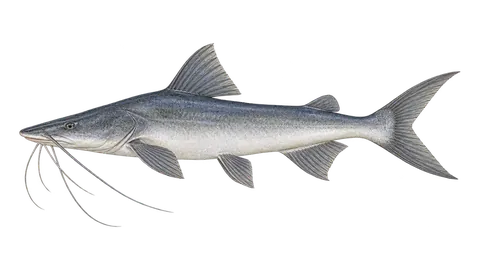
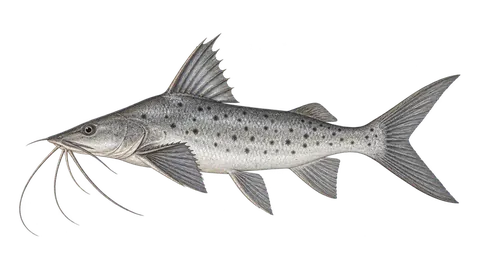
Scaleless, long, laterally compressed catfish that lives in mid-water and surface schools in rivers, lakes and reservoirs. It filters zooplankton with long, fine gill rakers, so it does not chase bait. It rises to the surface at night, when it is caught with nets. It is the base of artisanal fishing in the Tucuruí reservoir and the lower Tocantins (Cametá), and an important export resource of Amazonas. There are three mapará species in the genus; Hypophthalmus marginatus is the most studied in fishing.
fun facts
Eyes so low on the head that the fish seems to look sideways and downward at the same time.
Marginatus refers to the dark edge of the tail.
how to recognize it
identification
Elongated, compressed, silver body, scaleless. Eyes low on the side of the head, almost at mouth level. Wide mouth, no visible teeth, with long, flat barbels. Very long anal fin and small dorsal fin. Forked tail with a dark edge.
how porthole catfish fishing looks
Loading the next 7 days…
Each card shows the day's index (0 to 100) and, below it, a strip with the index for each hour, from 0h to 23h. from poor to excellent.
Whitewater rivers, várzea lakes and large reservoirs of the Amazon and Tocantins-Araguaia; heavily fished at Tucuruí (PA) and the lower Tocantins.
Habitat: Mid-water and surface of lakes, reservoirs and whitewater river channels.
native to the basins
AmazonTocantins-Araguaia
states
Amazonas, Pará, Amapá, Tocantins, Mato Grosso
calendar and clock
when to fish
best season
time of yearbest: Jul–Oct
JanFebSeaAprMayJunJulAugSepOctNovDec
Most fished in falling water and the dry season. From Nov 15 to Mar 15 there is a closed season in Amazonas, Acre, Pará and Amapá.
best time of day
Nighttime. Rises to the surface at night after zooplankton; deeper by day.
weather, water and behavior
what affects the porthole catfish
sensitivity The little bars show how much each factor affects this species. Five full: it feels it a lot.
cold and cold fronts
Cold snaps reduce activity.
atmospheric pressure
Little known effect.
moon
Anglers report more catches on dark nights, when the school rises.
rain
Little effect.
water level
Falling water concentrates the school.
noise
Not very sensitive.
wind
Strong wind makes surface net fishing difficult.
depth
Surface at night; down to 10 m by day.
technique, gear and bait
how to fish
rod
not applicable: mapará filters plankton and does not take a hook
spinning / baitcasting reel
not applicable
line
not applicable
leader
not applicable
hook
not applicable
tip from an angler
A net fish of professional fishing. For amateur anglers it works as an indicator: where mapará is, peacock bass and pescada are hunting.
what the law says
rules for the porthole catfish
Summary of the regulations we found, with the source for each. Rules change; before keeping or transporting fish, check with the state environmental agency. Conservation: Not on the national list (Portaria GM/MMA 1.667/2026).
Amazonian closed season (AM, AC, PA, AP)
catch, transport and sale prohibited (commercial fishing)15/11 to 15/03AMACPAAPAmazon
In AM, AC, PA and AP the mapará (Hypophthalmus spp.) is in Annex II of the ordinance, with fishing prohibited from Nov 15 to Mar 15. Under art. 2 of the ordinance, anglers fishing with a handline or pole, line and hook are exempt from this ban, unless a stricter state rule applies; during the period the angler's limit is 5 kg + 1 fish.
In Tocantins the mapará may only be kept between 25 and 55 cm. The rule identifies the mapará as Hypophthalmus edentatus, a species of the same genus; in practice enforcement officers use the common name. In TO anglers may not transport fish until Feb 28, 2029, except 1 native fish; they may consume up to 3 kg on site (Naturatins Ordinance 44/2026).
piracema closures in the basins where the species lives
Closed season in Goiás (state rule)
01/11 to 28/02GO
Allowed: Sport and guided fishing only in reservoirs, catch and release with barbless hooks (no keeping, transporting or eating). Subsistence: up to 5 kg per day, for household consumption only.
Spawning closure (piracema) in Mato Grosso (all basins)
01/10 to 31/01MT
Allowed: All fishing modalities are prohibited in rivers, including catch and release (Law 9.096/2009, art. 19-A). Exceptions: subsistence fishing from shore (3 kg or 1 fish, no transport or sale) and scientific fishing. Law 13.159/2025 now allows licensed sport fishing in UHE/PCH hydropower reservoirs, natural lakes and border rivers, subject to a scientific study and a license from the environmental agency. We have not confirmed whether these licenses are already being issued.
Spawning closure (piracema) in the Araguaia River basin
01/11 to 28/02GOTOPAMT
Allowed: Recreational fishing only in reservoirs, with handline, rod, or spinning or baitcasting reel. Fish may only be eaten on site, not transported. Competitions prohibited. Subsistence: 3 kg + 1 fish. State rules (GO and TO) may be stricter.
Spawning closure (piracema) in Tocantins (state rule)
01/11 to 28/02TO
Allowed: In 2025/26: catch and release with barbless hooks and recreational fishing card; subsistence fishing on foot or from a rowboat, with simple pole or handline.
Allowed: Recreational anglers with handline or rod, line and hook are outside the Annex II prohibitions, with a bag limit of 5 kg + 1 fish, unless a stricter state rule applies.
catch and release Releasing the fish alive, quickly and with a wet hand. During a closed season it isn't always allowed: what the regulation says applies.
Not applicable to hook fishing.
in the kitchen
Fatty, tender meat, highly prized in Pará: grilled over coals, fried or moqueado (cooked over embers); also salted and smoked.
calculator
how much it weighs without taking it out of the water
Length-weight relationship W = a·Lb (a = 0.0049, b = 3.09; FishBase). It's an average: a fat or lean fish can vary by 10% to 20%.
estimated weight
—
sources and references
The season weights (months), the time of day and the sensitivities (cold, pressure, moon, wind, rain, tide, strong light, murky water and noise) are the app's editorial estimates, based on the literature below and on the field experience of anglers and guides. They are not official data nor a measurement made for this species, and they may vary by region and year. Closed seasons and legal rules appear in the rules section, with the norm and a link.