

- common size
- 30–45 cm
- maximum
- 56 cm
- common weight
- 0.2–0.4 kg
- record/max.
- 0.6 kg
- depth
- 0.5–10 m
- ideal water
- 26–31 °C

the right time
to be on the water
Choose the place and the species. The index, from 0 to 100, combines weather, sun, moon and tide with each fish's habits. Up to 28 days, with each day's confidence.
Loading the forecast…
—
Looking for alerts within 30 km…
Looking for what anglers have logged near here…
what you need to fish herelicense, certification and boat documents
fish likely at this spot
Tap a fish to see its forecast.
hour by hour
slide your finger or mouse over the chart to see each hoursee hour-by-hour table
why this index at —?
choose the day
the fishing month at a glance
what's the best window for the crew?
Choose how many fishing days. We compare each stretch by its average index, discount days with a warning or closed season, and show the 3 best.
trend for the coming weeks
Line: the middle value of 31 simulations of the American GEFS model. Band: where 8 out of 10 fall. Narrow, firm trend; wide, high uncertainty.
everything about the porthole catfish
how to recognize it
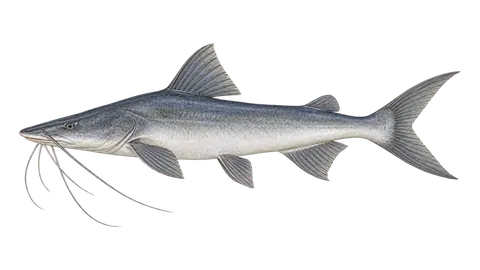
Elongated, compressed, silver body, scaleless. Eyes low on the side of the head, almost at mouth level. Wide mouth, no visible teeth, with long, flat barbels. Very long anal fin and small dorsal fin. Forked tail with a dark edge.
Also called: mapará, mampará
don't confuse with:
where found
open on the large mapWhere to look: Mid-water and surface of lakes, reservoirs and whitewater river channels.
Whitewater rivers, várzea lakes and large reservoirs of the Amazon and Tocantins-Araguaia; heavily fished at Tucuruí (PA) and the lower Tocantins.
native to the basins
states
Amazonas, Pará, Amapá, Tocantins, Mato Grosso
when to fish
best season
Most fished in falling water and the dry season. From Nov 15 to Mar 15 there is a closed season in Amazonas, Acre, Pará and Amapá.
best time of day
Nighttime. Rises to the surface at night after zooplankton; deeper by day.
what affects the porthole catfish
cold and cold fronts
Cold snaps reduce activity.
atmospheric pressure
Little known effect.
moon
Anglers report more catches on dark nights, when the school rises.
rain
Little effect.
water level
Falling water concentrates the school.
noise
Not very sensitive.
wind
Strong wind makes surface net fishing difficult.
depth
Surface at night; down to 10 m by day.
how to fish
tip from an angler
A net fish of professional fishing. For amateur anglers it works as an indicator: where mapará is, peacock bass and pescada are hunting.
- rod
- not applicable: mapará filters plankton and does not take a hook
- spinning / baitcasting reel
- not applicable
- line
- not applicable
- leader
- not applicable
- hook
- not applicable
catch and release
Not applicable to hook fishing.
rules for the porthole catfish
Rules change; before keeping or transporting fish, check with the state environmental agency.
Amazonian closed season (AM, AC, PA, AP)
catch, transport and sale prohibited (commercial fishing)15/11 to 15/03AMACPAAP details
In AM, AC, PA and AP the mapará (Hypophthalmus spp.) is in Annex II of the ordinance, with fishing prohibited from Nov 15 to Mar 15. Under art. 2 of the ordinance, anglers fishing with a handline or pole, line and hook are exempt from this ban, unless a stricter state rule applies; during the period the angler's limit is 5 kg + 1 fish.
TO: between 25 and 55 cm
25 cmTO details
In Tocantins the mapará may only be kept between 25 and 55 cm. The rule identifies the mapará as Hypophthalmus edentatus, a species of the same genus; in practice enforcement officers use the common name. In TO anglers may not transport fish until Feb 28, 2029, except 1 native fish; they may consume up to 3 kg on site (Naturatins Ordinance 44/2026).
Source: Portaria Naturatins nº 47/2026, Annex I, as amended by Portaria nº 105/2026
TO: maximum 55 cm
55 cmTO details
Above 55 cm the mapará must be returned to the water in Tocantins.
Source: Portaria Naturatins nº 47/2026, Annex I, as amended by Portaria nº 105/2026
piracema and closed seasons
Each bar is the period when fishing is prohibited or restricted. The green line is today. Tap the name to see what is still allowed.
Closed season in Goiás (state rule)
Allowed: Sport and guided fishing only in reservoirs, catch and release with barbless hooks (no keeping, transporting or eating). Subsistence: up to 5 kg per day, for household consumption only.
Spawning closure (piracema) in Mato Grosso (all basins)
Allowed: All fishing modalities are prohibited in rivers, including catch and release (Law 9.096/2009, art. 19-A). Exceptions: subsistence fishing from shore (3 kg or 1 fish, no transport or sale) and scientific fishing. Law 13.159/2025 now allows licensed sport fishing in UHE/PCH hydropower reservoirs, natural lakes and border rivers, subject to a scientific study and a license from the environmental agency. We have not confirmed whether these licenses are already being issued.
Spawning closure (piracema) in the Araguaia River basin
Allowed: Recreational fishing only in reservoirs, with handline, rod, or spinning or baitcasting reel. Fish may only be eaten on site, not transported. Competitions prohibited. Subsistence: 3 kg + 1 fish. State rules (GO and TO) may be stricter.
Spawning closure (piracema) in the Tocantins and Gurupi river basins
Allowed: Recreational fishing only in reservoirs, with on-site consumption. Subsistence: 5 kg + 1 fish. State rules may be stricter.
Spawning closure (piracema) in Tocantins (state rule)
Allowed: Recreational catch and release with barbless hooks and a recreational fishing card; subsistence fishing by riverside and artisanal fishers from the bank or a rowboat, with a cane pole, handline and hook, with no transport or sale.
Closed season in the Amazon basin in Amazonas
Allowed: Under Portaria 48/2007 (art. 2, II), the recreational angler who fishes with handline or rod, line and hook is outside the Annex II prohibitions, unless a stricter state rule applies. Recreational angler bag limit: 5 kg + 1 fish. Competitions prohibited.
Source: Portaria IBAMA nº 48/2007
Closed season in the Amazon basin in Acre
Allowed: Recreational anglers with handline or rod, line and hook are outside the Annex II prohibitions, with a bag limit of 5 kg + 1 fish, unless a stricter state rule applies. On the Acre River, no fishing of any species during the period.
Source: Portaria IBAMA nº 48/2007; IN IBAMA nº 205/2008 (Acre River)
Closed season in the Acre river
Allowed: IN Ibama 205/2008 prohibits fishing in the Acre river and its tributaries during the closed season, with no exception for recreational anglers: treat it as prohibited.
Source: IN IBAMA nº 205/2008
Closed season in the Amazon basin in Pará
Allowed: Recreational anglers with handline or rod, line and hook are outside the Annex II prohibitions, with a bag limit of 5 kg + 1 fish, unless a stricter state rule applies.
Source: Portaria IBAMA nº 48/2007
Closed season in the rivers of Marajó Island (PA)
Allowed: The same recreational-angler exceptions as in Portaria 48/2007 apply (handline or rod, 5 kg + 1 fish), unless a stricter state rule applies.
Source: Portaria IBAMA nº 48/2007
Amazon basin closed season in Rondônia
Allowed: In the Madeira, Mamoré, Jamari, Abunã, Machado and Roosevelt river basins and in the main channel of the Guaporé, licensed recreational anglers may fish only for non-protected species, using a single simple gear per person (handline, rod with or without a reel, or a simple pole with a single hook). The limit is up to 5 kg or 1 fish per week; if the fish is over 5 kg, you keep only that one. You may not sell, trade or give away the catch. Catch and release is allowed only with non-protected species. Fishing is always banned within 200 m of dams, rapids, waterfalls, fish ladders and river mouths.
Closed season in the Amazon basin in Amapá
Allowed: Recreational anglers with handline or rod, line and hook are outside the Annex II prohibitions, with a bag limit of 5 kg + 1 fish, unless a stricter state rule applies.
Source: Portaria IBAMA nº 48/2007
Closed season in Roraima
Border rivers MT/RO and MT/PA
Allowed: See the exceptions in Portaria 48/2007 and the state rules for each bank.
Source: Portaria IBAMA nº 48/2007
Conservation: Not on the national list (Portaria GM/MMA 1.667/2026).
how much it weighs without taking it out of the water
estimated weight
—
how we calculate
Length-weight relationship W = a·Lb (a = 0.0049, b = 3.09; FishBase). It's an average: a fat or lean fish can vary by 10% to 20%.
more about the porthole catfish
Scaleless, long, laterally compressed catfish that lives in mid-water and surface schools in rivers, lakes and reservoirs. It filters zooplankton with long, fine gill rakers, so it does not chase bait. It rises to the surface at night, when it is caught with nets. It is the base of artisanal fishing in the Tucuruí reservoir and the lower Tocantins (Cametá), and an important export resource of Amazonas. There are three mapará species in the genus; Hypophthalmus marginatus is the most studied in fishing.
Family: Pimelodidae · forage fish
fun facts
- Eyes so low on the head that the fish seems to look sideways and downward at the same time.
- Marginatus refers to the dark edge of the tail.
in the kitchen
Fatty, tender meat, highly prized in Pará: grilled over coals, fried or moqueado (cooked over embers); also salted and smoked.
similar species
sources and references (8)
The season weights (months), the time of day and the sensitivities (cold, pressure, moon, wind, rain, tide, strong light, murky water and noise) are the app's editorial estimates, based on the literature below and on the field experience of anglers and guides. They are not official data nor a measurement made for this species, and they may vary by region and year. Closed seasons and legal rules appear in the rules section, with the norm and a link.
- scientific FishBase — Hypophthalmus marginatus (ficha da espécie)Names, distribution, biology, length-weight relationship and references. Page checked on October 13, 2026.
- official Portaria GM/MMA nº 1.667, de 27 de abril de 2026 — Lista Nacional Oficial de Espécies da Fauna Ameaçadas de Extinção (peixes e invertebrados aquáticos)Most recent national list. The species is not on it (search by scientific name in the text published in the DOU, checked on October 13, 2026).
- official ICMBio/SALVE — Ficha de Hypophthalmus marginatus (avaliação nacional do risco de extinção)ICMBio national assessment, published in 2025. DOI checked on Crossref.
- scientific IUCN Red List — Hypophthalmus marginatus (avaliação global: Pouco Preocupante, LC, 28/12/2020)Global assessment. Link given on the FishBase entry (Red List, version 2025-2).
- scientific Cintra, I. H. A.; Pinheiro, J. C. R.; Juras, A. A.; Souza, R. F. C.; Ogawa, M. (2008). Biologia do mapará, Hypophthalmus marginatus (Valenciennes, 1840), no reservatório da Usina Hidrelétrica de Tucuruí (Pará, Brasil). Boletim Técnico-Científico do CEPNOR 8(1): 83–95.DOI checked in Crossref.
- scientific Cutrim, L.; Batista, V. S. (2005). Determinação de idade e crescimento do mapará (Hypophthalmus marginatus) na Amazônia Central. Acta Amazonica 35(1): 85–92.Describes the mapará as an important export fishery resource of Amazonas. DOI and abstract checked in Crossref.
- scientific Lundberg, J. G.; Littmann, M. W. (2003). Pimelodidae (long-whiskered catfishes). In: Reis, R. E.; Kullander, S. O.; Ferraris Jr., C. J. (orgs.). Check List of the Freshwater Fishes of South and Central America. Porto Alegre: EDIPUCRS, p. 432–446.Printed book chapter; the URL is the bibliographic record on FishBase, which cites the chapter for the species.
- scientific Ferreira, E. J. G.; Zuanon, J. A. S.; Santos, G. M. (1998). Peixes comerciais do médio Amazonas: região de Santarém, Pará. Brasília: Ibama. 211 p.Printed work; the URL is the bibliographic record on FishBase, which cites this work for the species.
how we calculatewhere each number comes from
The weather comes from three independent global models, cross-checked hour by hour: when they agree, confidence goes up; when they diverge, the band between them shows on the chart. Beyond 16 days, we use the GEFS ensemble of 31 simulations: if 20 of the 31 predict rain, the chance of rain is 65%. Sun and moon are calculated astronomically, with no uncertainty.
The index adds up, weighted for each species: time of day (species curve anchored to real sunrise and sunset), moon (transits, rise and set, phase), pressure (3 h trend and 24 h swing), water temperature (in rivers, estimated from air temperature; at sea, estimated by an ocean model), wind, rain, clouds, tide and the month in the species' cycle.
sources for this lookup
how accurate the forecast is
Accuracy measured in the reference project (4 regions, 93 days, forecast vs. observed): maximum temperature is off by 0.6 °C on average the next day and 1.7 °C at 7 days; rain of 5 mm or more is detected 76% of the time the next day and 57% at 7 days. Detection isn't everything: the false alarm rate isn't published here yet, and 93 days in 4 regions is still a small sample. We now also measure every day, at the app's destinations: