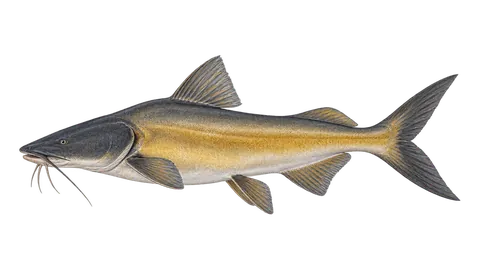
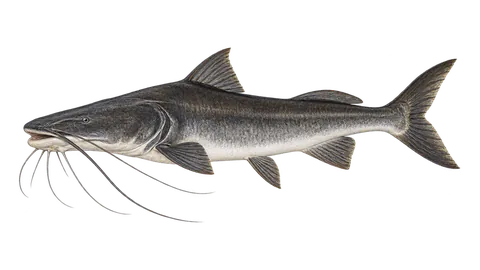
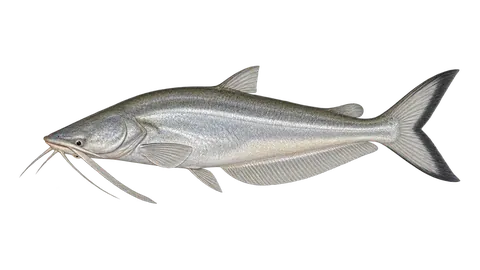
Leather catfish of the family of the dourada and piraíba. Juveniles and subadults live in the Amazon estuary and at the mouths of the big rivers, in muddy water over mud bottoms; adults swim upriver, and the species is cited among the freshwater catfish with the longest known migrations. It eats fish and crustaceans. It is the basis of an industrial trawl fishery in the estuary, with its own closed season, and of artisanal fishing with longlines and drift nets. On the line, it is caught with natural bait on the bottom, in channels with current and tide, and it fights hard.
fun facts
Mulher-ingrata is one of the common names FishBase records for the species.
The piramutaba is among the Amazonian catfish that use the estuary as a nursery and swim upriver as adults.
how to recognize it
identification
Elongated, scaleless body, blue-grey to silver on the back and pale on the belly. Flattened head, with long barbels (in juveniles they exceed the body length). Forked tail with pointed lobes. The dourada is golden and larger; the filhote (piraíba) has dark spots and grows much bigger.
how laulao catfish fishing looks
Loading the next 7 days…
Each card shows the day's index (0 to 100) and, below it, a strip with the index for each hour, from 0h to 23h. from poor to excellent.
Amazon estuary and Marajó Bay, mouth and channel of the great Amazon rivers, rivers of the northern coast and Maranhão. Adults swim up to the western Amazon.
Habitat: Estuarine channels and muddy-water river channels with mud bottoms; juveniles in the mixing zone of fresh and brackish water.
high-profile baitcasting reel or 5000 to 6000 spinning reel
line
braid 30 to 50 lb
leader
monofilament 50 to 80 lb, 1 m
hook
circle hook 5/0 to 8/0
natural baits
fish pieces (mapará, sardine)
shrimp
accessories
olive sinker or heavy pyramid sinker for the tide
alicate
tip from an angler
Sinker heavy enough to hold the bait on the bottom with the tide running; circle hook, and set the hook only by tensioning the line.
what the law says
rules for the laulao catfish
Summary of the regulations we found, with the source for each. Rules change; before keeping or transporting fish, check with the state environmental agency. Conservation: Not on the national list (Portaria GM/MMA 1.667/2026).
Trawling closed season (AP and PA): Sep 1 to Nov 30
trawl fishing prohibited01/09 to 30/11APPANorth Coast
Trawling for piramutaba is prohibited from the French Guiana border to the PA/MA boundary; authorized trawlers only set out from Dec 1. The rule also bans motorized trawling year-round within 10 miles of the coast in that area. The closed season applies only to trawling: line, longline and net fishing by other methods continue.
piracema closures in the basins where the species lives
Closed season in Goiás (state rule)
01/11 to 28/02GO
Allowed: Sport and guided fishing only in reservoirs, catch and release with barbless hooks (no keeping, transporting or eating). Subsistence: up to 5 kg per day, for household consumption only.
Spawning closure (piracema) in Mato Grosso (all basins)
01/10 to 31/01MT
Allowed: All fishing modalities are prohibited in rivers, including catch and release (Law 9.096/2009, art. 19-A). Exceptions: subsistence fishing from shore (3 kg or 1 fish, no transport or sale) and scientific fishing. Law 13.159/2025 now allows licensed sport fishing in UHE/PCH hydropower reservoirs, natural lakes and border rivers, subject to a scientific study and a license from the environmental agency. We have not confirmed whether these licenses are already being issued.
Spawning closure (piracema) in the Araguaia River basin
01/11 to 28/02GOTOPAMT
Allowed: Recreational fishing only in reservoirs, with handline, rod, or spinning or baitcasting reel. Fish may only be eaten on site, not transported. Competitions prohibited. Subsistence: 3 kg + 1 fish. State rules (GO and TO) may be stricter.
Spawning closure (piracema) in Tocantins (state rule)
01/11 to 28/02TO
Allowed: In 2025/26: catch and release with barbless hooks and recreational fishing card; subsistence fishing on foot or from a rowboat, with simple pole or handline.
Allowed: Recreational fishing from a boat or from shore with handline or rod, up to 5 kg or 1 fish. Transport only within the municipality. Competitions prohibited.
Allowed: Recreational anglers with handline or rod, line and hook are outside the Annex II prohibitions, with a bag limit of 5 kg + 1 fish, unless a stricter state rule applies.
catch and release Releasing the fish alive, quickly and with a wet hand. During a closed season it isn't always allowed: what the regulation says applies.
Use a circle hook, take the fish out of the water as little as possible, and hold it from underneath, watching out for the fin spines.
in the kitchen
White, firm and highly prized meat; sold as fillets and steaks; fried, baked or in caldeirada.
calculator
how much it weighs without taking it out of the water
Length-weight relationship W = a·Lb (a = 0.00501, b = 3.16; FishBase). It's an average: a fat or lean fish can vary by 10% to 20%.
estimated weight
—
sources and references
The season weights (months), the time of day and the sensitivities (cold, pressure, moon, wind, rain, tide, strong light, murky water and noise) are the app's editorial estimates, based on the literature below and on the field experience of anglers and guides. They are not official data nor a measurement made for this species, and they may vary by region and year. Closed seasons and legal rules appear in the rules section, with the norm and a link.