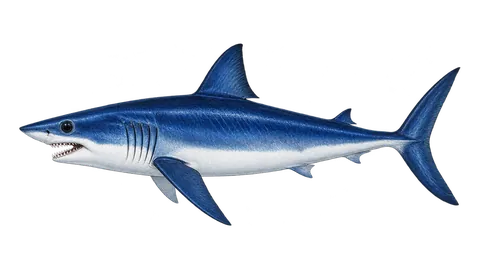
Cold-water shark, related to the mako and the white shark, with a white patch on the tip of the first dorsal fin. It is Vulnerable and grows slowly, and retaining it is banned in Uruguay: the right thing is to release it.
Also called: marracho, tubarão-golfinho, tubarão-sardo (nome usado em Portugal)
The porbeagle is a cold-water lamnid with an antitropical distribution: it lives in the North Atlantic and, in the southern hemisphere, in a band between about 30 and 60°S. In the southwestern Atlantic it occurs from southern Brazil (about 26°45'S) to Uruguay, Argentina and beyond. It is an open-sea and shelf fish, usually from the surface to 200 m, tolerating 2 to 23 °C and preferring 8 to 20 °C; like other lamnids, it keeps its body warmer than the water. In the region it migrates north in winter and south in summer. It eats pelagic and bottom fish, squid and, sometimes, other sharks. It is viviparous with oophagy: litters have 1 to 5 pups (usually 4), born at about 66 cm. It grows slowly and has low productivity; IUCN classifies it as Vulnerable, and CITES listed it in Appendix II in 2014. It is not on the Brazilian national list, but in Uruguay retaining the porbeagle is banned.
fun facts
Unlike other lamnids, there are no records of marine mammals or large fish in the porbeagle's stomach.
In the South Atlantic, the porbeagle appears mainly as bycatch on tuna and swordfish longlines (ICCAT).
FishBase gives a maximum age of 65 years in the southern hemisphere.
how to recognize it
identification
Robust, spindle-shaped shark with a moderately long conical snout, large dark eyes and very long gill slits. Blue-grey to dark grey above and white below; the free tip of the first dorsal fin has a characteristic white patch. Strong keel on the caudal peduncle and a smaller keel at the base of the tail; the second dorsal fin is tiny and sits over the anal fin. The teeth are small, smooth-edged, with small lateral cusps. The white shark is much larger and has serrated triangular teeth; the mako has a longer, sharper snout and no white patch on the dorsal fin.
how porbeagle fishing looks
Loading the next 7 days…
Each card shows the day's index (0 to 100) and, below it, a strip with the index for each hour, from 0h to 23h. from poor to excellent.
Antitropical: North Atlantic and a circumglobal band in the southern hemisphere, between about 30 and 60°S. In the southwestern Atlantic it occurs from southern Brazil (about 26°45'S), through Uruguay and Argentina, to South Georgia; in the Pacific it is recorded off Chile. In Brazil, the known northern limit is around 26°45'S, in the South.
Habitat: Open sea and shelf, from the surface to about 200 m, in cold water; comes close to shore only occasionally.
coast
South Coastshelfoceanic
calendar and clock
when to fish
best season
time of yearbest: Jun–Sep
JanFebSeaAprMayJunJulAugSepOctNovDec
Estimate based on migration observed in the southwestern Atlantic (north in winter, south in summer): near southern Brazil and Uruguay, the chance of encounter is higher from June to September. In Uruguay's longline fishery, catch per effort was higher with surface water at 11 to 12 °C.
best time of day
Any time. There is no time-of-day study for the southwestern Atlantic in the sources we checked.
weather, water and behavior
what affects the porbeagle
sensitivity The little bars show how much each factor affects this species. Five full: it feels it a lot.
cold and cold fronts
It is one of the sharks most tolerant of cold: catch drops when surface water temperature rises above about 19 °C.
atmospheric pressure
Little known effect.
moon
No study for the region.
rain
Little known effect.
water level
Not applicable at sea.
noise
No study; the effect is estimated as moderate.
wind
Rough seas make offshore boat fishing difficult.
tide
Little direct effect in open sea.
depth
From the surface to 200 m most of the time; records range from 1 m to 700 m.
50 to 80 lb monofilament, or 80 lb braided line with a monofilament leader
leader
1.5 to 2 m wire leader plus 3 to 5 m of 300 lb monofilament
hook
circle hook 12/0 to 16/0, barbless or with the barb flattened; a single hook
natural baits
whole sardine, mackerel or squid, drifting with chum
oily fish steak
accessories
cutting pliers for steel cable
long hook remover
luvas
fighting belt
tip from an angler
Fishing for release only: in Uruguay retaining it is banned, and the species grows slowly. Bring the porbeagle alongside the boat, don't bring it on board, and cut the line close to the hook if it is deep.
what the law says
rules for the porbeagle
Summary of the regulations we found, with the source for each. Rules change; before keeping or transporting fish, check with the state environmental agency. Conservation: Not on the Brazilian national list (Portaria GM/MMA nº 1.667/2026). Global assessment: Vulnerable (IUCN, Nov 6, 2018). Listed in CITES Appendix II (since 2014) and in CMS. The South Atlantic stock has little data: the 2020 ICCAT assessment could not conclude whether it is overfished. The finning ban applies.
Uruguay: retaining porbeagle banned (Lamna nasus)
retention on board, transshipment, landing, storage and sale prohibited; release aliveconfirm with the agency
Decree 67/013, of Feb 22, 2013 (published Mar 4, 2013), prohibits retaining on board, transshipping, landing, storing, selling or offering for sale any part or whole carcass of Lamna nasus (art. 1), and requires vessels to quickly release, without harm, live specimens caught by chance when they reach the side of the vessel (art. 2). The fine follows Law 13.833 (art. 3). The decree refers to vessels and does not mention sport fishing; in practice, anyone fishing in Uruguay should release the porbeagle.
Argentina: directed fishing for sharks and rays banned for the federal fleet; incidental sharks returned to the sea
directed fishing for chondrichthyans banned; return live sharks without gaff; finning bannedconfirm with the agency
Federal Fisheries Council Resolution 8/2021 (Consejo Federal Pesquero) bans directed fishing for chondrichthyans (sharks, rays and chimaeras), finning (cutting off the fins and discarding the body) and the use of gaffs to return live animals to the sea, and requires that sharks caught by chance be returned quickly and with minimal trauma, except cazón, gatuzo, pez ángel, espinoso and pintarroja. The text refers to trips and vessels, that is, the federal commercial fleet, and invites the provinces to adopt similar measures. For sport anglers, good practice is to release the shark in the water, without a gaff.
Chile: finning of sharks banned on board and at landing
landing with fins fully or partially attached to the body
Law 20.525 (2011) added art. 5 bis to the General Law on Fisheries and Aquaculture: it is forbidden to cut the fins of any shark on board fishing vessels or during transshipment, and landing must be done with the fins fully or partially attached to the body. A loose fin without the corresponding trunk on board is presumed to be an offense. The fine for the vessel owner ranges from 50 to 500 UTM. We did not verify a specific Chilean rule on shark retention in marine recreational fishing.
Finning prohibited: shark only whole, with its fins
fins naturally attached to the body
In Brazil, finning is prohibited (cutting off the fins and discarding the body). Every shark or ray landed must arrive with its fins attached to the body; it is prohibited to carry on board an animal without fins or with loose fins, and to transfer sharks between vessels. It applies to any shark that may be kept.
catch and release Releasing the fish alive, quickly and with a wet hand. During a closed season it isn't always allowed: what the regulation says applies.
Don't bring it aboard: lifting it out of the water stresses the animal and is dangerous for the angler. Fight it firmly and briefly, release it alongside the boat with the shark in the water, and cut the line close to the mouth. A preliminary estimate in the western North Atlantic recorded 100% survival of young sharks released after rod-and-reel fishing (Anderson et al. 2021, cited by ICCAT).
in the kitchen
It is not a fish to kill. In South Atlantic longline fishing it is often kept for sale, but retention is banned in Uruguay and the species is vulnerable. Release it.
calculator
how much it weighs without taking it out of the water
Length-weight relationship W = a·Lb (a = 0.01047, b = 3.03; FishBase (relação peso-comprimento bayesiana, estimativa da própria espécie)). It's an average: a fat or lean fish can vary by 10% to 20%.
estimated weight
—
sources and references
The season factors (months), the time of day, and the sensitivities (cold, pressure, moon, wind, rain, tide, strong light, murky water, and noise) are editorial estimates by the app, based on the literature cited below and on field experience of anglers and guides. They are not official data or measurements made for this species and may vary by region and year. Closed seasons and legal rules appear in the rules section, with the standard and link. The months indicate when the species is usually found near the coast or at the fishing spot, not a catch season. The water temperature range is also an editorial estimate, supported by FishBase values where they exist.