MS: minimum size for mussum
20 cmMSParaguay (Pantanal)Paraná
In MS, mussum caught as bait in the wild must be at least 20 cm.
Synbranchus marmoratus
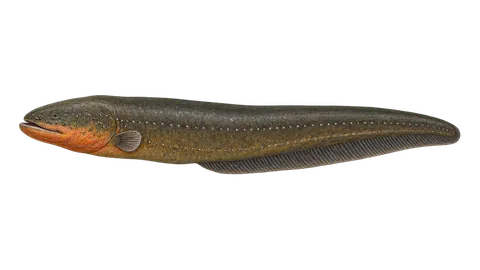
Snake-shaped fish with no visible fins, which breathes air and spends the dry season buried in mud. A hardy live bait, used for large catfish.
Also called: mussum, muçum, peixe-cobra, enguia-d'água-doce

Round, smooth-bodied fish, resembling a snake or eel, but not closely related to them. Lives in swamps, ditches, rice fields, lagoons and river edges, in clear or murky water, and is active at night, eating fish, shrimp, worms and insects. Breathes air when needed and, when water drops, digs tunnels into mud or banks and waits for the flood, still active; that is why it disappears from fish surveys in many places. It is hermaphroditic: born female, and some fish later become male; the male guards eggs in a nest or burrow. As bait, it stays alive on the hook for a long time, which makes it popular for catfish fishing. It ranges from Mexico to northern Argentina.
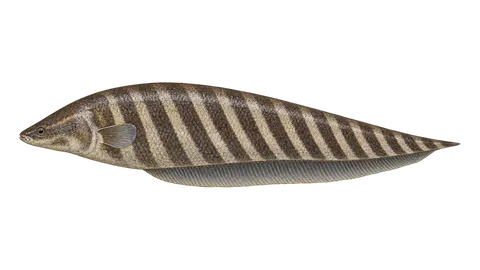
Cylindrical, very long body, smooth and slippery, with no pectoral or pelvic fins; dorsal and anal fins reduced to a skin fold near the tail. A single gill opening, a slit under the throat. Small eyes. Olive-brown to yellowish, with dark marbled spots. The tuvira is flattened on the sides and has a long anal fin; the poraquê is much bigger and also has a long anal fin.
Loading the next 7 days…
Each card shows the day's index (0 to 100) and, below it, a strip with the index for each hour, from 0h to 23h. from poor to excellent.
From Mexico to northern Argentina, including Cuba and Trinidad. In Brazil, in swamps, várzeas and rivers of nearly all basins; it also tolerates brackish water.
Habitat: Swamps, ditches, rice paddies, bays and river edges with mud and vegetation; in the dry season, buried in tunnels.
native to the basins
states
Amazonas, Pará, Mato Grosso, Mato Grosso do Sul, Goiás, Minas Gerais, São Paulo, Paraná, Santa Catarina, Rio Grande do Sul, Bahia, Pernambuco, Ceará, Maranhão, Tocantins
Found all year; in severe drought it stays buried and disappears from view.
Nighttime. Active at night; by day it stays in its burrow or in the mud.
Cold reduces activity.
Little effect.
Little known effect.
Rain that fills the swamps brings it out of its burrow.
In the dry season it digs tunnels in the mud and waits for the flood.
Not very sensitive.
Little effect.
Shallow, on the muddy bottom and along the bank.
natural baits
accessories
As bait, pass the hook through the mouth or the skin of the back, without piercing the body: it lasts for hours alive.
Summary of the regulations we found, with the source for each. Rules change; before keeping or transporting fish, check with the state environmental agency.
Conservation: Not on the national list of threatened species (Portaria GM/MMA nº 1.667/2026).
In MS, mussum caught as bait in the wild must be at least 20 cm.
In MS, catching mussum as live bait for sale may only be done by licensed professional fishers, with an Imasul permit and transport slip. Amateur anglers and riverside residents may not use cast nets or mesh gear to catch bait. Catching is banned within 200 m of waterfalls, rapids, springs and confluences, and within 1,000 m of dams and nesting colonies. During the spawning closure, commercial bait catch reopens only from February 20.
Allowed: Recreational fishing only for non-native species and hybrids (peacock bass, tilapia, black bass, carp, croaker, etc.; piauçu remains prohibited), with handline, simple pole, or rod with spinning or baitcasting reel, up to 10 kg + 1 fish. In rivers, from shore only; in reservoirs, from a boat or from shore. Prohibited: floodplain lakes, aquatic-animal bait, within 1,500 m of dams and waterfalls, and within 500 m of confluences. Tournaments only in reservoirs and only with non-native species.
Source: IN IBAMA nº 25/2009
Allowed: Only exotic or hybrid species, 3 kg + 1 fish per day, with handline, rod, simple pole, or spinning or baitcasting reel. Nets prohibited. Keep the minimum distances from dams and reservoirs.
Source: Portarias IEF nº 154/2011 (São Francisco), 155/2011 (East) and 156/2011 (Grande/Paranaíba)
Allowed: Sport and guided fishing only in reservoirs, catch and release with barbless hooks (no keeping, transporting or eating). Subsistence: up to 5 kg per day, for household consumption only.
Allowed: Subsistence fishing by riverside residents and authorized scientific fishing. Decree 15.166/2019 (art. 11, §5) allows catch and release only in February and only in the channels of the Paraguay and Paraná rivers. For the rest of the period, not even catch and release is allowed. Check the Imasul portaria for each season.
Source: Decreto estadual MS nº 15.166/2019, art. 11; IN IBAMA nº 201/2008
Allowed: All fishing modalities are prohibited in rivers, including catch and release (Law 9.096/2009, art. 19-A). Exceptions: subsistence fishing from shore (3 kg or 1 fish, no transport or sale) and scientific fishing. Law 13.159/2025 now allows licensed sport fishing in UHE/PCH hydropower reservoirs, natural lakes and border rivers, subject to a scientific study and a license from the environmental agency. We have not confirmed whether these licenses are already being issued.
Allowed: Recreational fishing only in reservoirs, with handline, rod, or spinning or baitcasting reel. Fish may only be eaten on site, not transported. Competitions prohibited. Subsistence: 3 kg + 1 fish. State rules (GO and TO) may be stricter.
Allowed: Recreational fishing only in reservoirs, with on-site consumption. Subsistence: 5 kg + 1 fish. State rules may be stricter.
Allowed: In 2025/26: catch and release with barbless hooks and recreational fishing card; subsistence fishing on foot or from a rowboat, with simple pole or handline.
Source: Portaria Naturatins nº 244/2025 (2025/26 season); INIs MPA/MMA nº 12 and 13/2011
Allowed: Recreational fishing from a boat or from shore with handline, rod, spinning or baitcasting reel, up to 5 kg + 1 fish. Prohibited within 1,000 m of dams, waterfalls and rapids, and within 500 m of confluences. Floodplain lakes have a longer closed season (see next item).
Source: Portaria IBAMA nº 50/2007
Allowed: No fishing in the floodplain lakes during the period.
Source: Portaria IBAMA nº 50/2007
Allowed: Recreational fishing from shore, or from a boat without motor. Only handline or rod, line and hook, one gear per angler, up to 5 kg. Prohibited in floodplain lakes, within 1,500 m of dams, within 500 m of confluences, and in stretches listed in the rule (e.g., Turvo River).
Source: IN IBAMA nº 193/2008
Allowed: Recreational fishing from a boat or from shore, with a single hook, one gear per angler, up to 5 kg.
Source: IN IBAMA nº 197/2008
Allowed: In rivers, shore fishing only; in reservoirs, from a boat or from shore. Only non-native species, hybrids, and giant river prawn (camarão-gigante-da-malásia), up to 10 kg + 1 fish. Prohibited in floodplain lakes and within 1,000 m of dams.
Source: IN IBAMA nº 195/2008
Allowed: Same rules as the Southeast basins: only non-native species and hybrids, up to 10 kg + 1 fish; in rivers, shore fishing only.
Source: IN IBAMA nº 196/2008
Allowed: Recreational fishing from a boat or from shore with handline, rod, spinning or baitcasting reel, up to 5 kg + 1 fish per day. Prohibited within 1,500 m of dams, waterfalls and rapids. Competitions prohibited.
Source: IN MMA nº 40/2005
Allowed: Recreational fishing from a boat or from shore with handline or rod, up to 5 kg or 1 fish. Transport only within the municipality. Competitions prohibited.
Source: Portaria IBAMA nº 85/2003
Allowed: Recreational fishing with handline or rod is outside the prohibition.
Source: Portaria IBAMA nº 04/2008
Allowed: The same recreational-angler exceptions as in Portaria 48/2007 apply (handline or rod, 5 kg + 1 fish), unless a stricter state rule applies.
Source: Portaria IBAMA nº 48/2007
Allowed: Recreational anglers with handline or rod, line and hook are outside the Annex II prohibitions, with a bag limit of 5 kg + 1 fish, unless a stricter state rule applies.
Source: Portaria IBAMA nº 48/2007
Allowed: Subsistence fishing only.
Source: Portaria IBAMA nº 48/2007
Allowed: See the exceptions in Portaria 48/2007 and the state rules for each bank.
Source: Portaria IBAMA nº 48/2007
Leftover bait must go back to the same swamp or river it came from.
Rarely eaten; its main use is as bait.
Length-weight relationship W = a·Lb (a = 0.00091, b = 3.08; FishBase). It's an average: a fat or lean fish can vary by 10% to 20%.
estimated weight
—
The season weights (months), the time of day and the sensitivities (cold, pressure, moon, wind, rain, tide, strong light, murky water and noise) are the app's editorial estimates, based on the literature below and on the field experience of anglers and guides. They are not official data nor a measurement made for this species, and they may vary by region and year. Closed seasons and legal rules appear in the rules section, with the norm and a link.
Your location is saved only on this device and feeds the forecast, the map and the "today" on the home page.