

banded knifefish
Gymnotus carapo
The most used live bait in the Pantanal for surubim (pintado), cachara and dorado. A striped knifefish that breathes air and lives among water hyacinth.
- common size
- 15–35 cm
- maximum
- 76 cm
- common weight
- 0.0–0.3 kg
- record/max.
- 1.2 kg
- depth
- 0.1–2 m
- ideal water
- 22–28 °C
how to recognize it
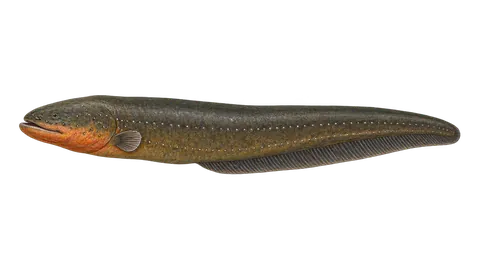
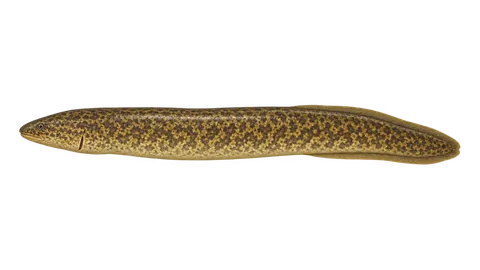
Long body flattened on the sides, like a blade, with no dorsal or pelvic fins and no caudal fin: a long anal fin runs along the underside and makes the fish move forward and backward. Brown to grey, with alternating pale and dark oblique bands. Small mouth and eyes. The poraquê is much bigger, round-bodied and unbanded; the mussum is round-bodied and lacks the long anal fin.
Also called: tuvira, sarapó, morenita, carapó, ituí, tuí
don't confuse with:
where found
open on the large mapWhere to look: Baías, corixos, swamps, lagoons and river edges with water hyacinth and flooded grass; murky, still water.
From southern Mexico to Paraguay and Uruguay, including Trinidad, considering the carapo complex. In Brazil there are tuviras in almost every basin; in the upper Paraná (Paranaíba, in GO), Pantanal species taken as bait are already treated as non-native.
native to the basins
states
Amazonas, Pará, Mato Grosso, Mato Grosso do Sul, Goiás, Minas Gerais, São Paulo, Paraná, Santa Catarina, Rio Grande do Sul, Bahia, Maranhão, Piauí, Tocantins, Rondônia
when to fish
next 7 days
Loading the next 7 days…
best season
Found all year. In MS, commercial catch by bait fishers closes during the spawning closure and reopens from February 20.
best time of day
Nighttime. Active at night; by day it hides among water hyacinth roots.
what affects the banded knifefish
cold and cold fronts
Cold reduces activity.
atmospheric pressure
Little effect.
moon
Little known effect.
rain
Little effect.
water level
In the dry season it stays in pools and baías, easier to find; in high water it spreads across the flooded fields.
noise
Not very sensitive.
wind
Little effect.
depth
Shallow, among the roots of floating vegetation.
how to fish
natural baits
- minhoca
- piece of shrimp
tip from an angler
As bait, pass the hook through the mouth or across the rear of the body, without hitting the spine: the tuvira stays alive and moves a lot. Use only tuvira from the same basin where you plan to fish.
- rod
- bamboo cane or telescopic rod, 2 to 3 m
- spinning / baitcasting reel
- optional
- line
- monofilament 0.20 to 0.25 mm
- leader
- optional
- hook
- #10 to 14
accessories
- bucket with water hyacinth and changed water to keep the baits alive
catch and release
Leftover bait must go back to the same place it came from, never to another basin.
rules for the banded knifefish
Rules change; before keeping or transporting fish, check with the state environmental agency.
MS: minimum size for tuvira
17 cmMS details
In MS, tuvira caught as bait in the wild must be at least 17 cm. The resolution lists tuvira as Gymnotus inaequilabiatus and G. paraguaiensis; in the field they cannot be told apart from G. carapo.
Source: Resolução SEMAC-MS nº 3/2011, art. 2º, § 1º, a (as amended by Resolução SEMAC nº 22/2011)
MS: commercial bait catch only by professionals
licensed professional fisher; amateur without cast net or netMS details
In MS, catching tuvira as live bait for sale may only be done by licensed professional fishers, with an Imasul permit and transport slip. Amateur anglers and riverside residents may not use cast nets or mesh gear to catch bait. Catching is banned within 200 m of waterfalls, rapids, springs and confluences, and within 1,000 m of dams and nesting colonies. During the spawning closure, commercial bait catch reopens only from February 20.
MG: minimum size for sarapó/tuvira
30 cmMG details
The IEF-MG minimum size table sets 30 cm for sarapó or tuvira (Gymnotus carapo).
PR: minimum size for morenita
20 cmPR details
In Paraná, morenita (Gymnotus sylvius and G. inaequilabiatus) caught in the wild, including as bait, must be at least 20 cm. Bait from a licensed hatchery, with an invoice, is exempt from the size limit.
GO and PR: using live bait from another basin is banned
live bait only from species native to the basinGOPR details
In Goiás, using a non-native or exotic species from another basin as live bait is treated as release or introduction of fauna and is banned; the rule already lists Pantanal tuviras as non-native in the Paranaíba. In Paraná, it is prohibited to use live non-native organisms from the area covered by the ordinance as bait.
piracema and closed seasons
Each bar is the period when fishing is prohibited or restricted. The green line is today. Tap the name to see what is still allowed.
Spawning closure (piracema) in the Paraná River basin
Allowed: Recreational fishing only for non-native species and hybrids (peacock bass, tilapia, black bass, carp, croaker, etc.; piauçu remains prohibited), with handline, simple pole, or rod with spinning or baitcasting reel, up to 10 kg + 1 fish. In rivers, from shore only; in reservoirs, from a boat or from shore. Prohibited: floodplain lakes, aquatic-animal bait, within 1,500 m of dams and waterfalls, and within 500 m of confluences. Tournaments only in reservoirs and only with non-native species.
Source: IN IBAMA nº 25/2009
Spawning closure (piracema) in Minas Gerais (state rule)
Allowed: Only exotic or hybrid species, 3 kg plus one fish per day or outing, with handline, rod or pole with spinning or baitcasting reel (at most 5 per angler). Nets prohibited. Respect the minimum distances from dams, waterfalls and rapids and the marginal lagoons.
Source: Portarias IEF nº 154/2011 (São Francisco), 155/2011 (East) and 156/2011 (Grande/Paranaíba)
Closed season in Goiás (state rule)
Allowed: Sport and guided fishing only in reservoirs, catch and release with barbless hooks (no keeping, transporting or eating). Subsistence: up to 5 kg per day, for household consumption only.
Spawning closure (piracema) in the Pantanal of Mato Grosso do Sul
Allowed: Subsistence by riverside and artisanal fishers: on land or in a rowboat, with a pole, handline and hook, up to 3 kg or 1 fish per day, with no sale or transport.
Spawning closure (piracema) in Mato Grosso (all basins)
Allowed: All fishing modalities are prohibited in rivers, including catch and release (Law 9.096/2009, art. 19-A). Exceptions: subsistence fishing from shore (3 kg or 1 fish, no transport or sale) and scientific fishing. Law 13.159/2025 now allows licensed sport fishing in UHE/PCH hydropower reservoirs, natural lakes and border rivers, subject to a scientific study and a license from the environmental agency. We have not confirmed whether these licenses are already being issued.
Spawning closure (piracema) in the Araguaia River basin
Allowed: Recreational fishing only in reservoirs, with handline, rod, or spinning or baitcasting reel. Fish may only be eaten on site, not transported. Competitions prohibited. Subsistence: 3 kg + 1 fish. State rules (GO and TO) may be stricter.
Spawning closure (piracema) in the Tocantins and Gurupi river basins
Allowed: Recreational fishing only in reservoirs, with on-site consumption. Subsistence: 5 kg + 1 fish. State rules may be stricter.
Spawning closure (piracema) in Tocantins (state rule)
Allowed: Recreational catch and release with barbless hooks and a recreational fishing card; subsistence fishing by riverside and artisanal fishers from the bank or a rowboat, with a cane pole, handline and hook, with no transport or sale.
Spawning closure (piracema) in the São Francisco River basin (rivers and reservoirs)
Allowed: Recreational fishing from a boat or from shore with handline, rod, spinning or baitcasting reel, up to 5 kg + 1 fish. Prohibited within 1,000 m of dams, waterfalls and rapids, and within 500 m of confluences. Floodplain lakes have a longer closed season (see next item).
Source: Portaria IBAMA nº 50/2007
São Francisco: floodplain lakes
Allowed: No fishing in the floodplain lakes during the period.
Source: Portaria IBAMA nº 50/2007
Spawning closure (piracema) in the Uruguay River basin
Allowed: Recreational fishing from shore, or from a boat without motor. Only handline or rod, line and hook, one gear per angler, up to 5 kg. Prohibited in floodplain lakes, within 1,500 m of dams, within 500 m of confluences, and in stretches listed in the rule (e.g., Turvo River).
Source: IN IBAMA nº 193/2008
Spawning closure (piracema) in the southern basins (RS and SC, outside the Uruguay)
Allowed: Recreational fishing from a boat or from shore, with a single hook, one gear per angler, up to 5 kg.
Source: IN IBAMA nº 197/2008
Spawning closure (piracema) in the Southeast basins
Allowed: In rivers, shore fishing only; in reservoirs, from a boat or from shore. Only non-native species, hybrids, and giant river prawn (camarão-gigante-da-malásia), up to 10 kg + 1 fish. Prohibited in floodplain lakes and within 1,000 m of dams.
Source: IN IBAMA nº 195/2008
Spawning closure (piracema) in the East basins
Allowed: Same rules as the Southeast basins: only non-native species and hybrids, up to 10 kg + 1 fish; in rivers, shore fishing only.
Source: IN IBAMA nº 196/2008
Spawning closure (piracema) in the Parnaíba River basin
Allowed: Recreational fishing from a boat or from shore with handline, rod, spinning or baitcasting reel, up to 5 kg + 1 fish per day. Prohibited within 1,500 m of dams, waterfalls and rapids. Competitions prohibited.
Source: IN MMA nº 40/2005
Closed season in the Maranhão basins
Allowed: Recreational fishing from a boat or from shore with handline or rod, up to 5 kg or 1 fish. Transport only within the municipality. Competitions prohibited.
Source: Portaria IBAMA nº 85/2003
Closed season in the Ceará basins
Allowed: Recreational fishing with handline or rod is outside the prohibition.
Source: Portaria IBAMA nº 04/2008
Closed season in the Amazon basin in Amazonas
Allowed: Under Portaria 48/2007 (art. 2, II), the recreational angler who fishes with handline or rod, line and hook is outside the Annex II prohibitions, unless a stricter state rule applies. Recreational angler bag limit: 5 kg + 1 fish. Competitions prohibited.
Source: Portaria IBAMA nº 48/2007
Closed season in the Amazon basin in Acre
Allowed: Recreational anglers with handline or rod, line and hook are outside the Annex II prohibitions, with a bag limit of 5 kg + 1 fish, unless a stricter state rule applies. On the Acre River, no fishing of any species during the period.
Source: Portaria IBAMA nº 48/2007; IN IBAMA nº 205/2008 (Acre River)
Closed season in the Acre river
Allowed: IN Ibama 205/2008 prohibits fishing in the Acre river and its tributaries during the closed season, with no exception for recreational anglers: treat it as prohibited.
Source: IN IBAMA nº 205/2008
Closed season in the Amazon basin in Pará
Allowed: Recreational anglers with handline or rod, line and hook are outside the Annex II prohibitions, with a bag limit of 5 kg + 1 fish, unless a stricter state rule applies.
Source: Portaria IBAMA nº 48/2007
Closed season in the rivers of Marajó Island (PA)
Allowed: The same recreational-angler exceptions as in Portaria 48/2007 apply (handline or rod, 5 kg + 1 fish), unless a stricter state rule applies.
Source: Portaria IBAMA nº 48/2007
Amazon basin closed season in Rondônia
Allowed: In the Madeira, Mamoré, Jamari, Abunã, Machado and Roosevelt river basins and in the main channel of the Guaporé, licensed recreational anglers may fish only for non-protected species, using a single simple gear per person (handline, rod with or without a reel, or a simple pole with a single hook). The limit is up to 5 kg or 1 fish per week; if the fish is over 5 kg, you keep only that one. You may not sell, trade or give away the catch. Catch and release is allowed only with non-protected species. Fishing is always banned within 200 m of dams, rapids, waterfalls, fish ladders and river mouths.
Closed season in the Amazon basin in Amapá
Allowed: Recreational anglers with handline or rod, line and hook are outside the Annex II prohibitions, with a bag limit of 5 kg + 1 fish, unless a stricter state rule applies.
Source: Portaria IBAMA nº 48/2007
Closed season in Roraima
Border rivers MT/RO and MT/PA
Allowed: See the exceptions in Portaria 48/2007 and the state rules for each bank.
Source: Portaria IBAMA nº 48/2007
Conservation: Not on the national list of threatened species (Portaria GM/MMA nº 1.667/2026).
how much it weighs without taking it out of the water
estimated weight
—
how we calculate
Length-weight relationship W = a·Lb (a = 0.00372, b = 2.93; FishBase). It's an average: a fat or lean fish can vary by 10% to 20%.
more about the banded knifefish
Weak electric fish, of the same order as the poraquê, which uses low-voltage discharges to orient itself and communicate, without risk to people. It lives in calm, murky waters, among water hyacinths and flooded grass, breathes air when oxygen is short and survives in drying pools. It feeds at night on worms, insects, shrimp and small fish, and the male guards the eggs and larvae. The name Gymnotus carapo covers a complex of very similar species: in the Pantanal, the tuvira sold as bait includes others of the genus, such as G. inaequilabiatus and G. paraguensis, cited in the Mato Grosso do Sul rule. In the field, all are tuvira. Commercial catching is an activity for licensed professional fishers, with a minimum size, and moving tuvira from one basin to use in another spreads species where they did not exist.
Family: Gymnotidae · predator
fun facts
- Each tuvira has an electric 'signature': FishBase cites studies in which it tells a familiar neighbor from a stranger by its discharge alone.
- It swims as well backward as forward, moving only its anal fin.
in the kitchen
Not a food fish; it is used as bait.
similar species
sources and references (9)
The season weights (months), the time of day and the sensitivities (cold, pressure, moon, wind, rain, tide, strong light, murky water and noise) are the app's editorial estimates, based on the literature below and on the field experience of anglers and guides. They are not official data nor a measurement made for this species, and they may vary by region and year. Closed seasons and legal rules appear in the rules section, with the norm and a link.
- scientific FishBase — Gymnotus carapo (ficha da espécie)Broad distribution (southern Mexico to Paraguay), biology, length-weight relationship and country list, considering the broad concept of the species. Page checked on Oct 13, 2026.
- scientific IUCN Red List — Gymnotus carapo (avaliação global: Pouco Preocupante, LC, 09/07/2018)Global assessment. Link given on the FishBase entry (Red List, version 2025-2).
- official Portaria GM/MMA nº 1.667, de 27 de abril de 2026 — Lista Nacional Oficial de Espécies da Fauna Ameaçadas de Extinção (peixes e invertebrados aquáticos)The species is not on the list (checked against the text published in the DOU of 28/04/2026, section 1, p. 96).
- official Resolução SEMAC-MS nº 3/2011 (com a redação da Resolução SEMAC nº 22/2011) — captura, transporte, comércio e cultivo de iscas vivas em MSMinimum sizes of live baits, commercial catch only by professional fishers, distances and permitted gear. Imasul text checked on Oct 13, 2026.
- official Lei estadual MS nº 2.898/2004 — iscas vivasLive bait catch only by licensed professional fishers; banned below minimum size and during spawning; in the Alto Paraguay, only baits native to the basin. Page checked on Oct 13, 2026.
- official Decreto estadual MS nº 15.166/2019 — pesca em Mato Grosso do SulArt. 11, § 4º: commercial catch of live baits may begin from February 20. Page checked on Oct 13, 2026.
- official IEF-MG — Tamanhos mínimos de captura de peixes (Portaria IEF nº 111/2003)Sarapó, tuvira (Gymnotus carapo): 30 cm. Page checked on Oct 13, 2026.
- official Portaria IAT nº 650/2025 — pesca nas bacias interiores do ParanáAnnex I (morenita, 20 cm) and bait rules (arts. 6º and 14). Page checked on Oct 13, 2026.
- official IN Semad-GO nº 17/2026 — normas de pesca em GoiásArt. 7º, § 6º, and Annex II (Gymnotus paraguensis and G. pantanal non-native in the Paranaíba, via the fish ladder (canal de piracema) and live bait). Page checked on Oct 13, 2026.