Closed season in Goiás (state rule)
01/11 to 28/02GO
Allowed: Sport and guided fishing only in reservoirs, catch and release with barbless hooks (no keeping, transporting or eating). Subsistence: up to 5 kg per day, for household consumption only.
Electrophorus electricus
The Amazon's electric fish, with discharges reaching 860 volts. It is not a fishing species: learn to recognize it and keep your distance.
Also called: poraquê, puraquê, peixe-elétrico, enguia-elétrica, treme-treme

Elongated fish like an eel, but a relative of the tuviras, which breathes air and surfaces every few minutes. It gives weak discharges to orient itself and strong ones to hunt and defend itself. In 2019, a study split the poraquê (electric eel) into three species: Electrophorus electricus, from the Guiana Shield; E. voltai, from the rivers of the Brazilian Shield, with a measured discharge of 860 V; and E. varii, from the Amazon lowlands. In the field they are practically identical, and this entry applies to all three. It lives in calm, shallow waters, such as lagoons, igapós, swamps and igarapés, including near houses and docks. Accidents hit fishers and swimmers: the shock contracts the muscles and can knock the person into the water, and there is a record of drowning.
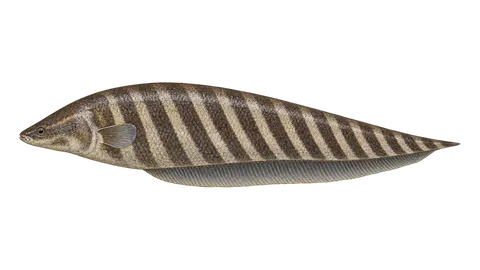
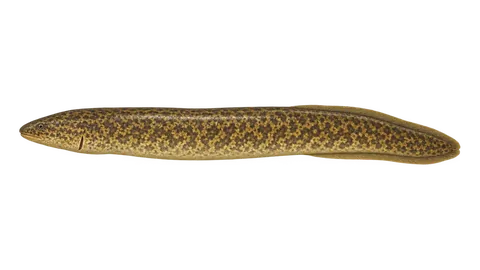
Cylindrical, very long body that can exceed 2 m, with no dorsal, pelvic or caudal fins; a long anal fin runs along almost the whole underside. Broad, flattened head, large mouth, small eyes. Dark grey to olive brown, with an orange to reddish throat in adults. The tuvira is much smaller, flattened on the sides and striped; the mussum is round-bodied but lacks the long anal fin.
Loading the next 7 days…
Each card shows the day's index (0 to 100) and, below it, a strip with the index for each hour, from 0h to 23h. from poor to excellent.
Greater Amazonia. E. electricus in the strict sense lives in the rivers of the Guiana Shield (Guyana, Suriname, French Guiana, with possible records in Brazil and Venezuela); E. voltai, in the Brazilian Shield rivers that flow north (such as the Xingu, Tapajós and Tocantins); and E. varii, in the lowlands of the Amazon trough, including in Peru.
Habitat: Still, shallow water: lagoons, igapós, swamps, igarapés, dry-season pools and vegetated banks, often low in oxygen.
native to the basins
states
Amazonas, Pará, Amapá, Roraima, Rondônia, Acre, Mato Grosso, Tocantins
There is no fishing season. In the dry season, with shallow lagoons and pools, encounters become more likely: be careful when entering the water.
Night and twilight. More active at night and at dusk; by day it hides in vegetation or on the shallow bottom.
Little relevance in the Amazon.
Little known effect.
Little known effect.
High water spreads the fish through the flooded forest.
In the dry season it gets trapped in shallow lagoons and pools, closer to people.
Not very sensitive; does not flee easily.
Little effect.
Shallow, 0.2 to 2 m, rises to the surface to breathe.
accessories
If you hook a poraquê by chance, don't pull it into the boat or touch the fish or the hook: cut the line as far from it as possible.
Summary of the regulations we found, with the source for each. Rules change; before keeping or transporting fish, check with the state environmental agency.
Conservation: Assessment of E. electricus in the strict sense. E. voltai is also Least Concern (LC, 2021) and E. varii has not been assessed. None of the three is on the national list (Portaria GM/MMA nº 1.667/2026).
We found no species-specific rule beyond the region's general rules.
Allowed: Sport and guided fishing only in reservoirs, catch and release with barbless hooks (no keeping, transporting or eating). Subsistence: up to 5 kg per day, for household consumption only.
Allowed: All fishing modalities are prohibited in rivers, including catch and release (Law 9.096/2009, art. 19-A). Exceptions: subsistence fishing from shore (3 kg or 1 fish, no transport or sale) and scientific fishing. Law 13.159/2025 now allows licensed sport fishing in UHE/PCH hydropower reservoirs, natural lakes and border rivers, subject to a scientific study and a license from the environmental agency. We have not confirmed whether these licenses are already being issued.
Allowed: Recreational fishing only in reservoirs, with handline, rod, or spinning or baitcasting reel. Fish may only be eaten on site, not transported. Competitions prohibited. Subsistence: 3 kg + 1 fish. State rules (GO and TO) may be stricter.
Allowed: Recreational fishing only in reservoirs, with on-site consumption. Subsistence: 5 kg + 1 fish. State rules may be stricter.
Allowed: In 2025/26: catch and release with barbless hooks and recreational fishing card; subsistence fishing on foot or from a rowboat, with simple pole or handline.
Source: Portaria Naturatins nº 244/2025 (2025/26 season); INIs MPA/MMA nº 12 and 13/2011
Allowed: The same recreational-angler exceptions as in Portaria 48/2007 apply (handline or rod, 5 kg + 1 fish), unless a stricter state rule applies.
Source: Portaria IBAMA nº 48/2007
Allowed: Recreational anglers with handline or rod, line and hook are outside the Annex II prohibitions, with a bag limit of 5 kg + 1 fish, unless a stricter state rule applies.
Source: Portaria IBAMA nº 48/2007
Allowed: Subsistence fishing only.
Source: Portaria IBAMA nº 48/2007
Allowed: See the exceptions in Portaria 48/2007 and the state rules for each bank.
Source: Portaria IBAMA nº 48/2007
Do not handle it. Cut the line from a distance, with a knife or long-handled pliers, and leave the hook. If someone gets an electric shock in the water, get the person out of the water, check that they are breathing and get medical care.
Not applicable: handling it is dangerous.
Length-weight relationship W = a·Lb (a = 0.00389, b = 3.12; FishBase). It's an average: a fat or lean fish can vary by 10% to 20%.
estimated weight
—
The season weights (months), the time of day and the sensitivities (cold, pressure, moon, wind, rain, tide, strong light, murky water and noise) are the app's editorial estimates, based on the literature below and on the field experience of anglers and guides. They are not official data nor a measurement made for this species, and they may vary by region and year. Closed seasons and legal rules appear in the rules section, with the norm and a link.
Your location is saved only on this device and feeds the forecast, the map and the "today" on the home page.