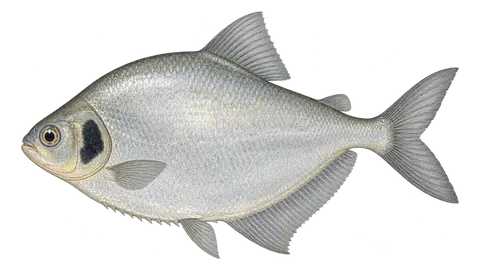
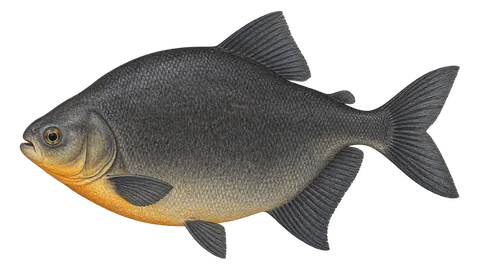
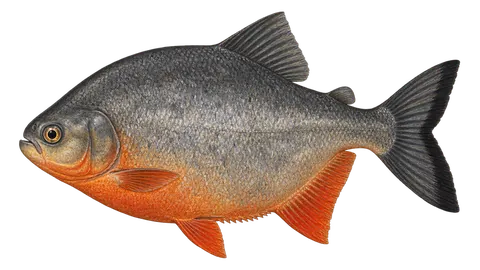
Small, silvery, flattened pacu with a black spot on the gill cover, from the Plata basin. It eats fruit and seeds, nibbles small hooks, and has a 20 cm minimum size in the Pantanal.
Also called: pacu-peva, pacupeba, pacu-peba, pacu-comum
Small disc-shaped pacu, up to about 25 cm and 1 kg, now restricted to the Plata basin (Paraguay, lower Paraná and lower Uruguay rivers) after the Mateussi et al. (2018) review separated the Amazonian forms (M. albiscopum and M. aureum) and the Tocantins-Araguaia form (M. unimaculatum). FishBase describes it as herbivorous, very dependent on floodplains and of great importance in commercial and sport fishing, and lists it as potamodromous, that is, migrating within rivers. Juveniles eat insects and adults eat fruit and seeds. In the Pantanal and MS it is the pacu-peva, with a 20 cm minimum size, and Goiás treats it as an introduced species in the Paranaíba. Pacu-manteiga is the name FishBase gives it, but in the Amazon the name belongs to another species (M. albiscopum).
fun facts
Until 2018 the name M. duriventre covered the pacu-manteiga of the Amazon and the Tocantins-Araguaia; Mateussi and colleagues' review left the name only for the Plata basin.
Even though it is small, it is a commercial and sport fish in the Pantanal, according to FishBase.
Pacupeba, pacu-peba and pacu-peva are variations of the same common name.
how to recognize it
identification
Disc-shaped, very compressed, silvery body with a very visible black spot on the gill cover and a keel with spines on the belly, the last one reaching the origin of the anal fin. The anal fin has 26 to 32 branched rays, and the lateral line has 74 to 98 scales. The Amazonian pacu-manteiga (Mylossoma albiscopum) has more anal rays (31 to 38), and M. aureum, from the Amazon, has almost no spot on the gill cover. Lower and smaller than the pacu and the pirapitinga.
how pacu-peva fishing looks
Loading the next 7 days…
Each card shows the day's index (0 to 100) and, below it, a strip with the index for each hour, from 0h to 23h. from poor to excellent.
Paraguay floodplain (Pantanal), in MT and MS. Outside Brazil, lower Paraná and lower Uruguay, in Argentina, Paraguay and Uruguay. Goiás lists it as introduced, of unknown origin, in the Paranaíba.
Habitat: Rivers, bays and lagoons of the Pantanal floodplain; it enters flooded vegetation at high water (due to its dependence on várzeas, as FishBase notes).
native to the basins
Paraguay (Pantanal)
introduced in
Paraná
states
Mato Grosso, Mato Grosso do Sul, Goiás
calendar and clock
when to fish
best season
time of yearbest: Aug–Nov
JanFebSeaAprMayJunJulAugSepOctNovDec
Estimate: falling water and dry season (July to October in the Pantanal) concentrate shoals in bays and channels; at high water the fish spreads out. Check your state's closed season in the general rules.
best time of day
Daytime. Feeds by day, most active early and late in the afternoon (estimate).
weather, water and behavior
what affects the pacu-peva
sensitivity The little bars show how much each factor affects this species. Five full: it feels it a lot.
3 to 4 m cane pole or light 5'6" to 6' rod, 6 to 12 lb
spinning / baitcasting reel
spinning reel 1000 to 2500
line
monofilament 0.20 to 0.25 mm
leader
optional
hook
small and strong, No. 4 to 1, short shank
natural baits
flour dough
boiled corn
fruit from the bank
minhoca
accessories
small float
corn or fruit chum where allowed
tip from an angler
Bait on the float, close to the vegetation on the bank. Strike quickly: it nibbles and lets go.
what the law says
rules for the pacu-peva
Summary of the regulations we found, with the source for each. Rules change; before keeping or transporting fish, check with the state environmental agency. Conservation: Not on the Brazilian national list (Ministerial Ordinance GM/MMA No. 1.667/2026).
MT (Alto Paraguay): minimum 20 cm
20 cmMTParaguay (Pantanal)
In the Alto Paraguay basin, in Mato Grosso, pacu-peva (listed as Mylossoma paraguayensis, same as M. duriventre) may only be caught at 20 cm or longer. Recreational fishing in MT is catch and release, with retention of up to 2 kg or 1 fish for consumption on site, within 500 m of the river (art. 19-C of Lei nº 9.096/2009).
In Mato Grosso do Sul, pacupeva (Mylossoma paraguayensis) has a 20 cm minimum size, with no maximum size. Recreational fishing is catch and release, with 1 native-species fish for transport, observing the sizes in the decree (art. 4º, I).
GO (Paranaíba): allochthonous species, catch allowed
catch, killing and transport without size or quantity limitGOParaná
In the Paranaíba basin, in Goiás, pacu-manteiga (Mylossoma aff. duriventre) is on the list of introduced species of unknown origin, and can be caught, kept and transported with no size or quantity limit. Fish from this catch may not be sold or processed, and a fishing license remains mandatory.
Colombia (Orinoquia): minimum 24 cm standard length
24 cm standard lengthconfirm with the agency
In the Colombian Orinoquia, palometa of the genus Mylossoma (the AUNAP compilation lists M. duriventre) has a minimum catch size of 24 cm standard length. The 1981 text refers to Mylossoma sp.; check the scientific name and validity with AUNAP before fishing.
piracema closures in the basins where the species lives
Spawning closure (piracema) in the Pantanal of Mato Grosso do Sul
05/11 to 28/02MS
Allowed: Subsistence fishing by riverside residents and authorized scientific fishing. Decree 15.166/2019 (art. 11, §5) allows catch and release only in February and only in the channels of the Paraguay and Paraná rivers. For the rest of the period, not even catch and release is allowed. Check the Imasul portaria for each season.
Spawning closure (piracema) in Mato Grosso (all basins)
01/10 to 31/01MT
Allowed: All fishing modalities are prohibited in rivers, including catch and release (Law 9.096/2009, art. 19-A). Exceptions: subsistence fishing from shore (3 kg or 1 fish, no transport or sale) and scientific fishing. Law 13.159/2025 now allows licensed sport fishing in UHE/PCH hydropower reservoirs, natural lakes and border rivers, subject to a scientific study and a license from the environmental agency. We have not confirmed whether these licenses are already being issued.
catch and release Releasing the fish alive, quickly and with a wet hand. During a closed season it isn't always allowed: what the regulation says applies.
Small, hardy fish: remove the hook in the water and release it.
in the kitchen
Fatty, tasty meat from small pacu; fried or grilled over embers. Counts as the native fish in the recreational angler's bag limit in MS.
calculator
how much it weighs without taking it out of the water
Length-weight relationship W = a·Lb (a = 0.02512, b = 3.03; FishBase (relação peso-comprimento bayesiana, estimativa da própria espécie)). It's an average: a fat or lean fish can vary by 10% to 20%.
estimated weight
—
sources and references
The season weights (months), the time of day and the sensitivities (cold, pressure, moon, wind, rain, tide, strong light, murky water and noise) are the app's editorial estimates, based on the literature below and on the field experience of anglers and guides. They are not official data nor a measurement made for this species, and they may vary by region and year. Closed seasons and legal rules appear in the rules section, with the norm and a link.
scientificFishBase: Mylossoma duriventre (ficha da espécie)Size, length-weight relationship, depth, habitat, distribution, biology and IUCN status. Page checked on October 13, 2026. The maximum weight of 1 kg is the one published in FishBase; the common sizes and weights on this card are editorial estimates, calculated from the length-weight relationship.
technicalWikipédia (en): Mylossoma duriventreDiet of juveniles (insects) and adults (fruit and seeds). Open encyclopedia, with data from the species' older concept; page checked on October 13, 2026.