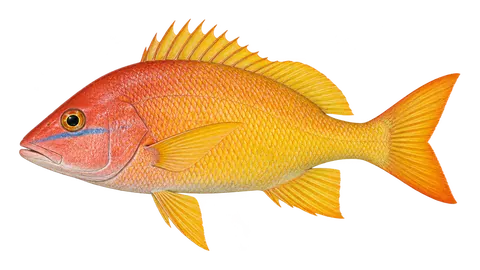
blue and gold snapper
Lutjanus viridis
Yellow snapper with blue stripes that lives on reefs near the coast, from Mexico to Ecuador. It is caught for subsistence and also taken in nets.
Also called: pargo-azul-dourado, pargo azul-dorado, pargo rayado, blue-and-gold snapper

- maximum
- 30 cm
- depth
- 9–15 m
who is the blue and gold snapper
The golden blue snapper belongs to the family Lutjanidae and reaches 30 cm. It is a yellow-bodied snapper with five whitish-blue stripes on the sides, edged in black, and lives near coral and rocky reefs, usually between 9 and 15 m. It occurs from Mexico to Ecuador, most numerous at oceanic islands such as Malpelo, Galapagos, Tres Marías and Revillagigedo. It sometimes forms large schools and eats fish and crabs. It has value in subsistence fishing, is sold fresh and is also caught in nets.
Essential profile. Identification, where it occurs and rules, with data from FishBase and the cited regulations. Season, time of day, technique and bait are added once we have a good source for the blue and gold snapper; in the meantime, see the similar species.
identification
Snapper of intense yellow color, with five whitish-blue stripes edged in black along the sides of the body. The belly is whitish, with thin gray lines, and most of the fins are yellow. The preopercle, on the cheek, has a strong notch and a bulge, which help identify it.
Loading the next 7 days…
Each card shows the day's index (0 to 100) and, below it, a strip with the index for each hour, from 0h to 23h. from poor to excellent.
Essential profile: the index uses a general fish model (weather, sun, moon and tide), without a season or time of day specific to this species.
where found
Occurs in the eastern Pacific, from Mexico to Ecuador, most concentrated at oceanic islands such as the Galapagos and Revillagigedo.
Habitat: Coral and rocky reefs, from 0 to 60 m, most common between 9 and 15 m.
rules for the blue and gold snapper
Summary of the regulations we found, with the source for each. Rules change; before keeping or transporting fish, check with the state environmental agency.
We found no species-specific rule beyond the region's general rules.
catch and release
catch and release Releasing the fish alive, quickly and with a wet hand. During a closed season it isn't always allowed: what the regulation says applies.
It poses no danger to anglers. As a reef fish, release it carefully and do not leave it out of water for long.
in the kitchen
Sold fresh.
how much it weighs without taking it out of the water
Length-weight relationship W = a·Lb (a = 0.01479, b = 2.96; FishBase (relação peso-comprimento bayesiana, estimativa pelo gênero e formato do corpo)). It's an average: a fat or lean fish can vary by 10% to 20%.
estimated weight
—
sources and references
Essential profile: size, length-weight, depth, countries and conservation come from FishBase and the cited regulations, and the texts were written from those sources. Season, time of day, sensitivities, technique and baits and lures are not included yet, because we did not find a good source for this species.
- scientific FishBase: Lutjanus viridis (ficha da espécie)Size, length-weight, depth, habitat, distribution, biology, and IUCN status. Page checked on Oct 13, 2026.
- scientific FishBase: nomes populares de Lutjanus viridisNames by country and language.