

mullet snapper
Lutjanus aratus
Schooling snapper of the eastern Pacific, greenish gray, with light-centered scales that form stripes. Lives on coastal reefs and can form schools of hundreds. Bottom and midwater fishing with natural bait and jigs.
- common size
- 28–45 cm
- maximum
- 100 cm
- common weight
- 0.3–1.2 kg
- record/max.
- 15.0 kg
- depth
- 0–60 m
- ideal water
- 23–29 °C
how to recognize it
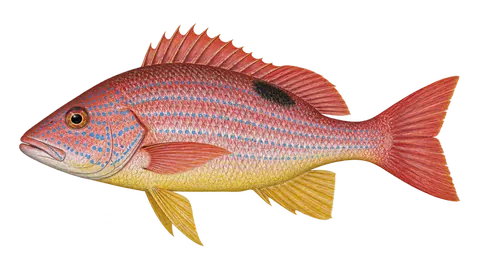
Elongated body, dark greenish-gray back and lighter belly. The scales have whitish-yellow centers and form alternating dark and light stripes along the flanks; fish from deeper waters look reddish, with red fins. The scale rows on the back run parallel to the lateral line, the notch and knob of the preopercle are moderate, the front teeth are enlarged, the dorsal fin has 11 to 12 spines and 12 soft rays, and the anal fin has 7 to 8 soft rays. Jordan's snapper (Lutjanus jordani) has a more pointed head and rows of silvery spots, and the lunarejo snapper has a dark spot on its back.
Also called: pargo-raicero, pargo-jilguero, mullet snapper
don't confuse with:
where found
open on the large mapWhere to look: Coastal reefs and hard bottoms, down to 50 to 60 m; juveniles in shallow water, tide pools and estuaries.
Not found in Brazil. Eastern Pacific: from Mexico to Ecuador (and northern Peru, according to STRI), including the Gulf of California and the Coco, Galápagos and Malpelo islands.
when to fish
next 7 days
Loading the next 7 days…
best season
Fishable all year. Dense schools over the rocks and clear water matter more than the month.
best time of day
Dawn and dusk. Bites well at dawn, late afternoon and at night; by day it takes natural bait on the bottom and jigs over schools that hold still among the rocks.
what affects the mullet snapper
cold and cold fronts
Cold upwelling shuts down activity.
atmospheric pressure
A front with the sea turning rough hampers bottom fishing.
moon
Strong moon phases move more water over the rocks and change activity.
rain
Little effect on the bottom; heavy rain muddies the estuaries where the juveniles live.
water level
Not applicable at sea.
noise
Anchor upstream of the rock and let the bait drift down; noise over the school spooks it.
wind
Strong wind makes it hard to keep the boat over the rock.
tide
Moderate current is best.
depth
From 10 to 50 m over rocks and shoals.
how to fish
lures
- metal jig 40 to 100 g
- jig head with an 8 to 10 cm shad
- slow jig
natural baits
- whole or filleted sardine
- squid strips
- shrimp
tip from an angler
When the school shows on the sonar over the rock, drop the jig or natural bait to a hand's width off the bottom and lift slowly: the raicero snapper strikes right beside the school.
- rod
- 6' to 7', 15 to 30 lb
- spinning / baitcasting reel
- 4000 spinning reel or small baitcasting reel
- line
- braided line 20 to 40 lb
- leader
- fluorocarbon 30 to 50 lb, 1 m
- hook
- circle 2/0 to 5/0
accessories
- sinker 60 to 150 g
- descender (fish descender)
- alicate
catch and release
A bottom fish can rise with an inflated swim bladder: use a descender to return it to depth. Don't puncture the bladder. Keep the fish in the water as long as possible and release those over the bag limit.
rules for the mullet snapper
Rules change; before keeping or transporting fish, check with the state environmental agency.
Mexico: up to 5 per species and 10 saltwater fish per day
5 specimens of the species per angler per day, within the limit of 10 saltwater fish details
In recreational sport fishing in Mexican federal waters, each angler may keep up to 10 marine fish per day, no more than 5 of the same species. Raicero snapper is not among the species reserved for sport fishing (marlin, sailfish, swordfish, tarpon, roosterfish and dorado, up to 50 nautical miles from shore, item 0.3 of the standard) and has no quota of its own. Fish over the limit go back alive, and sport-caught fish may not be sold. Anglers fishing from a boat need an individual permit; anglers fishing from shore do not.
Colombia: sport fishing has ceased to exist as a category; tourist fishing applies (Law 2501/2025)
Transition period: confirm with AUNAP before fishingconfirm with the agency details
In Judgment C-148 of Apr 27, 2022, the Constitutional Court declared unconstitutional the rules that provided for sport fishing, with effects postponed by one year. Law 2501, enacted on Jul 28, 2025, created the tourist fishing category, and the rules (gear, quantities, minimum sizes, methods, zones and seasons) depend on regulations from the Ministry of Agriculture with AUNAP. We have not confirmed whether the decrees have been issued: check with AUNAP and use a licensed tourism operator before fishing or keeping any fish.
Source: Constitutional Court of Colombia, Judgment C-148/2022; Law 2501 of 2025 (Congress of Colombia)
Conservation: Of least concern globally, based on an older assessment. The Incopesca legal size table (Costa Rica, 2017) does not list this species; check local rules before keeping any.
how much it weighs without taking it out of the water
estimated weight
—
how we calculate
Length-weight relationship W = a·Lb (a = 0.01479, b = 2.96; FishBase (relação peso-comprimento bayesiana, estimativa pelo gênero e formato do corpo)). It's an average: a fat or lean fish can vary by 10% to 20%.
more about the mullet snapper
Coastal snapper of the eastern Pacific, from Mexico to Ecuador (STRI goes as far as northern Peru), with the Coco, Galápagos and Malpelo islands. Lives over hard bottoms, on reefs and rocks, down to at least 50 m (FishBase cites up to 60 m). Adults can form schools of hundreds of fish, and juveniles stay in shallow water, tide pools and estuaries. It is carnivorous, eating fish and invertebrates. It reaches 1 m and 15 kg, with a common length of 35 cm (FishBase). It is caught for subsistence, sold fresh and considered a sport fish. For the angler it is the rock-bottom and midwater snapper that takes natural bait, jigs and silicone lures, and the dense schools allow for quantity fishing.
Family: Lutjanidae · predator
fun facts
- Schools can reach hundreds of fish (FishBase).
- Juveniles live in tide pools, estuaries and shallow water, where adults rarely appear.
- Fish from deeper water look reddish, with red fins.
in the kitchen
Sold fresh. White, firm flesh, typical of snappers: fried whole, baked or in ceviche.
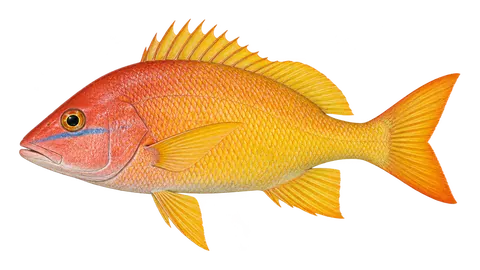
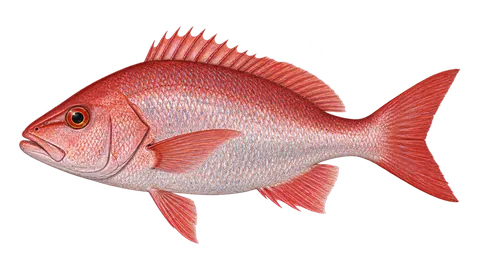
similar species

sources and references (8)
The season weights (months), the time of day and the sensitivities (cold, pressure, moon, wind, rain, tide, strong light, murky water and noise) are the app's editorial estimates, based on the literature below and on the field experience of anglers and guides. They are not official data nor a measurement made for this species, and they may vary by region and year. Closed seasons and legal rules appear in the rules section, with the norm and a link.
- scientific FishBase: Lutjanus aratus (ficha da espécie)Size, length-weight, depth, habitat, distribution, biology and IUCN status. Page checked on 13/10/2026. The common size range on this page is an editorial estimate around FishBase's common length (35 cm). STRI cites 0 to 70 m; the page keeps FishBase's range of 0 to 60 m.
- scientific FishBase: nomes populares de Lutjanus aratusNames by country and language.
- scientific Robertson, D. R. & Allen, G. R. (2024). Shorefishes of the Eastern Pacific online information system, versão 3.0. Smithsonian Tropical Research Institute: Lutjanus aratusDescription, colors, size (about 100 cm and at least 15 kg), depth of 0 to 70 m, diet and distribution (includes Coco, Galápagos and Malpelo). Page checked on 13/10/2026.
- scientific IUCN Red List: Lutjanus aratus (avaliação global)Least Concern (LC), assessed May 23, 2007. Assessment checked in the FishBase entry (Red List, version 2025-2); the species' Red List link was not opened.
- official DOF: Modificação da NOM-017-PESC-1994, para regular a pesca deportivo-recreativa em águas de jurisdição federal do México (publicada em 25/11/2013)Reserves species for sport fishing (item 0.3), permits (4.3 and 4.14), rods and hooks (4.6), bait (4.7), chumming in tournaments (4.8), daily limits at sea (4.9.1) and in fresh water (4.9.2), catch and release (4.9.5), closed zones, seasons and protected areas (4.10), a ban on selling the catch (4.11) and filleting (4.12). Text checked on Oct 13, 2026; the DOF records publication on Nov 25, 2013 and signature on Oct 14, 2013. We found no specific Conapesca federal closed season for this species.
- official Incopesca (Costa Rica): Acordo AJDIP/102-2017 da Junta Diretiva, tamanhos legais de primeira captura (24/02/2017)Table of snappers, croakers, tunas, sharks and others. Among the snappers, only the pargo lunarejo (32 cm), the Pacific red snapper (34 cm, called pargo seda) and the Pacific yellow snapper (33 cm) appear; the other species in this entry are not listed.
- official Corte Constitucional da Colômbia: Sentença C-148 de 27 de abril de 2022 (pesca deportiva)We checked the date and summary of the judgment, which holds sport fishing unconstitutional. The one-year postponement of effects comes from press reports on the decision; we did not read the full operative part.
- press Agenda del Mar: Pesca de turismo, qué se aprobó y qué falta (Lei 2501 de 2025)Reports the enactment of Law 2501 on Jul 28, 2025 and the regulatory deadlines (six months for tourism and one year for zones, species, methods and seasons). We could not open the official text of the law or confirm whether the decrees have been issued.