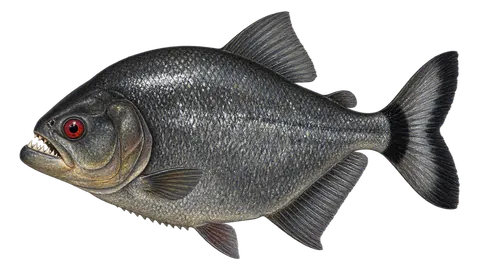
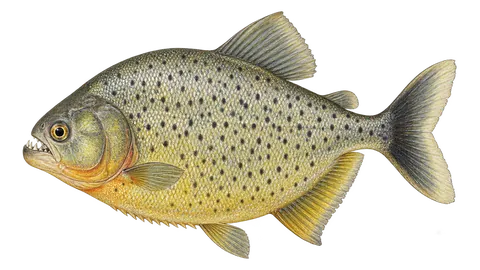
Small piranha from the headwaters of the large rivers of the Amazon, the Orinoco and the Guianas, up to about 20 cm. FishBase says it is rare in catches.
Small piranha, up to 20.1 cm and 230 g, from the headwaters of the main rivers of the Amazon and Orinoco basins and of the northern and eastern rivers of the Guiana Shield. FishBase describes it as rare in catches and records a stomach full of seeds, with fewer fin pieces, which indicates a mixed diet. It is on FishBase's list as a sport fish, but we found no reports of fishing targeted at the species. The classification of the genus Pristobrycon is debated, and intermediate forms complicate identification, according to aquarists.
fun facts
The genus name comes from Greek: pristis, 'saw', and bryko, 'to bite'.
It was described by Steindachner in 1908 and is now in another genus, as FishBase indicates with the author's name in parentheses.
how to recognize it
identification
Small piranha with a short, tall, disc-shaped body, a relatively small head in adults, triangular cutting teeth in one row and a serrated keel on the belly. According to aquarists, males have a hooked anal fin and females have a straight-edged one. Telling it apart from other small piranhas (Serrasalmus, other Pristobrycon) requires counts and comparison of specimens; in the field, treat it as a piranha.
how piranha-mafura fishing looks
Loading the next 7 days…
Each card shows the day's index (0 to 100) and, below it, a strip with the index for each hour, from 0h to 23h. from poor to excellent.
Rarely caught; if one comes up, take the care you would with any piranha: steel leader and long-nose pliers, because the teeth cut both line and hand.
what the law says
rules for the piranha-mafura
Summary of the regulations we found, with the source for each. Rules change; before keeping or transporting fish, check with the state environmental agency. Conservation: Not on the Brazilian national list (Ministerial Ordinance GM/MMA No. 1.667/2026).
We found no species-specific rule beyond the region's general rules.
piracema closures in the basins where the species lives
Spawning closure (piracema) in Mato Grosso (all basins)
01/10 to 31/01MT
Allowed: All fishing modalities are prohibited in rivers, including catch and release (Law 9.096/2009, art. 19-A). Exceptions: subsistence fishing from shore (3 kg or 1 fish, no transport or sale) and scientific fishing. Law 13.159/2025 now allows licensed sport fishing in UHE/PCH hydropower reservoirs, natural lakes and border rivers, subject to a scientific study and a license from the environmental agency. We have not confirmed whether these licenses are already being issued.
Allowed: Recreational anglers with handline or rod, line and hook are outside the Annex II prohibitions, with a bag limit of 5 kg + 1 fish, unless a stricter state rule applies.
catch and release Releasing the fish alive, quickly and with a wet hand. During a closed season it isn't always allowed: what the regulation says applies.
Long-nose pliers, and no hands near the mouth. Hold it with a damp cloth and release it quickly.
in the kitchen
Too small to have a known market; we found no preparation notes for the species.
calculator
how much it weighs without taking it out of the water
Length-weight relationship W = a·Lb (a = 0.01698, b = 3.14; FishBase (relação peso-comprimento bayesiana, estimativa da própria espécie)). It's an average: a fat or lean fish can vary by 10% to 20%.
estimated weight
—
sources and references
The season weights (months), the time of day and the sensitivities (cold, pressure, moon, wind, rain, tide, strong light, murky water and noise) are the app's editorial estimates, based on the literature below and on the field experience of anglers and guides. They are not official data nor a measurement made for this species, and they may vary by region and year. Closed seasons and legal rules appear in the rules section, with the norm and a link.
scientificFishBase: Pristobrycon striolatus (ficha da espécie)Size, length-weight relationship, depth, habitat, distribution, biology and IUCN status. Page checked on October 13, 2026. The common sizes and weights on this card are editorial estimates, calculated from the length-weight relationship.
technicalAquarium Glaser: Pristobrycon striolatusDisc-shaped adult, anal fin dimorphism and doubts about the genus classification. Aquarium source, not scientific; page checked on October 13, 2026.