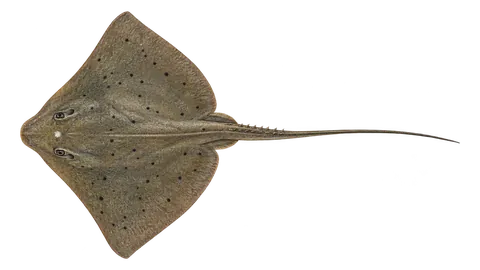
southern stingray
Hypanus americanus
The large whiptail stingray of the shoals, reefs and beaches of the Caribbean and the Gulf of Mexico. It does not occur in Brazil: the Brazilian raia-prego is a different species.
Also called: raia-prego-do-caribe, raia-americana

- common size
- 60–120 cm
- maximum
- 200 cm
- common weight
- —
- record/max.
- 135.6 kg
- depth
- 0–20 m
- ideal water
- 24–30 °C
who is the southern stingray
The Southern stingray (raia-prego-do-caribe) is a large whiptail stingray, reaching 2 m disc width and over 100 kg. It lives from the eastern United States and the Gulf of Mexico to the Antilles, Central America and the northern coast of South America, on sand bottoms, seagrass beds, lagoons, bays, estuaries, mangroves and in front of reefs. It spends the day buried in the sand and comes out at night to feed on bivalves, worms, shrimp, crabs and small fish, which it digs out of the bottom. It has 3 or 4 young per pregnancy and lives up to 28 years. It is fished as a sport target and by artisanal fishers. Until 2020 Brazilian stingrays were treated as this species; today they are Hypanus berthalutzae.
fun facts
- In the Cayman Islands, stingrays of this species have become used to tourists at famous dive sites.
- It visits cleaning stations on reefs, where small fish remove parasites from its skin.
identification
Diamond-shaped disc with sharp lateral corners, uniform dark brown, gray or olive back, and a white belly with a grayish edge. Irregular row of short spines along the middle of the back. Long tail with a serrated stinger, a long, high skin fold underneath and no fold on top. It differs from the Brazilian raia-prego by the lack of black spots on the back; the two do not meet, separated by the mouth of the Amazon. Measurements in this entry are disc width.
Loading the next 7 days…
Each card shows the day's index (0 to 100) and, below it, a strip with the index for each hour, from 0h to 23h. from poor to excellent.
where found
Does not occur in Brazil. From the eastern United States and the Gulf of Mexico to the Antilles, Central America and the northern coast of South America, as far as the Guianas.
Habitat: Sand shoals, seagrass beds, lagoons, bays, estuaries, mangroves and the front of reefs.
when to fish
best season
Present all year in the Caribbean; in the northern Gulf of Mexico it is more common in the warm months.
best time of day
Night and twilight. Buried in the sand for much of the day; comes out to feed late in the afternoon and at night.
what affects the southern stingray
sensitivity The little bars show how much each factor affects this species. Five full: it feels it a lot.
cold and cold fronts
Cold fronts in the northern Gulf of Mexico push it away from the shallows.
atmospheric pressure
Not very sensitive.
moon
Little known effect.
rain
Little effect.
water level
Not applicable at sea.
noise
On a clear shoal, it flees from noisy boats.
wind
Little effect.
tide
It climbs onto the shoals on the rising tide to look for food.
depth
0.5 to 5 m on the shoals; deeper at the front of reefs.
how to fish
- rod
- 7'0" to 8'0", 30 to 60 lb (boat or beach)
- spinning / baitcasting reel
- spinning reel 6000 to 10000 or baitcasting reel with plenty of line
- line
- braided line 50 to 80 lb
- leader
- monofilament 0.90 to 1.2 mm
- hook
- circle 8/0 to 12/0, barbless
natural baits
- lula
- shrimp
- caranguejo
- fish pieces
accessories
- long-nose pliers
- thick gloves
- line cutter
tip from an angler
It fights hard along the bottom and is heavy: keep steady pressure to pull it off the sand. Never pull the stingray by the tail or bring it into the boat.
rules for the southern stingray
Summary of the regulations we found, with the source for each. Rules change; before keeping or transporting fish, check with the state environmental agency.
Conservation: Does not occur in Brazil. We found no specific fishing rules in the countries of the area; in marine protected areas and dive sites with stingrays, catching may be prohibited. Check with the local authority.
We found no species-specific rule beyond the region's general rules.
catch and release
catch and release Releasing the fish alive, quickly and with a wet hand. During a closed season it isn't always allowed: what the regulation says applies.
The tail stinger is serrated and venomous: a sting causes intense pain and a deep cut. Keep the stingray in the water, away from the tail, and remove the hook with long pliers or cut the line close to the mouth. If stung, immerse the area in very hot water (not hot enough to burn) and seek medical care.
in the kitchen
Eaten in parts of the Caribbean, but the species is Near Threatened: release is preferable.
how much it weighs without taking it out of the water
Length-weight relationship W = a·Lb (a = 0.00447, b = 3.12; FishBase (estimativa bayesiana genérica para o formato de corpo da subfamília, em comprimento total com a cauda); para raias a medida usual é a largura do disco, e a calculadora dá só uma ordem de grandeza). It's an average: a fat or lean fish can vary by 10% to 20%.
estimated weight
—
sources and references
The season weights (months), the time of day and the sensitivities (cold, pressure, moon, wind, rain, tide, strong light, murky water and noise) are the app's editorial estimates, based on the literature below and on the field experience of anglers and guides. They are not official data nor a measurement made for this species, and they may vary by region and year. Closed seasons and legal rules appear in the rules section, with the norm and a link.
- scientific FishBase — Hypanus americanus (ficha da espécie)Names, distribution, biology, length-weight relationship, country list and references. Page checked on 13/10/2026. FishBase's country list still includes Brazil, based on records made before the description of H. berthalutzae; that is why Brazil was left out. Measurements are disc width.
- scientific IUCN Red List — Hypanus americanus (avaliação global: Quase Ameaçada, NT, 21/06/2019)Global assessment. Link given on the FishBase entry (Red List, version 2025-2).
- scientific Petean, F. F.; Naylor, G. J. P.; Lima, S. M. Q. (2020). Integrative taxonomy identifies a new stingray species of the genus Hypanus Rafinesque, 1818 (Dasyatidae, Myliobatiformes), from the Tropical Southwestern Atlantic. Journal of Fish Biology 97: 1120–1142.Description of Hypanus berthalutzae and separation from H. americanus; distribution from the mouth of the Amazon to São Paulo, including the oceanic islands of the Northeast. DOI and abstract checked on Crossref.