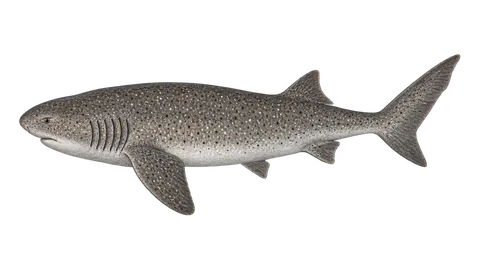
Heavy, deep-water shark with six pairs of gill slits and a single dorsal fin. It is not a threatened species in Brazil, but it is slow, lives a long time and should only be caught to be released.
Also called: tubarão-de-seis-guelras, tubarão-albafar
The sixgill shark (cañabota) lives in all oceans, with irregular distribution. It stays near the bottom, usually between 180 and 1,100 m, on the slope and outer shelf, around oceanic islands and seamounts; at night it rises to feed near the surface, where it can be caught on longlines set for other species. It eats fish, other sharks, rays, chimaeras, squid, crabs, shrimp, carrion and even seals, and large individuals (from about 2 m) also attack cetaceans. It is viviparous, with huge litters of 47 to 108 pups of 60 to 75 cm, and juveniles use shallow waters as a nursery. In the southwestern Atlantic there are records from northeastern to southern Brazil, Argentina and Uruguay, and the known distribution is irregular. It is not on the Brazilian national list, and the IUCN global assessment is Near Threatened. In sport bottom fishing it is a release fish.
fun facts
The name comes from Greek: 'hex' means six, the number of gill slits; most sharks have five.
Makes a daily vertical migration: on the bottom by day, near the surface at night.
The litters, of 47 to 108 pups, are huge for a shark.
Alive, it has fluorescent green eyes; FishBase records depths from 0 to 2,500 m.
how to recognize it
identification
Heavy body, broad head and rounded snout. It has six pairs of long gill slits (common sharks have five) and a single dorsal fin, set far back; the anal fin is smaller than the dorsal. Mouth underneath, with six rows of blade-shaped and comb-shaped teeth on each side of the lower jaw. Brown or grey above, paler below, with a pale band along the flank and white edges on the fins. Alive, its eyes glow fluorescent green. The cação-bruxa (gatopardo, Notorynchus cepedianus) has seven pairs of gill slits and dark spots on its body.
how bluntnose sixgill shark fishing looks
Loading the next 7 days…
Each card shows the day's index (0 to 100) and, below it, a strip with the index for each hour, from 0h to 23h. from poor to excellent.
Circumglobal, with irregular distribution. In the southwestern Atlantic there are records from northeastern to southern Brazil (Fernando de Noronha archipelago, São Pedro e São Paulo archipelago, Ceará and other points on the slope), Argentina and Uruguay. In practice, deep bottom fishing and longlines are what catch it.
Habitat: Slope and outer shelf, oceanic islands and seamounts, usually 180 to 1,100 m; at night it rises near the surface; juveniles use shallow waters.
Estimate: no known season; it lives in cold, deep water, where seasons change little, and can be found year-round.
best time of day
Nighttime. By day it stays near the bottom and at night it rises to feed near the surface, according to FishBase. For deep bottom anglers, night is the best time for a chance.
weather, water and behavior
what affects the bluntnose sixgill shark
sensitivity The little bars show how much each factor affects this species. Five full: it feels it a lot.
cold and cold fronts
Lives in cold water (well below 15 °C on the bottom); surface temperature matters little.
atmospheric pressure
Little known effect on the bottom.
moon
No study; the effect is estimated to be small.
rain
Little effect on the bottom; heavy rain only hampers the boat's maneuvering.
water level
Not applicable at sea.
noise
Not very sensitive; lives far from surface noise.
wind
Rough seas hamper deep bottom fishing from a boat, which requires the boat to hold position over the spot.
tide
Strong current drags the line and makes it hard to get the bait down to the bottom.
depth
180 to 1,100 m most of the time; at night it may rise near the surface.
short heavy-action stand-up rod, 50 to 80 lb, or a deep-sea rod in a rod holder
spinning / baitcasting reel
electric reel or large lever-drag reel with capacity for at least 600 m of line
line
braided line 80 to 130 lb
leader
2 to 3 m wire leader, spliced to heavy monofilament
hook
circle 14/0 to 18/0, barbless or with the barb crushed; a single hook
natural baits
mackerel steak or whole mackerel, bonito or other oily fish
large squid
accessories
heavy sinker with a breakaway clip
cutting pliers for steel cable
long hook remover
luvas
tip from an angler
Deep bottom fishing: for release only. Bring the shark alongside the hull with its head in the water, without taking it aboard, and cut the line flush with the hook if the hook is deep. Keep your hands away from the mouth.
what the law says
rules for the bluntnose sixgill shark
Summary of the regulations we found, with the source for each. Rules change; before keeping or transporting fish, check with the state environmental agency. Conservation: Not on the Brazilian national list (Portaria GM/MMA nº 1.667/2026). Global assessment: Near Threatened (IUCN, 21/11/2019). The finning ban applies.
Finning prohibited: shark only whole, with its fins
fins naturally attached to the body
In Brazil, finning is prohibited (cutting off the fins and discarding the body). Every shark or ray landed must arrive with its fins attached to the body; it is prohibited to carry on board an animal without fins or with loose fins, and to transfer sharks between vessels. It applies to any shark that may be kept.
1 specimen per angler per day (counts as 5 against the quota of 10)
In recreational sport fishing in Mexican saltwaters, the limit for sharks is one specimen per angler per day, which counts as five toward the total limit of ten fish. Fish caught in sport fishing may not be sold. Catch and release does not count toward the limit: prefer releasing.
Colombia: marine sharks and rays are not fishery resources
commercial or sport extraction not permitted (according to the decree's recitals)confirm with the agency
In 2021 Colombia stopped treating marine sharks and rays as fishery resources (AUNAP Resolution 0380/2021) and began treating them as hydrobiological resources; the recitals of Decree 281/2021 say they may not be extracted for commercial or sport purposes, and the decree creates an environmental protection plan and sets who enforces it. The articles include no list of species or sizes, and we did not check later AUNAP rules on incidental catch. When in doubt, release it in the water.
Chile: finning of sharks banned on board and at landing
landing with fins fully or partially attached to the body
Law 20.525 (2011) added art. 5 bis to the General Law on Fisheries and Aquaculture: it is forbidden to cut the fins of any shark on board fishing vessels or during transshipment, and landing must be done with the fins fully or partially attached to the body. A loose fin without the corresponding trunk on board is presumed to be an offense. The fine for the vessel owner ranges from 50 to 500 UTM. We did not verify a specific Chilean rule on shark retention in marine recreational fishing.
Argentina: directed fishing for sharks and rays banned for the federal fleet; incidental sharks returned to the sea
directed fishing for chondrichthyans banned; return live sharks without gaff; finning bannedconfirm with the agency
Federal Fisheries Council Resolution 8/2021 (Consejo Federal Pesquero) bans directed fishing for chondrichthyans (sharks, rays and chimaeras), finning (cutting off the fins and discarding the body) and the use of gaffs to return live animals to the sea, and requires that sharks caught by chance be returned quickly and with minimal trauma, except cazón, gatuzo, pez ángel, espinoso and pintarroja. The text refers to trips and vessels, that is, the federal commercial fleet, and invites the provinces to adopt similar measures. For sport anglers, good practice is to release the shark in the water, without a gaff.
Panama: shark finning banned in its jurisdictional waters
banned: cutting off the fins and throwing the body back into the sea
Law 9 of 2006 bans finning in Panama's jurisdictional waters. The law's definition of shark fishing covers directed or incidental catch by artisanal, commercial, industrial and sport vessels. The fine for artisanal fishing reaches 1,000 balboas, without prejudice to criminal liability. In the sources we checked, we did not find a specific Panamanian rule on retention or release for sport anglers.
catch and release Releasing the fish alive, quickly and with a wet hand. During a closed season it isn't always allowed: what the regulation says applies.
Do not lift it out of the water: the weight of the body injures the organs. Keep the fight short and release it beside the boat, with the shark in the water; cut the line flush with the mouth if the hook is deep. Lifting it from hundreds of metres exhausts the animal: do not hold it against the hull, release it quickly so it can return to the bottom.
in the kitchen
FishBase records commercial use of the species. As it is a large and probably long-lived shark, it is not a fish to be killed: release it.
calculator
how much it weighs without taking it out of the water
Length-weight relationship W = a·Lb (a = 0.00081, b = 3.23; FishBase (relação peso-comprimento bayesiana, estimativa da própria espécie)). It's an average: a fat or lean fish can vary by 10% to 20%.
estimated weight
—
sources and references
The season factors (months), the time of day, and the sensitivities (cold, pressure, moon, wind, rain, tide, strong light, murky water, and noise) are editorial estimates by the app, based on the literature cited below and on field experience of anglers and guides. They are not official data or measurements made for this species and may vary by region and year. Closed seasons and legal rules appear in the rules section, with the standard and link. The months indicate when the species is usually found near the coast or at the fishing spot, not a catch season. The water temperature range is also an editorial estimate, supported by FishBase values where they exist.
scientificFishBase: Hexanchus griseus (ficha da espécie)Size, length-weight, depth, habitat, distribution, biology and IUCN status. Page checked on 13/10/2026. Ecology, reproduction, diet and description data come from FishBase (which cites Compagno and Ebert et al. 2021).