

- common size
- —
- maximum
- 600 cm
- common weight
- —
- record/max.
- 590.0 kg
- depth
- 180–1,100 m
- ideal water
- 6–10 °C

the right time
to be on the water
Choose the place and the species. The index, from 0 to 100, combines weather, sun, moon and tide with each fish's habits. Up to 28 days, with each day's confidence.
Loading the forecast…
—
Looking for alerts within 30 km…
Looking for what anglers have logged near here…
what you need to fish herelicense, certification and boat documents
fish likely at this spot
Tap a fish to see its forecast.
hour by hour
slide your finger or mouse over the chart to see each hoursee hour-by-hour table
why this index at —?
choose the day
the fishing month at a glance
what's the best window for the crew?
Choose how many fishing days. We compare each stretch by its average index, discount days with a warning or closed season, and show the 3 best.
trend for the coming weeks
Line: the middle value of 31 simulations of the American GEFS model. Band: where 8 out of 10 fall. Narrow, firm trend; wide, high uncertainty.
everything about the bluntnose sixgill shark
how to recognize it
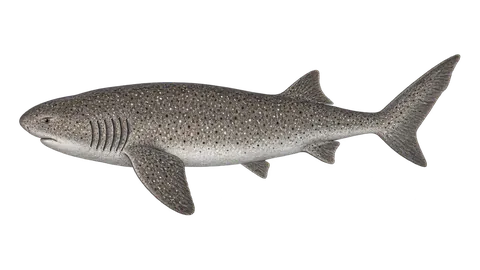
Heavy body, broad head and rounded snout. It has six pairs of long gill slits (common sharks have five) and a single dorsal fin, set far back; the anal fin is smaller than the dorsal. Mouth underneath, with six rows of blade-shaped and comb-shaped teeth on each side of the lower jaw. Brown or grey above, paler below, with a pale band along the flank and white edges on the fins. Alive, its eyes glow fluorescent green. The cação-bruxa (gatopardo, Notorynchus cepedianus) has seven pairs of gill slits and dark spots on its body.
Also called: tubarão-de-seis-guelras, tubarão-albafar
don't confuse with:
where found
open on the large mapWhere to look: Slope and outer shelf, oceanic islands and seamounts, usually 180 to 1,100 m; at night it rises near the surface; juveniles use shallow waters.
Circumglobal, with irregular distribution. In the southwestern Atlantic there are records from northeastern to southern Brazil (Fernando de Noronha archipelago, São Pedro e São Paulo archipelago, Ceará and other points on the slope), Argentina and Uruguay. In practice, deep bottom fishing and longlines are what catch it.
coast
when to fish
best season
Estimate: no known season; it lives in cold, deep water, where seasons change little, and can be found year-round.
best time of day
Nighttime. By day it stays near the bottom and at night it rises to feed near the surface, according to FishBase. For deep bottom anglers, night is the best time for a chance.
what affects the bluntnose sixgill shark
cold and cold fronts
Lives in cold water (well below 15 °C on the bottom); surface temperature matters little.
atmospheric pressure
Little known effect on the bottom.
moon
No study; the effect is estimated to be small.
rain
Little effect on the bottom; heavy rain only hampers the boat's maneuvering.
water level
Not applicable at sea.
noise
Not very sensitive; lives far from surface noise.
wind
Rough seas hamper deep bottom fishing from a boat, which requires the boat to hold position over the spot.
tide
Strong current drags the line and makes it hard to get the bait down to the bottom.
depth
180 to 1,100 m most of the time; at night it may rise near the surface.
how to fish
natural baits
- mackerel steak or whole mackerel, bonito or other oily fish
- large squid
tip from an angler
Deep bottom fishing: for release only. Bring the shark alongside the hull with its head in the water, without taking it aboard, and cut the line flush with the hook if the hook is deep. Keep your hands away from the mouth.
- rod
- short heavy-action stand-up rod, 50 to 80 lb, or a deep-sea rod in a rod holder
- spinning / baitcasting reel
- electric reel or large lever-drag reel with capacity for at least 600 m of line
- line
- braided line 80 to 130 lb
- leader
- 2 to 3 m wire leader, spliced to heavy monofilament
- hook
- circle 14/0 to 18/0, barbless or with the barb crushed; a single hook
accessories
- heavy sinker with a breakaway clip
- cutting pliers for steel cable
- long hook remover
- luvas
catch and release
Do not lift it out of the water: the weight of the body injures the organs. Keep the fight short and release it beside the boat, with the shark in the water; cut the line flush with the mouth if the hook is deep. Lifting it from hundreds of metres exhausts the animal: do not hold it against the hull, release it quickly so it can return to the bottom.
rules for the bluntnose sixgill shark
Rules change; before keeping or transporting fish, check with the state environmental agency.
Finning prohibited: shark only whole, with its fins
fins naturally attached to the body details
In Brazil, finning is prohibited (cutting off the fins and discarding the body). Every shark or ray landed must arrive with its fins attached to the body; it is prohibited to carry on board an animal without fins or with loose fins, and to transfer sharks between vessels. It applies to any shark that may be kept.
Mexico: no more than 1 shark per angler per day
1 specimen per angler per day (counts as 5 against the quota of 10) details
In recreational sport fishing in Mexican saltwaters, the limit for sharks is one specimen per angler per day, which counts as five toward the total limit of ten fish. Fish caught in sport fishing may not be sold. Catch and release does not count toward the limit: prefer releasing.
Colombia: marine sharks and rays are not fishery resources
commercial or sport extraction not permitted (according to the decree's recitals)confirm with the agency details
In 2021 Colombia stopped treating marine sharks and rays as fishery resources (AUNAP Resolution 0380/2021) and began treating them as hydrobiological resources; the recitals of Decree 281/2021 say they may not be extracted for commercial or sport purposes, and the decree creates an environmental protection plan and sets who enforces it. The articles include no list of species or sizes, and we did not check later AUNAP rules on incidental catch. When in doubt, release it in the water.
Chile: finning of sharks banned on board and at landing
landing with fins fully or partially attached to the body details
Law 20.525 (2011) added art. 5 bis to the General Law on Fisheries and Aquaculture: it is forbidden to cut the fins of any shark on board fishing vessels or during transshipment, and landing must be done with the fins fully or partially attached to the body. A loose fin without the corresponding trunk on board is presumed to be an offense. The fine for the vessel owner ranges from 50 to 500 UTM. We did not verify a specific Chilean rule on shark retention in marine recreational fishing.
Argentina: directed fishing for sharks and rays banned for the federal fleet; incidental sharks returned to the sea
directed fishing for chondrichthyans banned; return live sharks without gaff; finning bannedconfirm with the agency details
Federal Fisheries Council Resolution 8/2021 (Consejo Federal Pesquero) bans directed fishing for chondrichthyans (sharks, rays and chimaeras), finning (cutting off the fins and discarding the body) and the use of gaffs to return live animals to the sea, and requires that sharks caught by chance be returned quickly and with minimal trauma, except cazón, gatuzo, pez ángel, espinoso and pintarroja. The text refers to trips and vessels, that is, the federal commercial fleet, and invites the provinces to adopt similar measures. For sport anglers, good practice is to release the shark in the water, without a gaff.
Panama: shark finning banned in its jurisdictional waters
banned: cutting off the fins and throwing the body back into the sea details
Law 9 of 2006 bans finning in Panama's jurisdictional waters. The law's definition of shark fishing covers directed or incidental catch by artisanal, commercial, industrial and sport vessels. The fine for artisanal fishing reaches 1,000 balboas, without prejudice to criminal liability. In the sources we checked, we did not find a specific Panamanian rule on retention or release for sport anglers.
Conservation: Not on the Brazilian national list (Portaria GM/MMA nº 1.667/2026). Global assessment: Near Threatened (IUCN, 21/11/2019). The finning ban applies. IUCN global: NT · near threatened.
how much it weighs without taking it out of the water
estimated weight
—
how we calculate
Length-weight relationship W = a·Lb (a = 0.00081, b = 3.23; FishBase (relação peso-comprimento bayesiana, estimativa da própria espécie)). It's an average: a fat or lean fish can vary by 10% to 20%.
more about the bluntnose sixgill shark
The sixgill shark (cañabota) lives in all oceans, with irregular distribution. It stays near the bottom, usually between 180 and 1,100 m, on the slope and outer shelf, around oceanic islands and seamounts; at night it rises to feed near the surface, where it can be caught on longlines set for other species. It eats fish, other sharks, rays, chimaeras, squid, crabs, shrimp, carrion and even seals, and large individuals (from about 2 m) also attack cetaceans. It is viviparous, with huge litters of 47 to 108 pups of 60 to 75 cm, and juveniles use shallow waters as a nursery. In the southwestern Atlantic there are records from northeastern to southern Brazil, Argentina and Uruguay, and the known distribution is irregular. It is not on the Brazilian national list, and the IUCN global assessment is Near Threatened. In sport bottom fishing it is a release fish.
Family: Hexanchidae · predator
fun facts
- The name comes from Greek: 'hex' means six, the number of gill slits; most sharks have five.
- Makes a daily vertical migration: on the bottom by day, near the surface at night.
- The litters, of 47 to 108 pups, are huge for a shark.
- Alive, it has fluorescent green eyes; FishBase records depths from 0 to 2,500 m.
in the kitchen
FishBase records commercial use of the species. As it is a large and probably long-lived shark, it is not a fish to be killed: release it.
similar species
sources and references (11)
The season factors (months), the time of day, and the sensitivities (cold, pressure, moon, wind, rain, tide, strong light, murky water, and noise) are editorial estimates by the app, based on the literature cited below and on field experience of anglers and guides. They are not official data or measurements made for this species and may vary by region and year. Closed seasons and legal rules appear in the rules section, with the standard and link. The months indicate when the species is usually found near the coast or at the fishing spot, not a catch season. The water temperature range is also an editorial estimate, supported by FishBase values where they exist.
- scientific FishBase: Hexanchus griseus (ficha da espécie)Size, length-weight, depth, habitat, distribution, biology and IUCN status. Page checked on 13/10/2026. Ecology, reproduction, diet and description data come from FishBase (which cites Compagno and Ebert et al. 2021).
- scientific FishBase: nomes populares de Hexanchus griseusNames by country and language.
- official Portaria GM/MMA nº 1.667, de 27 de abril de 2026: Lista Nacional Oficial de Espécies da Fauna Ameaçadas de Extinção (peixes e invertebrados aquáticos)The species is not on the list. Checked in the DOU of April 28, 2026.
- scientific IUCN Red List: Hexanchus griseus (avaliação global: Quase Ameaçada, NT, 21/11/2019)Global assessment. Link given in the FishBase profile (IUCN Red List, version 2025-2); the assessment page was not opened.
- scientific Santander-Neto, J.; Rincon, G.; Jucá-Queiroz, B.; Paes da Cruz, V.; Lessa, R. (2022). Distribution and new records of the bluntnose sixgill shark, Hexanchus griseus (Hexanchiformes: Hexanchidae), from the Tropical Southwestern Atlantic. Animals 13(1): 91.23 new records in the tropical southwestern Atlantic; in the southwestern Atlantic, records from northeastern to southern Brazil, Argentina and Uruguay. DOI and abstract checked on Crossref.
- official Instrução Normativa Interministerial MPA/MMA nº 14, de 26 de novembro de 2012: desembarque, transporte, armazenamento e comércio de tubarões e raias (proibição do finning)Sislegis/MAPA text (DOU of Nov 28, 2012), art. 3, checked on Oct 13, 2026.
- official México: Modificação à NOM-017-PESC-1994 (pesca deportivo-recreativa), DOFOfficial text in the Official Gazette of the Federation (DOF); item 4.9.1 checked 13/10/2026.
- official Colômbia: Decreto 281 de 2021 (proteção e conservação de tubarões, raias marinhas e quimeras), Gestor Normativo da Função PúblicaText checked 13/10/2026. Later AUNAP changes on incidental catch were not checked.
- official Chile: Lei nº 20.525, de 2011 (aleteo de tubarões), Diário Oficial nº 40.029Official Gazette text checked on Oct 13, 2026 (art. 5 bis).
- official Argentina: Resolução CFP nº 8/2021 (medidas de manejo de condrictios), Consejo Federal PesqueroText checked on Oct 13, 2026 (Annex I, arts. 1, 6, 7, 8 and 12).
- official Panamá: Lei nº 9, de 16/03/2006 (aleteo de tubarões), Gaceta Oficial nº 25.506Digitized copy with partly illegible text; the definition of shark fishing and the ban on finning were checked on 13/10/2026.
how we calculatewhere each number comes from
The weather comes from three independent global models, cross-checked hour by hour: when they agree, confidence goes up; when they diverge, the band between them shows on the chart. Beyond 16 days, we use the GEFS ensemble of 31 simulations: if 20 of the 31 predict rain, the chance of rain is 65%. Sun and moon are calculated astronomically, with no uncertainty.
The index adds up, weighted for each species: time of day (species curve anchored to real sunrise and sunset), moon (transits, rise and set, phase), pressure (3 h trend and 24 h swing), water temperature (in rivers, estimated from air temperature; at sea, estimated by an ocean model), wind, rain, clouds, tide and the month in the species' cycle.
sources for this lookup
how accurate the forecast is
Accuracy measured in the reference project (4 regions, 93 days, forecast vs. observed): maximum temperature is off by 0.6 °C on average the next day and 1.7 °C at 7 days; rain of 5 mm or more is detected 76% of the time the next day and 57% at 7 days. Detection isn't everything: the false alarm rate isn't published here yet, and 93 days in 4 regions is still a small sample. We now also measure every day, at the app's destinations: