Skip to content
catalog Sphyrnidae · predator

scoophead

Sphyrna media

Seanational list: CR · critically endangered

Small hammerhead with a spade-shaped head, living near the coast and the bottom, from the equatorial Pacific to southern Brazil. Little known. Critically Endangered in Brazil and worldwide: capture banned.

Also called: tubarão-martelo-colher, cação-martelo, cação-cornudo

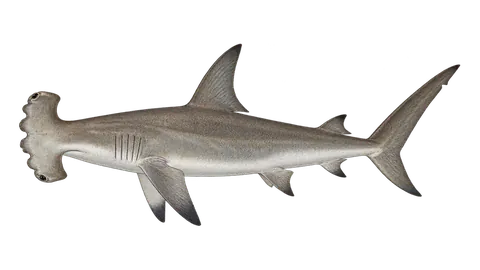
Scientific illustration of Scoophead
common size
100 cm
maximum
150 cm
common weight
—
record/max.
— kg
depth
—
ideal water
24–29 °C
overview

who is the scoophead

The scoophead shark is a small hammerhead, up to 150 cm, from the western Atlantic (from Panama to southern Brazil) and the eastern Pacific (from the Gulf of California to Ecuador and probably northern Peru). It lives in coastal areas over continental shelves, near the bottom, and is little studied: FishBase only records that it is viviparous, with a placenta, and that it is used fresh and for fishmeal, in a small commercial fishery. It is Critically Endangered worldwide (IUCN, 2019) and in Brazil, where it is on the national list, and it is in Appendix II of CITES. For the beach or boat angler who hooks it by accident, the job is to recognize it by its head and release it right away.

fun facts

  • FishBase calls it little known: almost everything known comes from incidental catches.
  • In English, scoophead: the head looks like a scoop or spoon.
  • It is viviparous, with a yolk-sac placenta, like the other hammerheads (FishBase).
how to recognize it

identification

Head shaped like a scoop or spade, short and rounded at the front (hence the names scoophead, in English, and cuchara, in Spanish). It is one of the smallest hammerheads on the coast: FishBase gives a maximum of 150 cm. In several countries the names 'cabeza de pala', 'tiburón pala' and 'cuchara' apply both to this hammerhead and to the bonnethead (S. tiburo), which also has a rounded head, which makes the two easy to confuse. As all hammerheads are protected in Brazil, when in doubt release it and treat it as protected.

how scoophead fishing looks

Loading the next 7 days…

Each card shows the day's index (0 to 100) and, below it, a strip with the index for each hour, from 0h to 23h. from poor to excellent.

distribution

where found

open on the large map

Western Atlantic: from Panama to southern Brazil, according to FishBase, which covers the whole Brazilian coast by latitude. Eastern Pacific: from the Gulf of California to Ecuador and probably northern Peru.

Habitat: Coastal areas over continental shelves, near the bottom, from about 8 m (FishBase). FishBase does not give the maximum depth.

coast

North CoastNortheast CoastSoutheast CoastSouth Coastcoastalshelf
calendar and clock

when to fish

best season

time of year
JanFebSeaAprMayJunJulAugSepOctNovDec

Estimate: no known season. Legal information: capture is banned year-round in Brazil.

best time of day

0h6h12h18h sunrise ~6amsunset ~6pm

Any time. Little known: FishBase describes the species as little studied, with no time of activity indicated.

weather, water and behavior

what affects the scoophead
sensitivity The little bars show how much each factor affects this species. Five full: it feels it a lot.

cold and cold fronts

Species of warm and subtropical waters; cold water keeps animals away from shallow areas. Effect little measured.

atmospheric pressure

Not well known.

moon

Not well known.

rain

Not very relevant.

water level

Not applicable at sea.

noise

Not well known.

wind

Rough seas prevent surf fishing and fishing from small boats.

tide

Not well known.

depth

Near the bottom, from about 8 m (FishBase).

technique, gear and bait

how to fish

rod
Catch prohibited in Brazil.
spinning / baitcasting reel
Not applicable.
line
Not applicable.
leader
Not applicable.
hook
When fishing from shore or a boat, prefer a barbless circle hook (or one with the barb flattened): it makes releasing what cannot be kept easier.

accessories

  • cutting pliers
  • long-handled hook remover

tip from an angler

If a hammerhead is hooked by chance, don't bring it out of the water: cut the line close to the mouth or remove the hook with pliers, release it right away and don't waste time on photos.

what the law says

rules for the scoophead

Summary of the regulations we found, with the source for each. Rules change; before keeping or transporting fish, check with the state environmental agency.
Conservation: On the national list of threatened species as CR; capture banned throughout Brazil. IUCN global assessment: CR (A2bcd), of 08/02/2019. Appendix II of CITES (FishBase). ICCAT prohibits retaining hammerhead sharks (except S. tiburo) in the fisheries it manages (Rec. 10-08). Hammerhead sharks of the genus Sphyrna were already protected by Portaria MMA 445/2014.

Threatened species in Brazil: catch banned

full protection

The national list (Portaria GM/MMA nº 1.667/2026) classifies the species as CR. Under Portaria GM/MMA nº 1.666/2026 (art. 3), VU, EN and CR species have full protection: catch, transport, storage, processing and trade are banned. If you hook one by accident, release it right away, with minimal handling.

Source: Portaria GM/MMA nº 1.666/2026, art. 3º, and Portaria GM/MMA nº 1.667/2026

Finning prohibited: shark only whole, with its fins

fins naturally attached to the body

Finning is banned in Brazil (catching sharks and rays and keeping only the fins, discarding the rest of the body). The rule covers landing, transport and trade by fishing vessels: every shark or ray must arrive with its fins naturally attached to the body (partial cutting to fold them against the body is allowed); it is forbidden to carry on board an animal without fins or with loose fins, and to transfer sharks and rays between vessels. This does not authorize catching this species, which is prohibited.

Source: Instrução Normativa Interministerial MPA/MMA nº 14, of Nov 26, 2012, art. 3º (Ministry of Fisheries and Aquaculture and Ministry of Environment)

Mexico: no more than 1 shark per angler per day

1 specimen per angler per day (counts as 5 against the quota of 10)

In recreational sport fishing in Mexican marine waters, the limit for sharks is one animal per angler per day, which counts as five toward the total limit of ten fish (no more than five of the same species). Animals over the quota may only be released alive, in good condition for survival (catch and release), and sport-caught fish may not be sold. Sport fishing also may not take place in closed areas or seasons or in natural protected areas without the proper permits. The scoophead is Critically Endangered worldwide: prefer to release it.

Source: NOM-017-PESC-1994 (recreational sport fishing), amendment published in the DOF, items 4.9.1 a and b, 4.9.5, 4.10 and 4.11 (Sagarpa/Conapesca)

Mexico: NOM-029-PESC-2006 regulates commercial shark and ray fishing

NOM-029 is the rule for commercial-scale shark and ray fishing: it applies to holders of permits for targeted fishing of these animals and to those who catch them by accident (item 1.2), and it covers commercial fishing vessels (item 4.2.1); sport fishing has its own rule, NOM-017. It bans using only shark fins (item 4.2.1) and provides for closed seasons and closed zones, set by notice in the DOF, for targeted fishing (items 4.2.3 and 4.3.4: no targeted fishing in closed seasons, within 5 km of coral reefs, in front of river mouths and lagoons, in front of turtle nesting beaches, and near sea lion colonies). The species is in Normative Appendix A (sharks of the Pacific, the Gulf of Mexico and the Caribbean Sea).

Source: NOM-029-PESC-2006, Responsible shark and ray fishing (DOF Feb 14, 2007), items 1.2, 4.2.1, 4.2.3, 4.3.4 and Normative Appendix A (Sagarpa)

Mexico: annual closed seasons for sharks and rays (check the dates for the year)

confirm with the agency

NOM-017 (item 4.10 a) prohibits recreational fishing in closed zones and seasons, and NOM-029 (item 4.2.3) requires the authority to set closed seasons for sharks and rays by notice in the DOF; the dates change and vary by coast. On Aug 1, 2025, the Secretaría de Agricultura and Conapesca announced, for the Pacific coast, the use of sharks and rays from August 1 to April 30 (May to July are excluded, our interpretation from the announcement) and, in Tabasco, Campeche, and Yucatán, a closed season from August 1 to 29. We did not find the official notice in force in 2026: confirm the dates with Conapesca before fishing.

Source: NOM-017-PESC-1994, item 4.10 a; NOM-029-PESC-2006, item 4.2.3; Crónica note on the Agricultura and Conapesca announcement of Aug 1, 2025

Colombia: marine sharks and rays are not fishery resources

commercial or sport extraction not permittedconfirm with the agency

In 2021 Colombia stopped considering sharks and marine rays a fishery resource and began treating them as a hydrobiological resource; the recitals of Decree 281/2021 state that they may not be extracted for commercial or sport purposes, and the decree created an environmental protection plan. Later AUNAP rules dealt with incidental catch in artisanal fishing; we did not check the consolidated text. When in doubt, release it into the water.

Source: Decreto nº 281, of Mar 18, 2021 (Ministry of Environment and Sustainable Development), which adds Section 27 to Decree 1076/2015; Resolución AUNAP nº 0380/2021

Panama: sharks and rays may not be caught in recreational fishing

catch, retention, and landing banned (from about Dec 10, 2026)

Executive Decree 9/2026 (art. 19) bans, throughout the national territory and in sport, recreational, or tourism fishing, the catch, retention, handling for recreational purposes, use, and landing of sharks and rays (subclass Elasmobranchii). If one is hooked by accident, it must be released immediately, without taking it fully out of the water and without unnecessary handling. It is also prohibited to promote them as targets in tournaments (art. 19) and to sell the catch (art. 20). The decree takes effect six months after its promulgation on June 10, 2026 (art. 40), around Dec 10, 2026, and repeals Resuelto ADM/ARAP 002/2012 (art. 39). Confirm the date with ARAP.

Source: Decreto Ejecutivo nº 9, of Jun 10, 2026, arts. 19, 20, 39 and 40 (Ministry of Agricultural Development / Panama Aquatic Resources Authority, Gaceta Oficial nº 30543-E)

Threatened sharks and rays: catching prohibited

North CoastNortheast CoastSoutheast CoastSouth Coast

Many sharks and rays are on the national list (CR, EN or VU), with catching, keeping and transport prohibited, including those listed here. Species added to the list only in 2026 follow the 180-day deadline (until about Oct 25, 2026). If unsure of the species, release it.

Source: Portaria GM/MMA nº 1.666/2026 (art. 3º) and nº 1.667/2026 (Annex I)

catch and release
catch and release Releasing the fish alive, quickly and with a wet hand. During a closed season it isn't always allowed: what the regulation says applies.

This is not catch and release: it is release of accidental catch. Leave the animal in the water, cut the line flush with the hook or remove the hook without taking the shark out of the water, and release it right away; avoid photos and do not hold it by the gills.

in the kitchen

Capture and trade banned in Brazil. Outside the country, FishBase records use of the fresh meat and for fishmeal.

calculator

how much it weighs without taking it out of the water

Length-weight relationship W = a·Lb (a = 0.00347, b = 3.12; FishBase (relação peso-comprimento bayesiana, estimativa)). It's an average: a fat or lean fish can vary by 10% to 20%.

estimated weight

—

sources and references

The seasonal weights (months), the time of day, the sensitivities (cold, pressure, moon, wind, rain, tide, strong light, murky water and noise), the water temperature range and the common size range are the app's editorial estimates, supported by FishBase and by the literature cited below, with no measurements of our own for this species. The months show when an angler may find the species near the coast, not a catch season. They are not official data and may vary by region and year. Legal rules appear in the rules section, with the norm and a link.

  1. scientific FishBase: Sphyrna media (ficha da espécie)Size, length-weight, depth, habitat, distribution, biology, and IUCN status. Page checked on Oct 13, 2026.
  2. scientific FishBase: nomes populares de Sphyrna mediaNames by country and language.
  3. official Portaria GM/MMA nº 1.667, de 27 de abril de 2026: Lista Nacional Oficial de Espécies da Fauna Ameaçadas de Extinção (peixes e invertebrados aquáticos)The species is on the list as CR (item 329 of Annex I). Checked in the DOU of 28/04/2026.
  4. official Portaria GM/MMA nº 1.666, de 27 de abril de 2026: regras e restrições para as espécies ameaçadas da lista nacionalArt. 3: full protection for EW, CR, EN, and VU species (catching, transporting, storing, holding, handling, processing, and trading are banned); § 4: the restriction does not apply to incidental catch when the animal is released alive; art. 12: for species added to the list by a new ordinance, the art. 3 bans start 180 days after publication. Text checked in the DOU on Oct 13, 2026.
  5. official Fiperj: Peixes cartilaginosos marinhos ameaçados de extinção (Portarias GM/MMA 1.666 e 1.667/2026), atualizado em 11/05/2026Poster from the Fundação Instituto de Pesca do Estado do Rio de Janeiro, with common names and categories of the cartilaginous fish species on the list; it states that the changes apply from Oct 27, 2026. Checked on Oct 13, 2026.
  6. official SEMIL-SP: Portaria MMA sobre espécies aquáticas ameaçadas volta a vigorar (15/08/2016)Note from the São Paulo Environment Secretariat on Portaria MMA 445/2014 (of Dec 17, 2014, later revoked by Portaria GM/MMA 1.667/2026): it lists the hammerhead sharks (Sphyrna lewini, media, mokarran, tiburo, tudes and zygaena) among species whose catch is prohibited.
  7. official ICCAT: Recommendation 10-08 on hammerhead sharks (family Sphyrnidae) caught in association with ICCAT fisheriesMember countries must prohibit retaining on board, transshipping, landing, storing and selling hammerhead sharks of the family Sphyrnidae (except S. tiburo) in ICCAT fisheries, and must release unharmed those brought alongside the vessel; developing coastal countries have an exception for local consumption. Text checked on 13/10/2026.
  8. official Instrução Normativa Interministerial MPA/MMA nº 14, de 26 de novembro de 2012: desembarque, transporte, armazenamento e comércio de tubarões e raias (proibição do finning)Text from Sislegis/MAPA (DOU of Nov 28, 2012), checked on Oct 13, 2026. § 6 of art. 3 (allowing the tail of rays to be discarded on board) was added by IN Interministerial 6/2013.
  9. official México: Modificación a la NOM-017-PESC-1994 (pesca deportivo-recreativa), DOFOfficial text in the Diario Oficial de la Federación; items 4.9.1, 4.9.5, 4.10, and 4.11 checked on Oct 13, 2026.
  10. official México: NOM-029-PESC-2006, pesca responsável de tubarões e raias (DOF de 14/02/2007)Copy of the text published in the DOF, on the standardization platform of the Secretaría de Economía. Items 1.2, 4.2.1, 4.2.3, and 4.3.4 and Normative Appendix A checked on Oct 13, 2026. The standard was written for commercial fishing; recreational fishing has its own standard, NOM-017.
  11. press Crónica: Anuncian periodos de veda y aprovechamiento de especies marinas (Agricultura e Conapesca, 01/08/2025)Press note reproducing the announcement by the Secretaría de Agricultura and Conapesca for sharks and rays in the Pacific and in Tabasco, Campeche, and Yucatán. The official notice in force in 2026 was not found; confirm the dates with Conapesca.
  12. official Colômbia: Decreto 281 de 2021 (proteção e conservação de tubarões, raias marinhas e quimeras), Gestor Normativo da Função PúblicaRecitals and rules of the decree on marine sharks and rays. Later AUNAP changes on incidental catch were not checked.
  13. official Panamá: Decreto Ejecutivo nº 9, de 10 de junho de 2026 (pesca deportiva), Gaceta Oficial Digital nº 30543-EArt. 19 (ban on catching, retaining, and landing sharks and rays in recreational fishing), art. 20 (ban on sales), art. 39 (repeals Resuelto ADM/ARAP 002/2012), and art. 40 (in force after six months). Art. 19 checked in the text on Oct 13, 2026.
don't confuse

similar species