

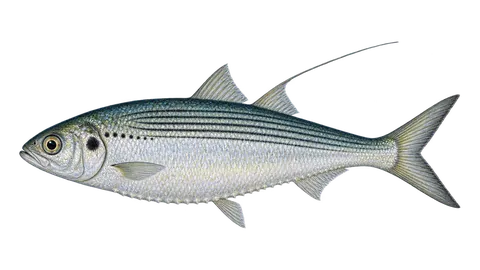
round sardinella
Sardinella aurita · Dorosomatidae · forage fish
A schooling, coastal and migratory sardine, common in the Caribbean, Venezuela and the Brazilian coast. It serves as live bait and food, and is told apart from the true sardine only by gill details.
Also called: alacha, sardinha, round sardinella, Spanish sardine, sardine

- common size
- 18–28 cm
- maximum
- 41 cm
- common weight
- 0.0–0.2 kg
- record/max.
- 0.4 kg
- depth
- 0–350 m
- ideal water
- 18–25 °C

the right time
to be on the water
Choose the place and the species. The index, from 0 to 100, combines weather, sun, moon and tide with each fish's habits. Up to 28 days, with each day's confidence.
Reading the weather across 3 global models and 31 simulations…
—
hour by hour
tap or drag on the chart to read each hour · on a keyboard, arrow keyssee hour-by-hour table
why this index at —?
choose the day
Each card shows the day's index (0 to 100) and, below it, a strip with the index for each hour, from 0h to 23h. from poor to excellent.
the fishing month at a glance
what's the best window for the crew?
Choose how many fishing days. We compare each stretch by its average index, discount days with a warning or closed season, and show the 3 best.
trend for the coming weeks
Line: the middle value of 31 simulations of the American GEFS model. Band: where 8 out of 10 fall. Narrow, firm trend; wide, high uncertainty.
everything about the round sardinella
who is the round sardinella
The alacha (Sardinella aurita) is a coastal, pelagic schooling sardine that prefers clean, salty water, usually below 24 °C. In the western Atlantic it ranges from Cape Cod (USA) to Argentina, including the Bahamas, the Antilles, the Gulf of Mexico and the Caribbean; in the east, from Gibraltar to South Africa, the Mediterranean and the Black Sea. It lives from the surface to the shelf edge and down to about 350 m, rises to the surface at night and moves a lot, coming closer to shore when cold water upwells and dropping below the thermocline when it is hot. It eats plankton, mainly copepods, and phytoplankton as juveniles. It grows to 41 cm and 420 g, with the common size around 25 cm, and lives up to about 7 years. It is an intensively fished commercial species, sold fresh, salted and canned, and as live bait.
fun facts
- It is a cold-water species: it prefers 18 to 25 °C and comes close to shore during upwelling.
- In West Africa it forms large populations in the three upwelling areas between Mauritania and Angola.
- FishBase treats the separation between it and the true sardine (Sardinella brasiliensis) as tentative.
identification
Elongated, almost cylindrical body, with a belly keel of scutes, silver with a fine golden line along the middle of the flank and a golden spot just behind the gill opening, and a dark spot on the edge of the gill cover. The pelvic fins have 1 simple and 8 branched rays, which sets it apart from other sardines of the genus Harengula, Opisthonema and others. Separating it from the true sardine (S. brasiliensis) relies on the shape of the gill rakers (straight here, curved downward in the true sardine) and is tentative according to FishBase.
where found
Along the entire Brazilian coast, in the coastal strip and on the shelf, closer to shore when cold water upwells. FishBase gives its range from Cape Cod (USA) to Argentina, through the Bahamas, the Antilles, the Gulf of Mexico and the Caribbean. In Brazil, its separation from the true sardine is uncertain.
Habitat: Clean, salty coastal waters, from the surface to the shelf edge and down to about 350 m, in migratory schools; juveniles stay in nursery areas.
coast
when to fish
best season
Moves closer to shore during upwelling season and retreats below the thermocline in strong heat. Spawning can happen all year, with peaks.
best time of day
Any time. Rises to the surface at night and disperses; by day it stays in a deeper, tighter school.
what affects the round sardinella
sensitivity The little bars show how much each factor affects this species. Five full: it feels it a lot.
cold and cold fronts
It is a cold-water species: it prefers 18 to 25 °C and comes close to shore during upwelling.
atmospheric pressure
Not very sensitive.
moon
On moonless nights, boat light concentrates the schools more.
rain
Avoids fresh and muddy water.
water level
Avoids the fresh water of floods.
noise
The school scatters with engine noise and hull noise.
wind
Choppy sea scatters the schools.
tide
A rising tide brings the school into bays and coves.
depth
From the surface to 350 m; at night, closer to the surface.
how to fish
- rod
- light rod 6'0" to 8'0" or cane pole
- spinning / baitcasting reel
- spinning reel 1000 to 3000
- line
- monofilament 0.20 to 0.25 mm
- leader
- sabiki (chuveirinho) size 8 to 12
- hook
- sabiki hooks or maruseigo 12 to 14
lures
- sabiki
natural baits
- ground sardine chum
accessories
- aerated bucket or livewell
- cast net (where permitted)
- night-fishing light, where permitted
tip from an angler
Anglers who catch bait in the Southeast and South should, as a precaution, treat the schooling sardine as the true sardine for minimum size and closed season purposes, since the two are hard to tell apart.
rules for the round sardinella
Summary of the regulations we found, with the source for each. Rules change; before keeping or transporting fish, check with the state environmental agency.
Conservation: Not on the Brazilian national list (Portaria GM/MMA nº 1.667/2026). We found no specific Brazilian federal rule; the rules for the true sardine name Sardinella brasiliensis.
We found no species-specific rule beyond the region's general rules.
catch and release
catch and release Releasing the fish alive, quickly and with a wet hand. During a closed season it isn't always allowed: what the regulation says applies.
Very fragile: if you won't use it as bait, put it back right away without holding it with a dry hand. It usually survives release poorly.
in the kitchen
Dark, oily flesh, good grilled, baked, in escabeche or canned; sold fresh and salted.
how much it weighs without taking it out of the water
Length-weight relationship W = a·Lb (a = 0.00692, b = 3.04; FishBase (relação peso-comprimento bayesiana, estimativa da própria espécie)). It's an average: a fat or lean fish can vary by 10% to 20%.
estimated weight
—
sources and references
The season weights (months), the time of day and the sensitivities (cold, pressure, moon, wind, rain, tide, strong light, murky water and noise) are the app's editorial estimates, based on the literature below and on field experience from anglers and guides. They are not official data or measurements made for this species and may vary by region and year. Closed seasons and legal rules appear in the rules section, with the rule and link. Common sizes and weights are ranges around the common length reported by FishBase, with the weight calculated from the length-weight relationship.
- scientific FishBase: Sardinella aurita (ficha da espécie)Size, length-weight, depth, habitat, distribution, biology, and IUCN status. Page checked on Oct 13, 2026.
- scientific FishBase: nomes populares de Sardinella auritaNames by country and language. Alacha is the Portuguese name in FishBase, borrowed from Spanish; we did not find a specific Brazilian common name for the species.
- official Portaria GM/MMA nº 1.667, de 27 de abril de 2026: Lista Nacional Oficial de Espécies da Fauna Ameaçadas de Extinção (peixes e invertebrados aquáticos)The species is not on the list. Checked in the DOU of April 28, 2026.
- official Instrução Normativa MMA nº 53, de 22 de novembro de 2005: tamanho mínimo de captura de espécies marinhas e estuarinas do litoral Sudeste e SulAnnex II, from ES to RS. Checked Oct 13, 2026: the species is not in Annex II.
- official Instrução Normativa Ibama nº 15, de 21 de maio de 2009: ordenamento da pesca da sardinha-verdadeira (Sardinella brasiliensis)The rule names only Sardinella brasiliensis; FishBase says the separation from S. aurita is tentative. Checked Oct 13, 2026.
similar species



where each number comes from
The weather comes from three independent global models, cross-checked hour by hour: when they agree, confidence goes up; when they diverge, the band between them shows on the chart. Beyond 16 days, we use the GEFS ensemble of 31 simulations: if 20 of the 31 predict rain, the chance of rain is 65%. Sun and moon are calculated astronomically, with no uncertainty.
The index adds up, weighted for each species: time of day (species curve anchored to real sunrise and sunset), moon (transits, rise and set, phase), pressure (3 h trend and 24 h swing), water temperature (in rivers, estimated from air temperature; at sea, estimated by an ocean model), wind, rain, clouds, tide and the month in the species' cycle.
sources for this lookup
how accurate the forecast is
Accuracy measured in the reference project (4 regions, 93 days, forecast vs. observed): maximum temperature is off by 0.6 °C on average the next day and 1.7 °C at 7 days; rain of 5 mm or more is detected 76% of the time the next day and 57% at 7 days. Detection isn't everything: the false alarm rate isn't published here yet, and 93 days in 4 regions is still a small sample. We now also measure every day, at the app's destinations: